Hematocrit: Normal Range, High and Low Levels After 40
Your hematocrit is the share of your blood made up of red blood cells, so a result of 44% means red cells fill 44% of the sample. Most US labs call roughly 41% to 50% normal for men and about 36% to 45% for women, give or take a couple of points. However, trusted sources draw those lines in different places, and after 40 common reasons for a high number include testosterone, smoking, dehydration and certain diabetes drugs.
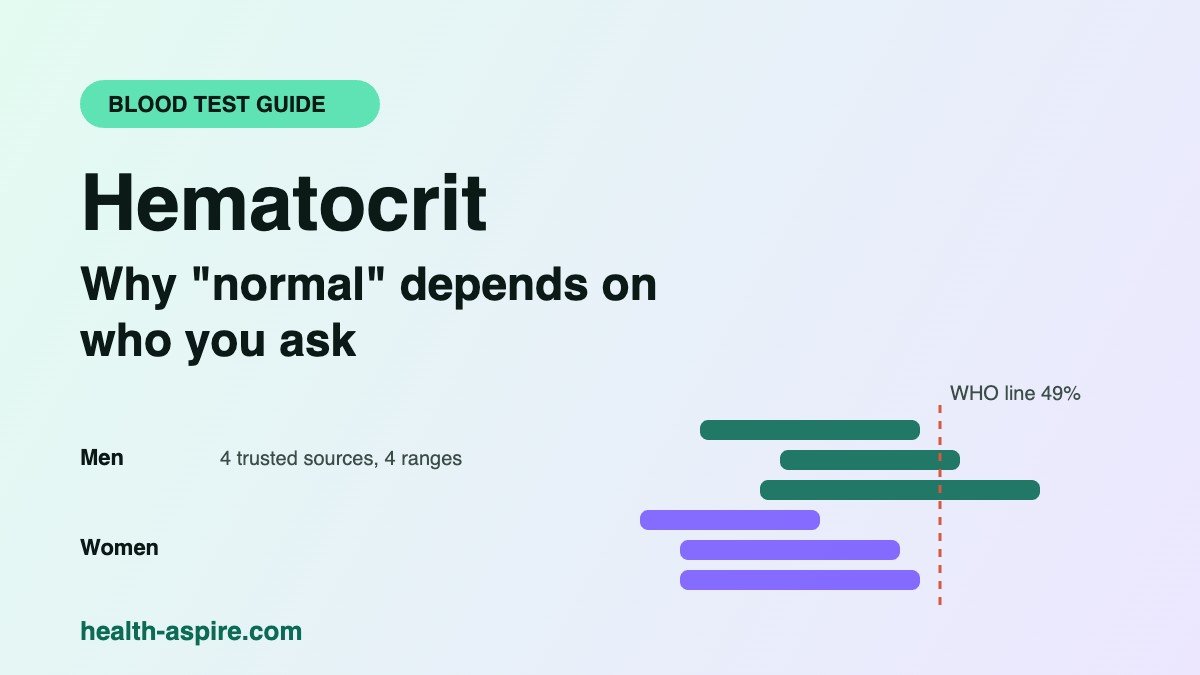
I started digging into hematocrit after noticing something odd. The four references most US readers will land on (MedlinePlus, Mayo Clinic, Cleveland Clinic and the classic Clinical Methods textbook) each print a different normal range. As a result, a man at 51% can be “high” on one chart and perfectly normal on another. So, below you will find all four ranges side by side, the guideline lines that actually change what doctors do, and three worked examples.
What is hematocrit, and how is it measured?
Hematocrit (often printed as Hct or HCT) is the percentage of your blood volume taken up by red cells. Moreover, it appears on every CBC blood test, and you do not need to fast for it. In the past, labs spun blood in a thin tube and measured the red layer. Today, analyzers usually calculate it instead.
According to Clinical Methods, automated counters multiply your red cell count by your mean cell volume. In other words, you can check it yourself. For example, an RBC of 5.4 million/µL and an MCV of 90 fL give 5.4 × 90 ÷ 10 = 48.6%. In addition, labs outside the US often print the same value as a fraction, so 0.45 L/L simply means 45%.
Normal hematocrit range: why four sources give four answers
There is no single normal hematocrit range. Instead, each lab sets its own from the healthy people it tested and the analyzer it uses. That is why MedlinePlus lists 37% to 48% for men while Clinical Methods lists 40% to 54%. Ultimately, your own report’s range is the one that matters, but the chart below shows how much room for disagreement there is.
Hematocrit comparison table: where your number lands
Next, find your result in the left column. Then read across to see how each reference would label it, and finally what it means in plain terms.
| Hematocrit | As L/L | Men: what the references say | Women: what the references say | In everyday terms |
|---|---|---|---|---|
| Under 34% | under 0.34 | Low on all four ranges | Low on all four ranges | Fewer red cells than expected; worth finding out why |
| 34% to 35.9% | 0.34 to 0.359 | Low on all four | Normal only on MedlinePlus | Borderline for women, low for men |
| 36% to 40.9% | 0.36 to 0.409 | Low on Mayo and Cleveland; normal on MedlinePlus from 37% and Clinical Methods from 40% | Normal on all four (MedlinePlus to 43%) | Typical for women; lowish for men |
| 41% to 44% | 0.41 to 0.44 | Normal on all four | Normal on Mayo, Cleveland, Clinical Methods (MedlinePlus to 43) | Middle of the road |
| 44.1% to 48% | 0.441 to 0.48 | Normal on all four | Above MedlinePlus (43) and Cleveland (44); past 47, Mayo too | Fine for men; worth a look for women |
| 48.1% to 50% | 0.481 to 0.50 | Above MedlinePlus; past 49, over the WHO line | High on all four; over the WHO line | Repeat it, well hydrated, and look for a cause |
| 50.1% to 54% | 0.501 to 0.54 | High on three of four; normal only on Clinical Methods | High on all four | Needs an explanation, especially on testosterone |
| Over 54% | over 0.54 | High on all four; past the usual testosterone stop line | High on all four | Call your doctor soon rather than waiting |
What does a high hematocrit mean after 40?
A high hematocrit means your blood holds more red cells than your lab expects, or less plasma. Very often, though, the cause is simple: dehydration, smoking or living at altitude. In midlife, testosterone therapy and SGLT2 diabetes drugs are common too. On the other hand, a high hematocrit less often points to a bone marrow disorder called polycythemia vera.
First, rule out the easy one. Hematocrit depends on plasma volume, so a dehydrated person reads higher than their true red cell mass, as Clinical Methods explains. Next, consider the causes that MedlinePlus lists: smoking, low blood oxygen from lung or heart disease, and rarely a kidney tumor.
Testosterone therapy
To begin with, testosterone stimulates red cell production, and a high hematocrit is a common side effect. The Endocrine Society advises checking hematocrit at baseline, again 3 to 6 months after starting, and then yearly. Meanwhile, a 2024 review in Endocrine Connections notes that most guidelines use about 54% as the line to stop or adjust treatment.
SGLT2 inhibitors such as empagliflozin
Similarly, these diabetes and heart drugs reliably nudge hematocrit up by a few points. Surprisingly, that rise seems to be part of how they help. In a mediation analysis of the EMPA-REG OUTCOME trial, changes in hematocrit accounted for 51.8% of empagliflozin’s effect on cardiovascular death. So a modest rise after starting one is expected, although it still deserves a mention at your next visit.
Sleep apnea is a weaker explanation than you might think
Many guides blame sleep apnea for a high hematocrit. However, a 2023 study in the American Journal of Hematology found that more than 98% of 527 people with obstructive sleep apnea did not have elevated hemoglobin. Of course, treating apnea matters for many reasons. Even so, if your hematocrit is high, apnea alone probably is not the full story.
What does a low hematocrit mean?
In most cases, a low hematocrit means anemia: too few red cells to carry oxygen comfortably. After 40, the usual suspects are iron loss (heavy periods before menopause, slow bleeding from the gut later), low B12 or folate, kidney disease and other chronic illness. Also, being overhydrated or pregnant can lower the number without any real anemia.
However, the number alone rarely tells you the cause. Instead, Clinical Methods recommends looking next at the red cell indices, a blood smear and a reticulocyte count. In practice, that means reading your hematocrit together with MCV, RDW and MCHC on the same report.
Three worked hematocrit examples
To be clear, these three readers are made up, but their numbers are realistic. Each one is run through the four ranges and guideline lines above, so you can see how the same logic applies to your own report.
| Example reader (made up) | Hematocrit | Context | How the lines read it | A good question to ask |
|---|---|---|---|---|
| Dave, 57 | 52.5% (was 45% before treatment) | Testosterone gel for 8 months, non-smoker | High on Mayo, Cleveland and MedlinePlus; over the WHO 49% line; still under the 54% stop line | “Should we lower my dose and recheck in a few months?” |
| Karen, 61 | 33.5% | MCV 78 fL, tired on stairs, overdue for colon screening | Low on all four ranges; small cells | “Can we check ferritin and look for a source of blood loss?” |
| Mike, 49 | 50.5% (was 46.8%) | Type 2 diabetes, started empagliflozin 6 months ago, smokes | High on three of four ranges; over the WHO line; normal on Clinical Methods | “Is this rise from my new drug, my smoking, or both?” |
Notice that Dave and Mike sit at similar numbers for very different reasons. Therefore, the context column matters as much as the hematocrit itself. Karen, on the other hand, is a reminder that a low number after 60 deserves a cause, not just an iron pill.
A simple hematocrit decision guide
Use this as a script for your next appointment, not as a diagnosis. In addition, each step follows a named source listed at the end.
- Slightly outside your lab’s range, once: ask whether to repeat it when you are well hydrated, since plasma volume shifts the result (Clinical Methods).
- Repeatedly over 49% (men) or 48% (women) with no clear cause: this is the WHO threshold used in polycythemia vera, so ask whether a JAK2 mutation test or erythropoietin level makes sense (WHO 2016).
- On testosterone: make sure you are tested at baseline, at 3 to 6 months and then yearly; at about 54%, expect your doctor to pause or change treatment (Endocrine Society; Bond et al., 2024).
- Recently started an SGLT2 inhibitor: a rise of a few points is expected; mention it, but do not stop the drug on your own (EMPA-REG OUTCOME).
- Below your lab’s range: ask what your MCV, RDW and reticulocyte count say about the cause (Clinical Methods).
What to do next
- Find your hematocrit and your lab’s range on your report, then place it in the comparison table above.
- Check the math: RBC × MCV ÷ 10 should land close to your printed hematocrit.
- Write down your context (testosterone, SGLT2 drug, smoking, altitude, recent illness) and the matching question from the decision guide.
- Bring it all to your appointment with our free Before Your Check-up planner.
- Keep our lab markers cheat sheet handy, and read the rest of your panel with our comprehensive metabolic panel guide.
Hematocrit FAQ
What is the difference between hemoglobin and hematocrit?
First, hemoglobin is the oxygen-carrying protein, measured in g/dL. Hematocrit, by contrast, is the share of blood volume taken up by red cells. As a result, the two usually move together. In fact, dividing hemoglobin by hematocrit and multiplying by 100 gives your MCHC.
Can drinking water lower my hematocrit?
Only if dehydration was inflating it. Because hematocrit depends on plasma volume, a dehydrated sample reads high. Then, once you are well hydrated, a repeat test shows your true level. However, water will not lower a hematocrit that is high because of real extra red cells.
Is a hematocrit of 50% dangerous?
Not by itself. For example, for a man, 50% sits at the top of the Mayo and Cleveland ranges and inside the Clinical Methods range. Still, it is above the WHO line, so a repeat test and a look at possible causes are sensible. For a woman, however, 50% is high on every range.
Does hematocrit change with age?
In general, the adult ranges above do not change with age. What changes after 40 is the background: more medicines, more chronic conditions and, for men, more testosterone prescriptions. Consequently, a new shift in your hematocrit deserves an explanation rather than a shrug.
For the rest of your blood work, browse our metabolism and blood test guides.
Sources
- Rumi E., Cazzola M. Diagnosis, risk stratification, and response evaluation in classical myeloproliferative neoplasms (Blood, 2017)
- Bhasin S., Brito J.P., Cunningham G.R., et al. Testosterone Therapy in Men With Hypogonadism: An Endocrine Society Clinical Practice Guideline (Journal of Clinical Endocrinology and Metabolism, 2018)
- Bond P., Verdegaal T., Smit D.L. Testosterone therapy-induced erythrocytosis: can phlebotomy be justified? (Endocrine Connections, 2024)
- Inzucchi S.E., Zinman B., Fitchett D., et al. How Does Empagliflozin Reduce Cardiovascular Mortality? Insights From a Mediation Analysis of the EMPA-REG OUTCOME Trial (Diabetes Care, 2018)
- Song J., Sundar K.M., Horvathova M., et al. Increased blood reactive oxygen species and hepcidin in obstructive sleep apnea precludes expected erythrocytosis (American Journal of Hematology, 2023)
- Billett H.H. Hemoglobin and Hematocrit. In: Walker H.K., Hall W.D., Hurst J.W., eds. Clinical Methods, 3rd edition (Butterworths, 1990)
- MedlinePlus. Hematocrit (US National Library of Medicine)
- Mayo Clinic. Hematocrit test
- Cleveland Clinic. Hematocrit
This guide is for education and is not medical advice. Talk to your doctor about your own numbers and treatment. See our medical disclaimer.
Free weekly email
A short, honest health email. Every Thursday.
The week’s most useful research for life after 40, explained in plain English, plus one step picked for what matters to you. No spam, no selling your email, unsubscribe in one click.