MCV Blood Test: What High or Low Results Mean After 40
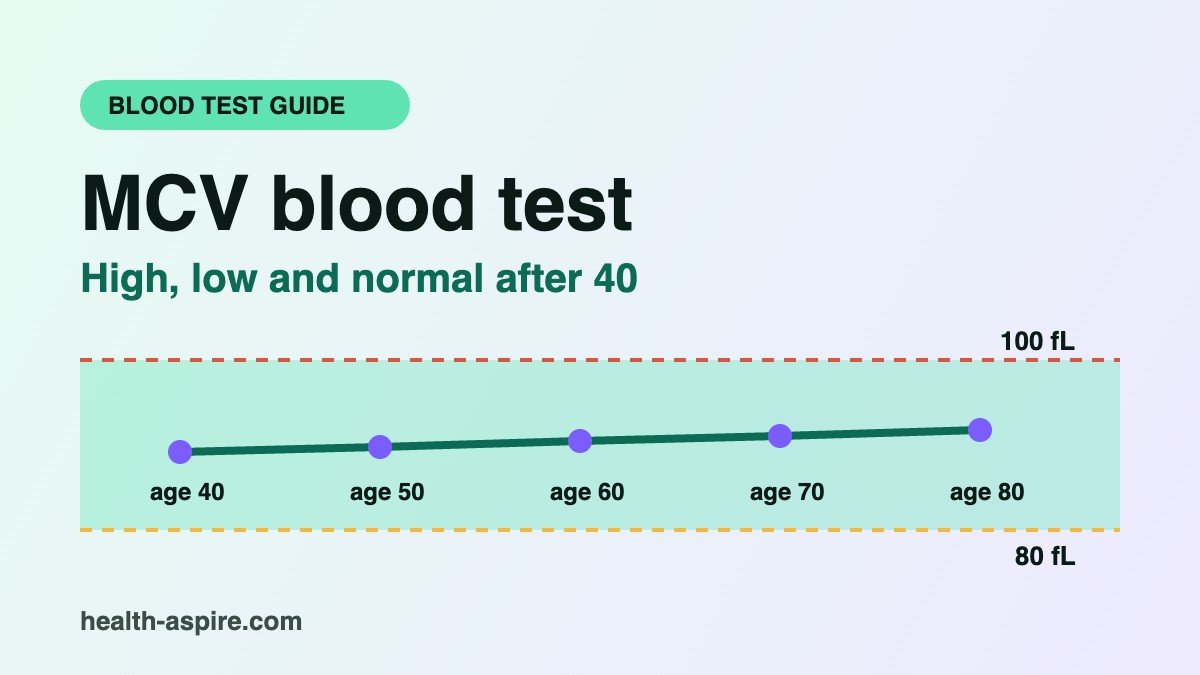
An MCV blood test measures the average size of your red blood cells. Most labs call 80 to 100 femtoliters (fL) normal. A result under 80 points first to iron deficiency; over 100 points to low B12 or folate, alcohol, liver or thyroid problems, or medicines. After 40, age by itself barely moves it.
MCV sits in the middle of the red cell block on a CBC, and most of us read straight past it. I did too, at first. Then I learned that two of the most common prescriptions after 50 can slowly push it up, and that a normal MCV can still hide two problems that cancel each other out. So this guide puts the numbers the big health sites skip in one place: how much MCV really changes with age, the over-40 causes with their study numbers, and three worked example reports.
What is an MCV blood test?
An MCV blood test is not a separate draw. Instead, it is one line of your CBC blood test, calculated by the same analyzer that counts your cells. MCV stands for mean corpuscular volume, and it is reported in femtoliters, a tiny unit of volume. Also, no fasting or special preparation is needed, according to MedlinePlus.
Basically, think of it as the average shoe size of your red cells. For example, small cells (microcytic) usually mean the body is short of the material needed to fill them, most often iron. Large cells (macrocytic), on the other hand, usually mean that cell making in the bone marrow is slowed or disturbed. Low B12 or folate, alcohol, the liver and some medicines can all do that.
MCV blood test normal range, and how much age changes it
Most US labs print 80 to 100 fL as normal, while MedlinePlus lists 79 to 95 fL, so always compare with the range on your own report. Age, however, moves the middle only a little. In nearly a million results from adults without anemia, the median MCV rose about 0.4 fL per decade in women and 0.6 fL in men.
How much does MCV change with age?
So we turned the published age equations into a lookup table: a typical MCV at your age, and how far it sits from the 100 fL line.
| Age | Women: typical (median) MCV | Men: typical (median) MCV | Room left below 100 fL (men) |
|---|---|---|---|
| 40 | 90.6 fL | 90.7 fL | 9.3 fL |
| 50 | 91.0 fL | 91.3 fL | 8.7 fL |
| 60 | 91.4 fL | 91.9 fL | 8.1 fL |
| 70 | 91.8 fL | 92.5 fL | 7.5 fL |
| 80 | 92.2 fL | 93.1 fL | 6.9 fL |
So what does that mean in everyday terms? Going from 40 to 80 adds roughly 1.6 fL for women and 2.4 fL for men. In other words, if your MCV climbed from 92 to 104 over a few years, getting older is not the explanation. Instead, that change is worth a conversation with your doctor. Keep in mind the data come from one hospital in Korea, so treat the exact decimals as a guide.
What does a low MCV blood test result mean?
A low MCV, under 80 fL, means your red cells are small. In the US, iron deficiency is the most common cause, according to a review in American Family Physician. Other causes include thalassemia trait, anemia of chronic disease and, rarely, lead poisoning. For this reason, the usual first test is ferritin, which reflects your iron stores.
Then, here is how the same review reads ferritin. A level under 15 ng/mL suggests iron deficiency in an otherwise healthy person. With chronic inflammation, though, the cut-off rises to 50 ng/mL, because inflammation pushes ferritin up. Above 100 ng/mL usually rules iron deficiency out.
Above all, one point matters more than any number. In men and in women who no longer have periods, iron deficiency calls for a look at the gut for hidden bleeding, including cancer, the review says. That is why simply taking iron and moving on is not enough after 40.
What does a high MCV blood test mean?
A high MCV, over 100 fL, is called macrocytosis, and it shows up in about 3% of people. The most common causes are alcohol, low vitamin B12 or folate, and medicines. In older adults, an underactive thyroid, liver disease and bone marrow disorders are also common causes, according to American Family Physician.
Moreover, two details from that review are worth knowing. First, alcohol usually keeps MCV below 110 fL, so a much higher number points elsewhere. Second, only about 10% of people with B12 deficiency are anemic. As a result, a large MCV can be the first clue while hemoglobin still looks fine.
Next, for a high MCV, the review suggests three first steps: a blood smear, a reticulocyte count (young red cells) and a B12 level. If B12 comes back borderline, between 100 and 400 pg/mL, methylmalonic acid and homocysteine can confirm a true shortage. After that, a metabolic panel, TSH and red cell folate are next.
Causes of an abnormal MCV after 40, with the numbers
However, most guides list causes without saying how common they are. So we pulled the figures from the original studies and lined them up for the situations most common in midlife.
| Cause | What the study found | In everyday terms | Usual first test |
|---|---|---|---|
| Metformin (diabetes or prediabetes) | Low B12 (203 pg/mL or less) in 4.3% on metformin vs 2.3% on placebo after 5 years; low or borderline (298 or less) in 19.1% vs 9.5% | About 1 in 5 long-term users had low or borderline B12, double the placebo rate | B12 level |
| Acid reducers (PPIs) for 2+ years | 1.65 times the odds of B12 deficiency; 1.95 times at more than 1.5 pills a day | Long, high-dose use raises the risk most | B12 level |
| Age 60 and older | About 6% have B12 deficiency and close to 20% have marginal levels | Absorbing B12 from food gets harder with age | B12, then methylmalonic acid if borderline |
| Regular drinking | A cause in up to 80% of macrocytosis in some groups; MCV usually stays under 110 fL | A common, reversible reason for large cells | Alcohol history, liver tests |
| Iron deficiency | The most common cause of a low MCV in the US | Small cells; needs a reason found, not just iron | Ferritin |
Where metformin and alcohol fit in
If you take metformin, you can also check how your diabetes numbers are tracking in our A1C levels chart. Likewise, if alcohol could be part of the picture, see whether 2 drinks a day is too much.
Three example MCV blood test reports, read step by step
To make this concrete, here are three made-up readers. Then each one is run through the American Family Physician steps above. For small cells, we also use the Mentzer index: MCV divided by red cell count (RBC, in millions per microliter). Under 13 leans toward thalassemia trait, while over 13 leans toward iron deficiency. It is a screening clue, not a diagnosis.
| Example reader | Key numbers | The math | What a doctor would likely check first |
|---|---|---|---|
| Linda, 54, periods stopped 3 years ago, tired on stairs | MCV 74 fL, RBC 4.0, hemoglobin low | 74 ÷ 4.0 = 18.5, over 13: iron deficiency more likely | Ferritin; if low, a gut check for hidden bleeding, since she no longer menstruates |
| Marco, 47, Mediterranean family, feels fine | MCV 66 fL, RBC 5.9, hemoglobin slightly low | 66 ÷ 5.9 = 11.2, under 13: thalassemia trait more likely | Ferritin first; if iron is normal, hemoglobin electrophoresis |
| Dave, 63, metformin for 8 years, daily acid reducer | MCV 104 fL, hemoglobin normal | 104 minus about 92 (typical at 63) = 12 fL above his age norm | B12 level, smear and reticulocytes; methylmalonic acid if B12 is borderline |
Finally, notice that Dave has no anemia at all. Even so, his MCV is far above what age alone would give him, and both of his daily medicines are linked to low B12. That is exactly the case where a single overlooked line on a CBC earns its place.
Can a normal MCV hide a problem?
Yes. If you have iron deficiency (small cells) and B12 deficiency (large cells) at the same time, the average can land in the normal range. That is why RDW, the spread of cell sizes, matters. In fact, a normal MCV with a high RDW is a classic flag for an early or mixed deficiency.
For more detail, our RDW blood test guide has the full MCV and RDW pattern grid. Also, remember that red cells turn over slowly. After iron treatment, for example, hemoglobin typically returns to normal by about eight weeks in most patients, according to American Family Physician. So a repeat CBC a few months later usually tells you more than a quick recheck.
What to do next
- Run our free A14 Health Check after 40 to see which numbers matter most for you right now.
- Use Before Your Check-up to bring your MCV result, your medicines and your questions to your next visit.
- Read the rest of the panel with our CBC blood test guide.
- If your liver numbers are also off, see our liver function test guide, because liver disease can enlarge red cells.
- Keep all your lab ranges in one place with the lab markers cheat sheet.
MCV blood test FAQ
Is an MCV of 101 dangerous?
Not by itself. After all, a value just over 100 fL is common with regular drinking, some medicines, or simply your lab’s range. Still, it is worth a B12 level and a repeat at your next CBC, especially if you take metformin or an acid reducer.
Can high blood sugar affect MCV?
Yes, but falsely. American Family Physician lists very high blood sugar, cold agglutinins and very high white cell counts as causes of spurious macrocytosis. In other words, the machine reads the cells as larger than they really are.
Does fixing low B12 bring MCV back down?
Usually, yes, if low B12 was the cause. Because new, normal-sized cells slowly replace the old ones, the change takes weeks to months. Get tested before starting supplements, though, so your doctor can confirm the cause.
Sources
- Lee J.Y., Choi H., Park J.W., et al. Age-related changes in mean corpuscular volumes in patients without anaemia: An analysis of large-volume data from a single institute (Journal of Cellular and Molecular Medicine, 2022)
- Aroda V.R., Edelstein S.L., Goldberg R.B., et al. Long-term Metformin Use and Vitamin B12 Deficiency in the Diabetes Prevention Program Outcomes Study (Journal of Clinical Endocrinology and Metabolism, 2016)
- Lam J.R., Schneider J.L., Zhao W., Corley D.A. Proton Pump Inhibitor and Histamine 2 Receptor Antagonist Use and Vitamin B12 Deficiency (JAMA, 2013)
- Allen L.H. How common is vitamin B-12 deficiency? (American Journal of Clinical Nutrition, 2009)
- Mentzer W.C. Differentiation of iron deficiency from thalassaemia trait (The Lancet, 1973)
- Kaferle J., Strzoda C.E. Evaluation of Macrocytosis (American Family Physician, 2009)
- Van Vranken M. Evaluation of Microcytosis (American Family Physician, 2010)
- Lanier J.B., Park J.J., Callahan R.C. Anemia in Older Adults (American Family Physician, 2018)
- MedlinePlus. RBC indices (US National Library of Medicine)
- Cleveland Clinic. MCV Blood Test
This guide is for education and is not medical advice. Talk to your doctor about your own numbers and treatment. See our medical disclaimer.
Free weekly email
A short, honest health email. Every Thursday.
The week’s most useful research for life after 40, explained in plain English, plus one step picked for what matters to you. No spam, no selling your email, unsubscribe in one click.