Liver Function Test Results: How to Read Them After 40
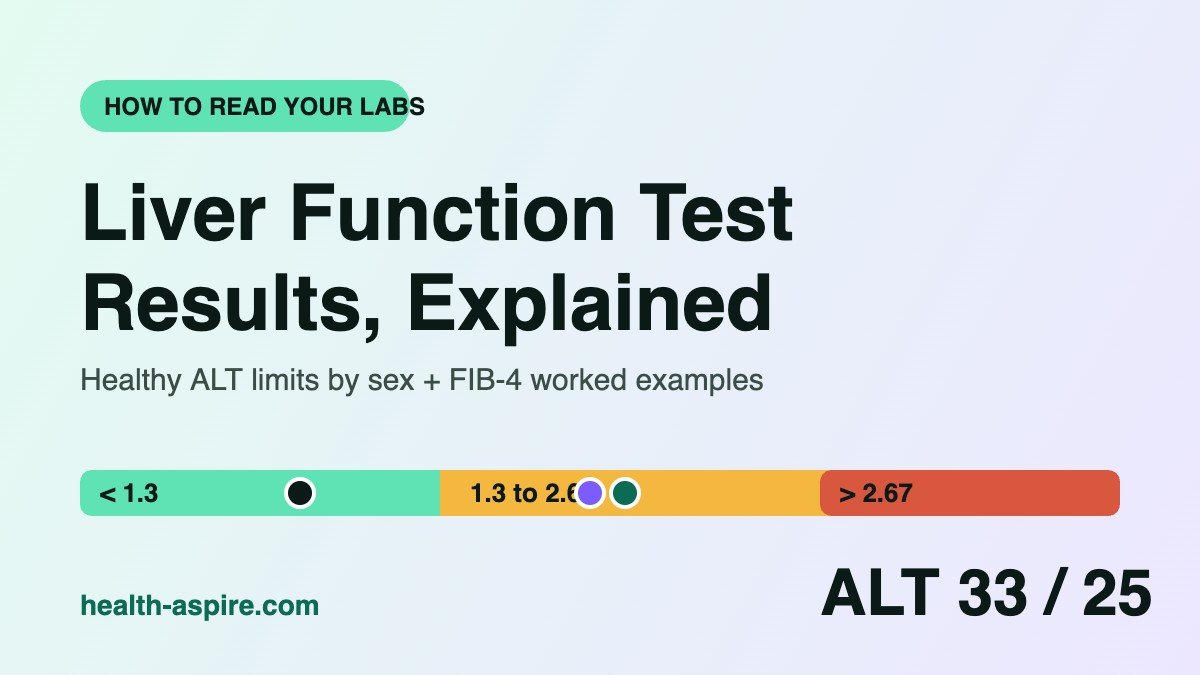
A liver function test is a set of blood tests, usually ALT, AST, ALP, GGT, bilirubin and albumin, that shows whether liver cells are under strain or bile is backing up. After 40, ALT is the line to read first. A healthy ALT is lower than many reports suggest: about 33 U/L or less for men and 25 or less for women, according to the American College of Gastroenterology.
The first time I read my own blood report, I treated the liver lines as pass or fail. No red flag, nothing to think about. Later I noticed that a typical lab range for ALT runs up to 55, while the gastroenterology guideline draws the healthy line far lower. That gap is where most people over 40 sit without knowing it. So this guide reads every line of the panel against the guidelines, then shows you how to turn numbers you already have into a liver scarring score.
What does a liver function test measure?
A liver function test measures enzymes that leak out of stressed liver cells (ALT and AST), enzymes tied to the bile ducts (ALP and GGT), and products the liver makes or clears (albumin, total protein and bilirubin). In other words, it shows strain and workload more than true “function,” and one result is rarely a diagnosis.
The same set is often printed as a “hepatic function panel.” For example, Labcorp’s 7-test version includes ALT, AST, ALP, albumin, total protein, and total and direct bilirubin. Meanwhile, MedlinePlus notes that GGT, LDH and prothrombin time (PT) are sometimes added, and that you may be asked to fast for 10 to 12 hours.
| Line on your report | Typical range (Mayo Clinic, adult men) | What it mostly reflects | Worth knowing after 40 |
|---|---|---|---|
| ALT (SGPT) | 7 to 55 U/L | Liver cell strain; the most liver-specific enzyme | The ACG healthy limit is much lower: 29 to 33 (men), 19 to 25 (women) |
| AST (SGOT) | 8 to 48 U/L | Liver cells, but also muscle and heart | AST more than twice ALT points toward alcohol (ACG) |
| ALP | 40 to 129 U/L | Bile ducts, also bone | If ALP is high, GGT helps show whether it comes from the liver |
| GGT | 8 to 61 U/L | Bile ducts; rises with alcohol and some medicines | ACG: not a screening test when other liver lines are normal |
| Bilirubin, total | 0.1 to 1.2 mg/dL | Breakdown of old red cells, cleared by the liver | If high, it should be split into direct and indirect |
| Albumin | 3.5 to 5.0 g/dL | Protein the liver makes | Low values suggest long-standing illness or poor nutrition |
| Total protein | 6.3 to 7.9 g/dL | Albumin plus other blood proteins | Read with albumin |
Liver function test normal range vs. a healthy ALT
The normal range printed on your liver function test describes most people the lab tests, and many of them have fatty liver. Therefore, the ACG guideline sets a “true healthy” ALT at 29 to 33 U/L for men and 19 to 25 for women, and says levels above that should be assessed. The table turns that into plain numbers.
| ACG category | Multiple of the healthy limit | Men (limit 33 U/L) | Women (limit 25 U/L) | What usually happens next |
|---|---|---|---|---|
| Healthy | At or below the limit | 33 or less | 25 or less | Nothing, unless other lines are off |
| Borderline | Under 2x | 34 to 65 | 26 to 49 | Repeat the panel, review alcohol, weight and medicines |
| Mild | 2x to 5x | 66 to 165 | 50 to 125 | Repeat plus a structured work-up for common causes |
| Moderate | 5x to 15x | 166 to 495 | 126 to 375 | Prompt work-up, often including imaging |
| Severe | Over 15x | Over 495 | Over 375 | Urgent evaluation |
| Massive | Any | Over 10,000 | Over 10,000 | Emergency care |
Our calculation: ACG 2017 categories (Kwo, Cohen and Lim) applied to the top of the guideline’s healthy ALT range for each sex. Note that a man at 50 U/L and a woman at 50 U/L are in different categories, even though both look “normal” against a 7 to 55 lab range.
How we chose the numbers in this guide
Every number here passed the same four checks. As a result, you can trace each one back to its source in a few clicks.
- Specialty guidelines first. Cut-offs come from the American College of Gastroenterology (ACG) and the American Association for the Study of Liver Diseases (AASLD).
- Large US data. Prevalence figures come from NHANES, the national survey that measures real people, not self-reports.
- Reference ranges from a major US clinic. We used Mayo Clinic’s published adult ranges and say so, because every lab differs slightly.
- Nothing to sell. We left out “liver detox” sites and any source selling supplements. No company paid to appear here, and we checked every DOI.
How to read your liver function test in 5 steps
Read your liver function test in this order: compare ALT with the healthy limit for your sex, size the rise, see which group of enzymes moved, check the AST to ALT ratio, and then work out a FIB-4 score. Above all, the ACG guideline says an abnormal panel should be repeated before a full work-up begins.
- Compare ALT with your limit, not only the flag. Use 33 U/L for men and 25 for women from the table above.
- Size the rise. Under 2x the limit is borderline, 2x to 5x mild, 5x to 15x moderate, and over 15x severe.
- Look at the pattern. If ALT and AST rose most, the strain is in liver cells. If ALP and GGT rose most, it points to the bile ducts. For clearly abnormal results, doctors use the R ratio, (ALT divided by its upper limit) divided by (ALP divided by its upper limit): over 5 means liver cell injury, under 2 a bile duct pattern, and 2 to 5 mixed.
- Check AST against ALT. According to the ACG, about 90% of people with alcohol-related liver disease have AST higher than ALT, and over 70% have a ratio above 2.
- Work out FIB-4. This step turns the panel plus one CBC line into a scarring estimate, as shown in the next section.
Is my liver scarred? FIB-4 worked examples
FIB-4 is a free score built from four numbers on a routine blood draw: age, AST, ALT and platelet count. It estimates the chance of advanced liver scarring (fibrosis). AASLD guidance treats under 1.3 as low risk, over 2.67 as high risk, and anything in between as a reason for a second test.
The formula, from Sterling and colleagues in 2006, is: FIB-4 = (age x AST) / (platelets x the square root of ALT), with platelets in thousands per microliter, as most US reports print them. However, age changes the math, so for people 65 and older a lower line of 2.0 is used instead of 1.3, based on work by McPherson and colleagues.
| Example reader | Inputs: age, AST, ALT, platelets | FIB-4 | What the guideline logic says |
|---|---|---|---|
| Linda, 52 | 52 years, AST 28, ALT 36, platelets 260 | 0.93 | Low risk. Her ALT is 1.4x the healthy limit for women, so it is borderline and worth repeating. |
| Mark, 58 | 58 years, AST 45, ALT 64, platelets 190 | 1.72 | Between 1.3 and 2.67: AASLD suggests a second test, such as liver stiffness (elastography) or an ELF blood test. |
| Ruth, 68 | 68 years, AST 26, ALT 25, platelets 220 | 1.61 | Over 1.3, but she is 65+, so the 2.0 cut-off applies: advanced scarring is unlikely. |
Notice what the examples show. Mark’s ALT sits only a little above a 7 to 55 lab range, yet his FIB-4 points to a follow-up test. Ruth, on the other hand, would have been sent for extra testing without the age adjustment. That is why reading the panel as a whole matters more than any single flag.
Why fatty liver is the usual reason for high liver enzymes after 40
In midlife, the most common reason for a raised ALT is fat in the liver linked to weight, blood sugar, blood pressure and cholesterol. Doctors now call it MASLD (metabolic dysfunction-associated steatotic liver disease), the name agreed by liver societies in 2023. It is very common, and it usually causes no symptoms.
Put simply, about half of Americans over 40 in that survey had fat in the liver. Because so many people are affected, the AASLD advises that people with type 2 diabetes, prediabetes or two or more metabolic risk factors repeat a FIB-4 check every 1 to 2 years when it is low. Everyone else with a low score can recheck every 2 to 3 years.
Red flags: when a liver result needs a call today
Most raised liver enzymes are mild and found by chance. Still, some results and symptoms should not wait for your next routine visit. Call your doctor promptly, or seek urgent care, if any of these apply.
- Yellow skin or eyes (jaundice), dark urine or pale stools
- New swelling of the belly or legs, or constant itching
- ALT or AST more than 15 times the upper limit, which the ACG calls a severe rise
- High bilirubin, especially with pain in the upper right belly
- Ongoing nausea, vomiting or loss of appetite alongside abnormal results
How to judge a liver test website or app
Plenty of pages explain liver function test results, but quality varies widely. Before you trust one, run it through this quick checklist.
- Does it name its sources, ideally the ACG, AASLD, MedlinePlus or a major clinic?
- Does it give separate healthy ALT limits for men and women?
- Does it tell you to repeat an abnormal result before drawing conclusions?
- Does it mention FIB-4 or another way to look past single numbers?
- Does it say when a result is urgent?
Be wary, however, of any page that sells a “liver detox,” “cleanse” or “flush.” Such products are not part of the guideline work-up, which focuses on finding the cause, and a single lab value is never a diagnosis.
Where Health Aspire fits
We are a small, free, ad-free site for adults over 40, and I am an editor, not a doctor. We don’t have a liver calculator of our own, so for FIB-4 your doctor’s office or a guideline-linked calculator is the right place. What we can do is put guideline numbers side by side, show how age changes them, and help you arrive with clear questions. Our waist-to-height tool fits here too, because waist size is one of the metabolic risk factors that drive fatty liver.
What to do next
- List your questions, including “What is my FIB-4?”, with our free Before Your Check-up planner.
- Check one of the main metabolic risk factors with our waist-to-height ratio calculator.
- Read the rest of the same blood draw with our comprehensive metabolic panel guide, and find your platelet count with our CBC blood test guide.
- See how drinking affects the liver in is 2 drinks a day too much? and how meal timing plays in with is eating late at night bad for your liver?
- Since blood sugar and liver fat travel together, check where you stand on our A1C levels chart.
FAQ
Do I need to fast for a liver function test?
Often, yes. MedlinePlus says you will probably be asked to fast for 10 to 12 hours, but your provider gives the final instructions. Also, tell them about every medicine you take, since some can change the results. Don’t stop a medicine on your own.
Is an ALT of 40 bad?
It is not dangerous, but it is above the healthy limit. For a man, 40 U/L is borderline (under 2x the limit of 33). For a woman, it is 1.6x the limit of 25. In both cases, the ACG approach is to repeat the test and look for common causes such as alcohol, weight gain and medicines.
What is the difference between a hepatic function panel and a CMP?
A hepatic function panel focuses on the liver: ALT, AST, ALP, bilirubin, albumin and total protein. A comprehensive metabolic panel (CMP) shares most of those lines but adds glucose, kidney markers and electrolytes. As a result, if you had a CMP, you already have most of your liver numbers.
Does a low FIB-4 mean my liver is fine?
A score under 1.3 makes advanced scarring unlikely, and AASLD guidance says you can be followed by your primary care doctor. Even so, it does not rule out fat in the liver, so recheck every 1 to 3 years depending on your risk factors.
Sources
- Kwo P.Y., Cohen S.M., Lim J.K. ACG Clinical Guideline: Evaluation of Abnormal Liver Chemistries (American Journal of Gastroenterology, 2017)
- Rinella M.E., Neuschwander-Tetri B.A., Siddiqui M.S., et al. AASLD Practice Guidance on the clinical assessment and management of nonalcoholic fatty liver disease (Hepatology, 2023)
- Sterling R.K., Lissen E., Clumeck N., et al. Development of a simple noninvasive index to predict significant fibrosis in patients with HIV/HCV coinfection (Hepatology, 2006)
- McPherson S., Hardy T., Dufour J.F., et al. Age as a Confounding Factor for the Accurate Non-Invasive Diagnosis of Advanced NAFLD Fibrosis (American Journal of Gastroenterology, 2017)
- Díaz L.A., Lazarus J.V., Fuentes-López E., et al. Disparities in steatosis prevalence in the United States by Race or Ethnicity according to the 2023 criteria (Communications Medicine, 2024)
- Rinella M.E., Lazarus J.V., Ratziu V., et al. A multisociety Delphi consensus statement on new fatty liver disease nomenclature (Journal of Hepatology, 2023)
- AASLD Liver Fellow Network. Spare Me the Jab: Noninvasive Assessment of Patients with MASLD
- MedlinePlus. Liver Function Tests (US National Library of Medicine)
- Mayo Clinic. Liver function tests
- Labcorp. Hepatic Function Panel (7)
This guide is for education and is not medical advice. Talk to your doctor about your own numbers and treatment. See our medical disclaimer.
Free weekly email
A short, honest health email. Every Thursday.
The week’s most useful research for life after 40, explained in plain English, plus one step picked for what matters to you. No spam, no selling your email, unsubscribe in one click.