CBC Blood Test After 40: How to Read Every Line
A CBC blood test (complete blood count) measures your red cells, white cells and platelets from one small tube of blood, usually with no fasting. After 40, three lines tell you the most: hemoglobin, MCV and RDW. Together they show whether you have anemia and, if you do, which kind your doctor will look for first.
The first page of my own blood report was not cholesterol. It was a column of abbreviations: WBC, RBC, HGB, HCT, MCV, MCH, RDW, PLT. Nothing was flagged, so naturally I skipped it. Later I learned that a few of those lines change meaning as we age, and that some research cut-offs sit above the lab’s printed range. So this guide reads every line the way a careful family doctor would, using only sources you can check.
What does a CBC blood test measure?
A CBC blood test counts and sizes three kinds of blood cells. For example, red cells carry oxygen, white cells fight infection, and platelets help blood clot. According to MedlinePlus, it is often part of a routine check-up, needs no special preparation, and carries very little risk beyond a small bruise.
In addition, a “CBC with differential” adds a breakdown of the five types of white cells. Most adult panels include it. As a result, your report has three blocks: a red cell block (RBC, hemoglobin, hematocrit, MCV, MCH, MCHC, RDW), a white cell block (WBC plus the differential) and a platelet block.
CBC normal ranges in US and SI units, plus the lines that matter after 40
First of all, your lab’s range describes most healthy people it tests. A research cut-off is different: it is the point where studies show something worth acting on. For this reason, we placed both side by side, with SI units for anyone reading a report from Canada, the UK or Europe.
Red cell lines on a CBC blood test
| CBC line | Typical adult range (US units) | Same range in SI units | Cut-off worth knowing after 40 | If it is off, what is usually checked next |
|---|---|---|---|---|
| Hemoglobin (HGB) | Women 11.5 to 15.5 g/dL; men 13 to 17 g/dL | Women 115 to 155 g/L; men 130 to 170 g/L | WHO anemia: under 12 (women), under 13 (men). Beutler and Waalen: under 13.2 for white men 60 and older, 12.7 for Black men 60 and older | MCV, to sort the type of anemia |
| MCV (cell size) | 80 to 100 fL | 80 to 100 fL | AAFP: under 80 is microcytic (small cells); over 100 is macrocytic (large cells) | Small or normal size: ferritin. Large: smear, reticulocytes, B12 and folate |
| RDW (size spread) | 12% to 15% | 0.12 to 0.15 | Each 1% higher RDW: 22% higher risk of death over follow-up in adults 45+ (Patel 2009) | Read with MCV; a wide spread often points to a mix of old and new cells |
| Hematocrit (HCT) | Women 36% to 48%; men 40% to 55% | 0.36 to 0.48 L/L; 0.40 to 0.55 L/L | Moves with hemoglobin | Same as hemoglobin |
| RBC count | Women 4.0 to 5.4; men 4.5 to 6.1 million/mcL | Same numbers, x1012/L | Use the lab range | Read with hemoglobin and MCV |
| MCH, MCHC | 27 to 31 pg; 32 to 36 g/dL | 27 to 31 pg; 320 to 360 g/L | Use the lab range | Usually fall with iron deficiency |
White cells and platelets on a CBC blood test
| CBC line | Typical adult range (US units) | Same range in SI units | Cut-off worth knowing after 40 | If it is off, what is usually checked next |
|---|---|---|---|---|
| WBC | 4,000 to 10,000 per mcL | 4.0 to 10.0 x10⁹/L | Use the lab range; check the differential | Repeat test, review infections and medicines |
| Neutrophils | 2,500 to 7,000 per mcL | 2.5 to 7.0 x10⁹/L | Neutropenia: under 1,500 per mcL (Hsieh 2007) | Compare with your past results |
| Platelets | 150,000 to 400,000 per mcL | 150 to 400 x109/L | Also used in the FIB-4 liver score | Repeat test; your doctor decides on further tests |
Sources: adult ranges from Cleveland Clinic (labs vary, so your report’s range comes first); WHO thresholds as tabulated by Le 2016; age-adjusted hemoglobin limits from Beutler and Waalen 2006 as summarized by the AAFP 2018 review; RDW risk from Patel et al. 2009; neutropenia definition from Hsieh et al. 2007. SI conversions are ours.
How common is anemia after 40?
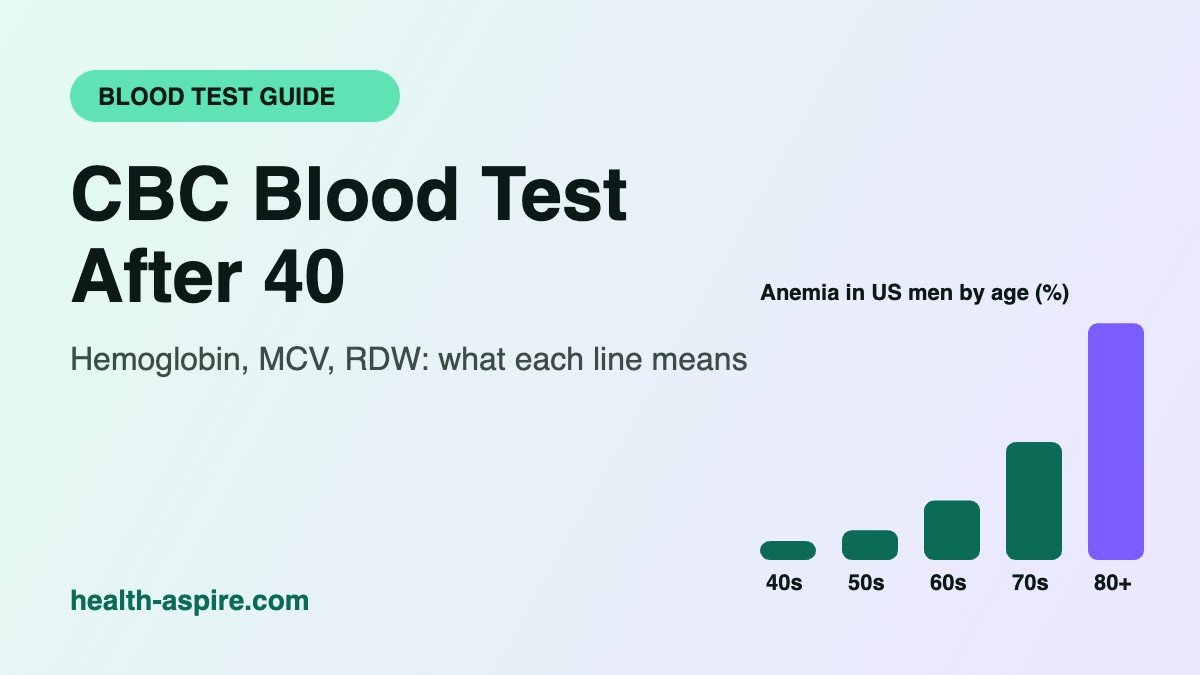
Overall, anemia becomes much more common after 70, and the pattern differs by sex. In US national data from 2003 to 2012, women in their 40s had the highest rate of any midlife group, mostly before menopause. Then men overtook women in their 60s, and by 80 to 85 about one man in four had anemia. An earlier national analysis found similar numbers: about 11% of men and 10% of women over 65, rising above 20% after 85.
Why anemia matters when you read a CBC blood test
So why does this matter? Because the AAFP review notes that most anemia in older adults is mild, yet even mild anemia is linked to more illness and death. In addition, roughly a third of cases come from nutrient shortfalls such as iron, a third from chronic inflammation or kidney disease, and a third have no clear cause.
What does MCV mean on a blood test?
MCV (mean corpuscular volume) is the average size of your red cells, measured in femtoliters. The usual range is 80 to 100 fL. On its own, though, it rarely means much. However, when hemoglobin is low, MCV is the fork in the road: it tells your doctor which tests to order first.
The decision guide below follows the 2018 American Family Physician review “Anemia in Older Adults” step by step. In other words, it is a map for your conversation, not a self-diagnosis tool.
MCV under 100 fL (small or normal cells)
1. Ask about ferritin, your iron stores.
2. Ferritin under 19 ng/mL strongly suggests iron deficiency. 45 or less still raises the odds. 46 to 100 makes it less likely, not impossible.
3. If iron is low, ask why: in older adults the review advises looking for hidden bleeding in the gut, often with endoscopy.
4. If iron is fine, kidney function (creatinine, eGFR), a blood smear and a reticulocyte count come next.
MCV over 100 fL (large cells)
1. A blood smear and reticulocyte count come first.
2. A low reticulocyte count can point to low vitamin B12 or folate. B12 under 100 pg/mL confirms deficiency; borderline results may need methylmalonic acid or homocysteine.
3. An abnormal smear usually means a referral to a blood specialist (hematologist).
Based on Lanier, Park and Callahan, Anemia in Older Adults, American Family Physician 2018. Your doctor may order tests in a different order based on your history.
What does RDW mean, and should a high RDW worry you?
RDW (red cell distribution width) shows how much your red cells vary in size. A high RDW means a mix of small and large cells, which often happens early in iron deficiency or when B12 runs low. In short, it is a clue to read alongside MCV, not a diagnosis on its own.
There is also a second, newer reason to notice it. In 8,175 US adults aged 45 and older, each 1% rise in RDW came with a 22% higher risk of death during follow-up. Notably, the link held even in people without anemia. Still, nobody knows yet whether lowering RDW changes anything, so a high value is a reason for a fuller check-up, not for alarm.
White blood cell count and platelets: what to check
For white cells, first read the total and then the differential. A single slightly high or low value after a cold, a hard workout or a new medicine is common, so doctors often simply repeat the CBC blood test. MedlinePlus notes that an abnormal level does not always mean a condition that needs treatment.
One detail many guides skip: a lower neutrophil count is far more common in some groups. In national data, 4.5% of Black participants had neutrophils under 1,500 per mcL, compared with 0.79% of white participants. For many people, therefore, a lifelong “low” count is their normal. That is why your past results are the best comparison. Platelets, meanwhile, also feed the FIB-4 liver score we explain in our metabolic panel guide.
Three example readers (made up, for illustration)
- Example 1: Linda, 58, hemoglobin 11.6, MCV 76, RDW 16.5%. Her hemoglobin sits just above the bottom of some lab ranges (11.5), so her report may show no flag. By the WHO cut-off of 12, though, she has mild anemia. Next, small cells plus a wide RDW point first to iron. Following the AAFP path, she would ask about ferritin and, if it is low, about finding the source of iron loss.
- Example 2: Robert, 71, white, hemoglobin 12.9, MCV 104. First, he is below 13.2, the age-adjusted lower limit for white men over 60, and below the WHO line of 13. Large cells send him down the other branch: a blood smear, a reticulocyte count, and B12 and folate levels.
- Example 3: Denise, 49, Black, neutrophils 1,300 per mcL, everything else normal, no frequent infections. On paper, she is below the 1,500 line used to define neutropenia. Yet national data show this is far more common in Black adults and often harmless. A good question for her doctor: “Were my earlier counts similar?”
How we chose the CBC blood test ranges and sources
To begin with, every number above comes from a hospital reference page, a peer-reviewed study or a clinical review that we read in full or in abstract this week. We also used US government survey data (NHANES) for the age chart, because it samples ordinary Americans rather than hospital patients. Above all, we avoided supplement sellers and “optimal range” charts without a cited source. Finally, nobody paid to be included.
How to read your CBC blood test results in 5 steps
- Start with hemoglobin. Compare it with the lab range and with the WHO line (12 for women, 13 for men).
- If it is low, read MCV. Under 80, 80 to 100 or over 100 decides the next test.
- Check RDW. A wide spread supports an iron or B12 question.
- Scan white cells and platelets. Note anything flagged and whether it was also off last time.
- Compare with older reports. A trend over years says more than one value.
Red flags on a CBC blood test
- Hemoglobin under 7 to 8 g/dL, or anemia with symptoms such as breathlessness or chest pain. The AAFP review says these may need urgent care.
- New iron deficiency in a man or a woman past menopause, since hidden bleeding needs to be ruled out.
- Red cells, white cells and platelets all off at the same time.
- A result your lab marks as “critical”. In that case, labs usually phone the doctor directly.
Trusted places to look up CBC blood test results
- MedlinePlus (NIH): plain-English test explanations, no ads. Best for what each line means.
- Cleveland Clinic: a clear adult reference table for every CBC line.
- American Family Physician: the review doctors themselves read on anemia in older adults. Technical, but free.
Where Health Aspire fits
We are a small, free, ad-free site for adults over 40. However, we are not doctors and cannot read your report for you. What we can do is put guideline numbers side by side, show where age changes the picture, and help you walk into your appointment with better questions.
What to do next
- Write down your questions with our free Before Your Check-up planner.
- If kidney function comes up as a cause of anemia, check the number with our eGFR calculator.
- Read the rest of the same blood draw with our comprehensive metabolic panel guide and cholesterol test results explained.
- See which other tests make sense at your age in our health assessment after 40 and, for blood sugar, our A1C levels chart.
FAQ
Do I need to fast for a CBC blood test?
Usually not. MedlinePlus says no special preparation is needed. However, if cholesterol or glucose is drawn from the same sample, you may be asked to fast for several hours.
Can a CBC blood test detect cancer?
Not directly. MedlinePlus lists blood cancers among the conditions a CBC can help diagnose or monitor, but most abnormal results have common causes. Further tests, such as a blood smear, are needed before anyone can say more.
Is a hemoglobin of 12.5 normal for a 70-year-old man?
It is below the WHO line of 13 and below the age-adjusted limits of 13.2 (white men over 60) and 12.7 (Black men over 60). Therefore, it counts as mild anemia by both standards and is worth a conversation about MCV and ferritin.
Why is my MCV high when everything else is normal?
Even so, large red cells without anemia can still be an early clue. The AAFP review’s macrocytic path, a smear, a reticulocyte count and B12 and folate levels, is a reasonable list to bring to your doctor.
Sources
- Lanier J.B., Park J.J., Callahan R.C. Anemia in Older Adults (American Family Physician, 2018;98(7):437-442)
- Le C.H.H. The Prevalence of Anemia and Moderate-Severe Anemia in the US Population (NHANES 2003-2012) (PLOS ONE, 2016)
- Beutler E., Waalen J. The definition of anemia: what is the lower limit of normal of the blood hemoglobin concentration? (Blood, 2006)
- Patel K.V., Ferrucci L., Ershler W.B., et al. Red Blood Cell Distribution Width and the Risk of Death in Middle-aged and Older Adults (Archives of Internal Medicine, 2009)
- Hsieh M.M., Everhart J.E., Byrd-Holt D.D., et al. Prevalence of Neutropenia in the U.S. Population: Age, Sex, Smoking Status, and Ethnic Differences (Annals of Internal Medicine, 2007)
- Guralnik J.M., Eisenstaedt R.S., Ferrucci L., et al. Prevalence of anemia in persons 65 years and older in the United States (Blood, 2004)
- MedlinePlus. Complete Blood Count (CBC) (US National Library of Medicine)
- Cleveland Clinic. Complete Blood Count (CBC)
This guide is for education and is not medical advice. Talk to your doctor about your own numbers and treatment. See our medical disclaimer.
Free weekly email
A short, honest health email. Every Thursday.
The week’s most useful research for life after 40, explained in plain English, plus one step picked for what matters to you. No spam, no selling your email, unsubscribe in one click.