This heart attack risk calculator estimates your chance of having a heart attack or stroke in the next 10 years, using the American Heart Association’s PREVENT equations. These are the same equations that the 2025 blood pressure guideline and the 2026 cholesterol guideline from the AHA and the American College of Cardiology use for adults aged 30 to 79.
You need a few numbers from a routine check-up: blood pressure, total and HDL cholesterol, and, if you have it, kidney function. It takes about three minutes. Your answers stay in your browser.
AHA PREVENT equations · about 3 minutes
This calculator is built for people who have not had heart disease or a stroke. If you have, your doctor will already treat your risk as high, and an estimate like this one does not apply. The best next step is a regular check-up with your care team.
Blood pressure
Cholesterol
From a standard blood test (lipid panel). Fasting is not required.
Health and habits
Kidney function
Your kidneys and heart are closely linked. You will find these numbers on a routine blood test (metabolic panel).
Your numbers stay in your browser. Nothing is stored or sent.
Your estimate ·
Your heart attack and stroke risk
Next 10 years · heart attack or stroke
–
● people with numbers like yours expected to have a heart attack or stroke in 10 years ● people who would not
How doctors group this number
Groups from the 2026 ACC/AHA cholesterol guideline, used to guide a conversation about prevention.
The long view · next 30 years
What would change your number most
This estimate uses the American Heart Association's PREVENT equations (Khan et al., Circulation 2024), built from data on more than 6 million US adults. It is an estimate for groups of people with similar numbers, not a prediction for you personally, and it is not a diagnosis. It may underestimate risk in people with very high LDL cholesterol (190 mg/dL or more), familial hypercholesterolemia, chronic inflammatory disease or a strong family history of early heart disease. Share it with your doctor. If you have chest pain, shortness of breath, weakness on one side or trouble speaking, call 911 now.
How this heart attack risk calculator works
The PREVENT equations were developed by an AHA team from health records of more than 3.2 million US adults, then tested in another 3.3 million. They combine ten things that matter for your heart: age, sex, blood pressure, cholesterol, diabetes, smoking, weight, kidney function, and whether you take blood pressure or cholesterol medicine.
First, the calculator turns your numbers into the same scale the researchers used. Then it applies the published formula for women or for men. Finally, it shows three 10-year estimates: a heart attack or stroke, heart failure, and any of these together. If you are 30 to 59, it also shows your 30-year risk.
We checked our version against the worked example in the PREVENT research paper, and it gives the same results to the decimal.
What your heart attack risk result means
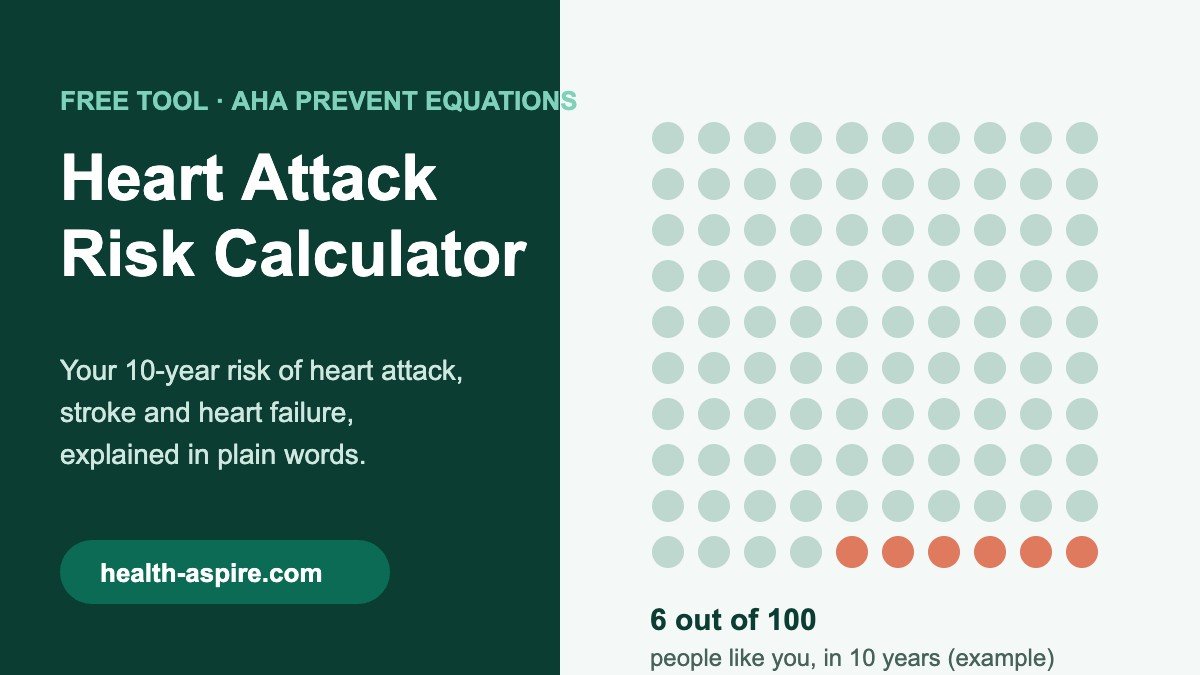
Your result is a percentage. For example, 4% means that about 4 out of 100 people with numbers like yours would be expected to have a heart attack or stroke in the next 10 years, while 96 would not. In other words, it describes a group of people like you. It is not a prediction of what will happen to you.
The 2026 ACC/AHA cholesterol guideline groups the 10-year heart attack and stroke estimate like this:
- Low: under 3%.
- Borderline: 3% to under 5%.
- Intermediate: 5% to under 10%.
- High: 10% or more.
Doctors use these groups to start a conversation about prevention. For most people, that starts with everyday habits. For some people, it also includes medicine for blood pressure or cholesterol. Only your doctor can make that call with you, because they also know your history and other test results.
What the heart attack risk calculator does not include
No calculator sees everything. PREVENT may underestimate risk if you have very high LDL cholesterol (190 mg/dL or more), familial hypercholesterolemia, a chronic inflammatory disease such as rheumatoid arthritis or psoriasis, a history of preeclampsia or early menopause, or a parent or sibling who had heart disease at a young age. If any of these apply, tell your doctor.
Also, the calculator is not for people who have already had a heart attack, a stroke or heart failure. In that case, your care team already treats your risk as high.
How to lower your risk of heart attack and stroke
The good news is that most heart risk can be changed. The American Heart Association’s Life’s Essential 8 lists the habits and numbers that matter most: not smoking, regular activity, a healthy diet, enough sleep, a healthy weight, and healthy blood pressure, cholesterol and blood sugar. The heart attack risk calculator also shows which of your numbers would change your estimate the most, so you know where to start.
To see where you stand on all eight measures, take our free A14 Protocol health check. For more practical steps, read our heart health guide.
Heart attack risk calculator FAQ
Is this the same heart risk calculator doctors use?
It uses the same published PREVENT equations. In 2025 and 2026, the AHA and ACC adopted PREVENT in their guidelines for blood pressure and cholesterol, replacing the older Pooled Cohort Equations from 2013.
Why does it ask about my kidneys?
Kidney function and heart health are closely linked, so PREVENT includes eGFR, a standard measure on a routine blood test. If you only have your creatinine level, the calculator works out your eGFR with the CKD-EPI 2021 equation. If you don’t know either, it assumes normal kidney function and tells you so.
Why is my 30-year risk so much higher?
Thirty years is three times as long as ten, so the chance of an event is naturally higher. The 30-year number is useful because it shows how today’s habits add up over time. As a result, changes made in your 30s, 40s and 50s pay off the most.
Why doesn’t the calculator ask about race?
The older equations used race. PREVENT was built without it, because race is a social category, not a biological cause of heart disease. Instead, the researchers added measures such as kidney function and tested the equations across racial and ethnic groups.
Does a low result mean I can skip my check-ups?
No. Your numbers can change over the years, so keep having your blood pressure and cholesterol checked as your doctor recommends, and repeat this estimate when you get new results.
Not sure what the numbers on your lab report mean? Read cholesterol test results explained, see what your LDL number means, and find out why every adult should have one Lp(a) test.
Sources
- Khan SS et al. Development and validation of the American Heart Association’s PREVENT equations. Circulation, 2024. Source
- 2026 ACC/AHA Guideline on the Management of Dyslipidemia. Circulation, 2026. Source
- 2025 AHA/ACC Guideline for the Prevention, Detection, Evaluation and Management of High Blood Pressure in Adults. Circulation, 2025. Source
- Inker LA et al. New creatinine- and cystatin C-based equations to estimate GFR without race. New England Journal of Medicine, 2021. Source
- Lloyd-Jones DM et al. Life’s Essential 8. Circulation, 2022. Source
- Mayer MG. preventr: an implementation of the PREVENT equations (R package, used to check our results). Source
This heart attack risk calculator is for education. It gives a population-based estimate, not a diagnosis, and it does not replace advice from your doctor. If you have chest pain, shortness of breath, sudden weakness on one side, or trouble speaking, call 911 now.