Non-HDL Cholesterol: What Your Number Means After 40
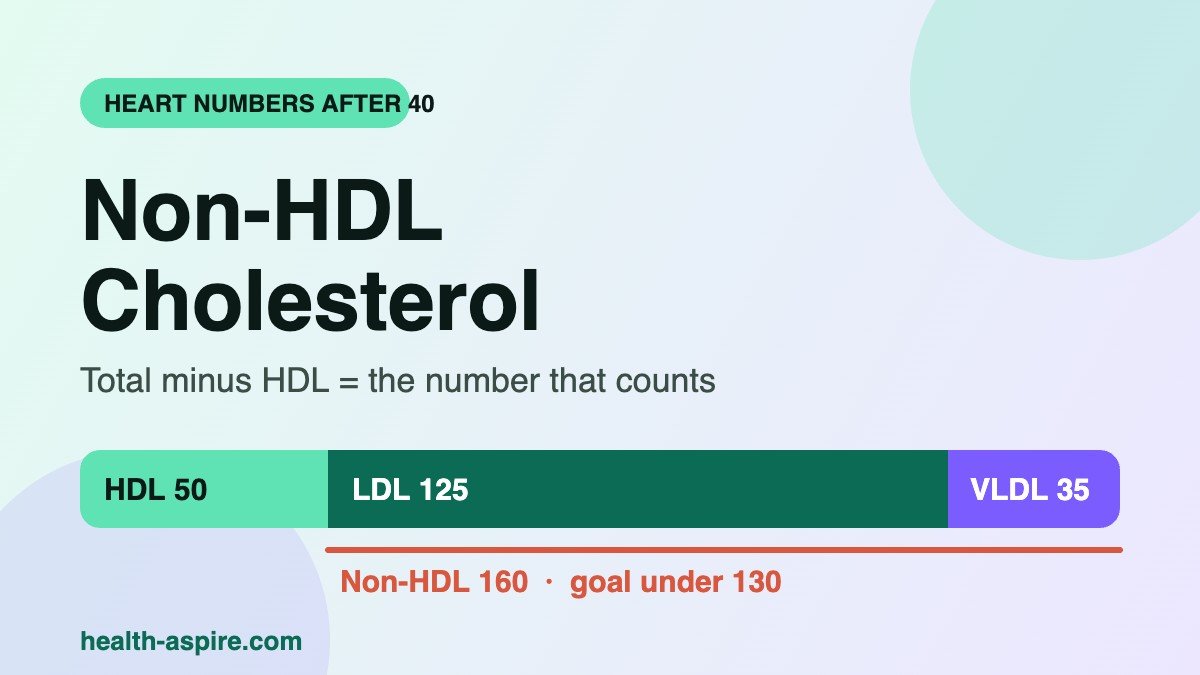
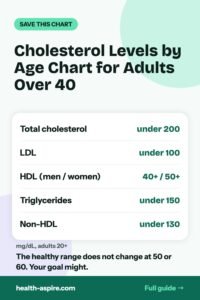
Your non-HDL cholesterol is your total cholesterol minus your HDL, the “good” kind. It adds up the cholesterol carried by every particle that can lodge in an artery wall, not just LDL. For most adults without heart disease, under 130 mg/dL is the target, and lower is better if your risk is high.
It sits quietly on almost every lipid panel, often on the last line, and many doctors never mention it. That is a shame, because it often predicts heart risk better than LDL alone, it works even if you ate breakfast before the test, and the 2026 ACC/AHA cholesterol guideline brought back specific non-HDL goals. Here is how to read yours, what the new goals are, and what to do if it is high.
What is non-HDL cholesterol?
Non-HDL cholesterol is all the cholesterol in your blood that is not riding on HDL particles. That includes LDL, VLDL and its leftovers (called remnants), and Lp(a). Each of these particles can slip into the wall of an artery and help build plaque, so non-HDL is a single number for your total “artery-clogging” load.
Think of your total cholesterol as passengers on a fleet of buses. HDL buses mostly carry cholesterol away from your arteries and back to the liver. Every other bus can drop passengers off inside the artery wall. Non-HDL counts the passengers on all of those risky buses at once.
LDL is the biggest of them, which is why it gets most of the attention. However, when triglycerides run high, VLDL and remnant particles carry a lot more cholesterol too. An LDL number can miss that. Non-HDL cannot, because it captures everything except HDL.
How do you calculate non-HDL cholesterol?
To calculate non-HDL cholesterol, subtract your HDL from your total cholesterol. Both numbers are on any standard lipid panel. If your total is 210 mg/dL and your HDL is 50 mg/dL, your non-HDL is 160 mg/dL. Many labs print it for you, and our free LDL calculator does the math automatically.
There is one more thing that makes this number handy. Because it uses only two directly measured values, it does not depend on a formula that guesses LDL from triglycerides. As a result, it stays reliable when you have not fasted. A 2016 joint statement from the European Atherosclerosis Society and European laboratory medicine experts concluded that fasting is not routinely needed for a lipid profile, and the 2026 US guideline also allows fasting or nonfasting testing.
If your report is in mmol/L, divide mg/dL by 38.67 to convert. So 130 mg/dL is about 3.4 mmol/L, and 100 mg/dL is about 2.6 mmol/L.
Non-HDL cholesterol normal range
For adults, a non-HDL cholesterol level under 130 mg/dL is called desirable. The National Lipid Association grades higher values in 30-point steps, from above desirable at 130 to very high at 220 and over. Your personal goal may be lower than 130, depending on your heart risk.
Here is the full scale, alongside the matching LDL ranges, so you can see the 30-point gap between the two.
| Category | Non-HDL cholesterol (mg/dL) | Matching LDL (mg/dL) | In plain terms |
|---|---|---|---|
| Desirable | Under 130 | Under 100 | Where most adults want to be |
| Above desirable | 130 to 159 | 100 to 129 | Mildly raised; lifestyle matters most |
| Borderline high | 160 to 189 | 130 to 159 | Worth a risk discussion with your doctor |
| High | 190 to 219 | 160 to 189 | Raises long-term risk on its own |
| Very high | 220 and over | 190 and over | Ask about genetic causes such as familial hypercholesterolemia |
Source: National Lipid Association recommendations (Jacobson et al., 2014). Some labs use slightly different cutoffs, so check the reference range printed on your own report.
Non-HDL cholesterol goals in the 2026 guideline
The 2026 ACC/AHA dyslipidemia guideline sets non-HDL cholesterol goals by your 10-year heart risk from the AHA PREVENT calculator. They run 30 mg/dL above the LDL goals: under 130 for borderline or intermediate risk, under 100 for high risk, and under 85 for people with heart disease at very high risk.
This is a real change. The 2018 guideline had moved away from numeric targets, while the new one says LDL and non-HDL goals are back to guide treatment.
| Your situation | 10-year PREVENT risk | LDL goal (mg/dL) | Non-HDL goal (mg/dL) |
|---|---|---|---|
| Low risk | Under 3% | Healthy habits; no numeric drug goal | Healthy habits; no numeric drug goal |
| Borderline risk | 3% to under 5% | Under 100 | Under 130 |
| Intermediate risk | 5% to under 10% | Under 100 | Under 130 |
| High risk | 10% or more | Under 70 | Under 100 |
| Diabetes, ages 40 to 75 | Any | Under 100 (under 70 if risk is over 10%) | Under 130 (under 100 if risk is over 10%) |
| Heart disease, very high risk | Not applicable | Under 55 | Under 85 |
If you do not know your 10-year risk, that is the place to start. You can get an estimate in two minutes with our heart attack risk calculator and then compare it with what your doctor calculates.
Is non-HDL cholesterol better than LDL?
For predicting heart attacks and strokes, non-HDL cholesterol is usually a slightly better marker than LDL, because it also counts the cholesterol in triglyceride-rich particles and Lp(a). ApoB, a test that counts the particles themselves, does better still. Even so, all three point in the same direction most of the time.
The numbers back this up. In a 2011 meta-analysis of 12 studies with over 233,000 people, the standardized risk ratio was 1.25 for LDL, 1.34 for non-HDL and 1.43 for apoB (Sniderman et al.). In other words, each step up in non-HDL tracked more closely with heart events than the same step in LDL.
Long-term data are just as clear. A Lancet study pooled 38 cohorts and nearly 399,000 people followed for up to 43 years. Among women, the 30-year rate of heart attack or stroke rose from 7.7% with non-HDL under about 100 mg/dL to 33.7% at about 220 mg/dL or higher. For men, it climbed from 12.8% to 43.6% (Brunner et al., 2019).
Of course, those are averages across many people, and other factors such as blood pressure, smoking and diabetes shift your own odds a lot. Still, the pattern is steady: more non-HDL over more years means more plaque.
Why is my non-HDL cholesterol high when my LDL is normal?
A high non-HDL cholesterol with a normal LDL almost always means your triglycerides are raised. Extra triglycerides travel in VLDL and remnant particles, and those carry cholesterol too. The gap between your non-HDL and your LDL is roughly that hidden cholesterol, and anything much over 30 mg/dL deserves attention.
A quick check: subtract your LDL from your non-HDL. If the difference is around 30, your triglycerides are probably near 150. If it is 50 or 60, your triglycerides are likely in the 250 to 300 range, and LDL alone is underselling your risk.
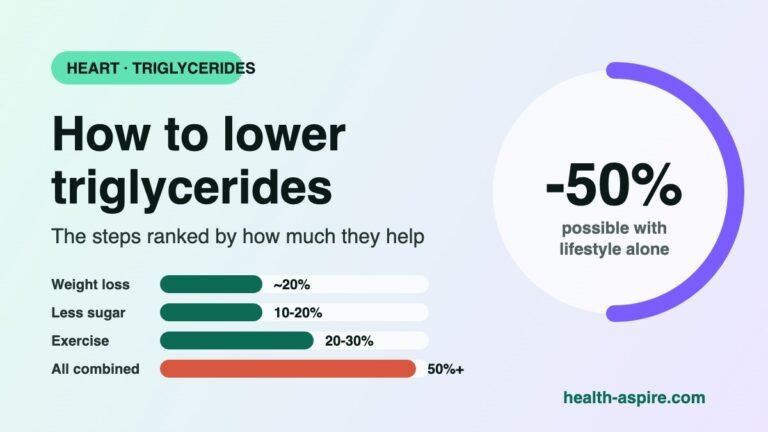
This pattern is common after 40, especially with belly weight gain, insulin resistance, prediabetes or type 2 diabetes, heavy drinking, and some medications. For that reason, it is often the first lab clue to a metabolic problem. Our guide on how to lower triglycerides covers the steps that move that gap the most.
It is also exactly the situation where the 2026 guideline suggests an apoB test once LDL and non-HDL are at goal, since apoB shows how many risky particles you really have.
How to lower non-HDL cholesterol
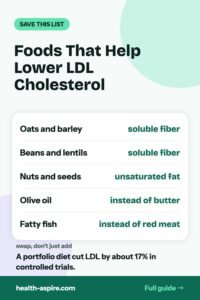
You lower non-HDL cholesterol by lowering both of its parts: LDL and the triglyceride-rich particles. Eating less saturated fat and more fiber helps the first. Cutting added sugar and alcohol, losing some belly fat and moving daily helps the second. If your risk is high, a statin is the proven foundation.
- Swap the fat, not just the amount. Replacing butter, fatty meat and full-fat dairy with olive oil, nuts and fish lowers LDL, the biggest piece of non-HDL.
- Go after triglycerides. Sugary drinks, refined carbs and alcohol raise VLDL. Trimming them often brings the non-HDL minus LDL gap down within weeks.
- Move most days. Regular aerobic exercise lowers triglycerides and nudges HDL up, which shrinks non-HDL from both ends.
- Lose a little weight if you carry it around the middle. Even a modest loss tends to improve triglycerides first.
- Talk about medication when the goal is far away. The 2026 guideline keeps statins as the first drug for both high LDL and persistently high triglycerides, with other options added if needed.
Then recheck. Most doctors repeat a lipid panel 4 to 12 weeks after a change in treatment, so you can see whether you have reached your goal.
What to do next
- Plug your total cholesterol, HDL and triglycerides into our free LDL calculator to see your LDL and non-HDL side by side.
- Use Before Your Check-up to note the questions you want to ask, including “What is my non-HDL goal?”
- Compare your other lipid numbers with our guide to LDL cholesterol levels and the full cholesterol test results explained.
- See how your numbers stack up for your age in cholesterol levels by age.
- Ask whether a one-time Lp(a) test makes sense, since Lp(a) is part of non-HDL and is mostly inherited.
FAQ
Is a reading of 160 bad?
A non-HDL of 160 mg/dL is borderline high. It is 30 points above the usual goal of 130, which is roughly like an LDL of 130. It is not an emergency, but it is worth checking your 10-year risk and triglycerides and asking your doctor whether lifestyle changes alone are enough.
Do I need to fast for the test?
Usually not. Total cholesterol and HDL change very little after a normal meal, so non-HDL stays reliable without fasting. Your doctor may still ask you to fast if your triglycerides were very high before or if they need a precise LDL.
Can the number be too low?
For most people, no. Very low non-HDL levels are generally seen with low heart risk. If your number is unusually low without treatment, though, your doctor may look for other causes such as an overactive thyroid or poor nutrition.
Is non-HDL the same as LDL?
No. LDL is one part of non-HDL. Non-HDL also includes VLDL, remnant particles and Lp(a). Usually non-HDL runs about 30 mg/dL higher than LDL, and more than that when triglycerides are high.
Sources
- Blumenthal R.S., Morris P.B., Gaudino M., et al. 2026 ACC/AHA/AACVPR/ABC/ACPM/ADA/AGS/APhA/ASPC/NLA/PCNA Guideline on the Management of Dyslipidemia (Journal of the American College of Cardiology, 2026)
- Jacobson T.A., et al. National Lipid Association recommendations for patient-centered management of dyslipidemia: Part 1, executive summary (Journal of Clinical Lipidology, 2014)
- Brunner F.J., et al. Application of non-HDL cholesterol for population-based cardiovascular risk stratification: results from the Multinational Cardiovascular Risk Consortium (The Lancet, 2019)
- Sniderman A.D., et al. A meta-analysis of LDL cholesterol, non-HDL cholesterol, and apolipoprotein B as markers of cardiovascular risk (Circulation: Cardiovascular Quality and Outcomes, 2011)
- Nordestgaard B.G., et al. Fasting is not routinely required for determination of a lipid profile (European Heart Journal, 2016)
This guide is for education and is not medical advice. Talk to your doctor about your own numbers and treatment. See our medical disclaimer.
Free weekly email
A short, honest health email. Every Thursday.
The week’s most useful research for life after 40, explained in plain English, plus one step picked for what matters to you. No spam, no selling your email, unsubscribe in one click.