This free LDL calculator estimates your LDL cholesterol from the three numbers on a standard lipid panel: total cholesterol, HDL and triglycerides. It uses the Sampson/NIH equation, which the 2026 ACC/AHA dyslipidemia guideline prefers over the older Friedewald formula, and shows your non-HDL cholesterol and the LDL goal that fits your risk.
Free weekly email
Want to bring your LDL down?
Every Thursday: one short email on cholesterol, ApoB and heart health after 40, in plain English, with one step to try. No spam, unsubscribe in one click.
Which formula does this LDL calculator use?
Most labs do not measure LDL directly; they calculate it. For decades the standard was the Friedewald formula (LDL = total cholesterol minus HDL minus triglycerides divided by 5). It becomes inaccurate when triglycerides are high or LDL is low. The 2026 ACC/AHA guideline recommends the Martin/Hopkins or Sampson/NIH equations instead (Class 1). This LDL calculator uses the Sampson/NIH equation, which works up to triglycerides of 800 mg/dL, and shows Friedewald alongside for comparison.
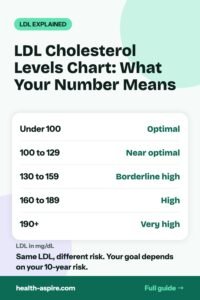
LDL cholesterol levels chart
| LDL cholesterol | mg/dL | mmol/L |
|---|---|---|
| Optimal | under 100 | under 2.6 |
| Near optimal | 100 to 129 | 2.6 to 3.3 |
| Borderline high | 130 to 159 | 3.4 to 4.1 |
| High | 160 to 189 | 4.1 to 4.9 |
| Very high | 190 or more | 4.9 or more |
These are the classic NCEP categories. Your personal goal depends on your 10-year risk of a heart attack or stroke, which you can estimate with our heart risk calculator (AHA PREVENT equations).
Your LDL goal by risk (2026 ACC/AHA guideline)
| Situation | LDL goal | Non-HDL goal |
|---|---|---|
| No heart disease, 10-year PREVENT-ASCVD risk 3% to under 10%, starting a statin | under 100 mg/dL (2.6 mmol/L) | under 130 mg/dL (3.4 mmol/L) |
| No heart disease, 10-year PREVENT-ASCVD risk 10% or higher, starting a statin | under 70 mg/dL (1.8 mmol/L) | under 100 mg/dL (2.6 mmol/L) |
| Heart disease, not at very high risk | under 70 mg/dL (1.8 mmol/L) | under 100 mg/dL (2.6 mmol/L) |
| Heart disease at very high risk | under 55 mg/dL (1.4 mmol/L) | under 85 mg/dL (2.2 mmol/L) |
What is non-HDL cholesterol?
Non-HDL cholesterol is total cholesterol minus HDL. It counts the cholesterol in every particle that can build plaque, not just LDL, and needs no formula. Its goal is simply your LDL goal plus 30 mg/dL. A non-HDL of 190 mg/dL or more counts as a risk enhancer in the 2026 guideline.
When to see a doctor after using the LDL calculator
- LDL of 190 mg/dL (4.9 mmol/L) or higher: this can be inherited (familial hypercholesterolemia), and treatment is generally recommended.
- Triglycerides of 500 mg/dL (5.7 mmol/L) or higher, which raise the risk of pancreatitis.
- LDL that stays at 160 mg/dL or more, especially with early heart disease in your family.
For a structured 90-day plan to lower LDL with food and habits, plus a one-page summary for your doctor, see the Know Your Heart Numbers Kit.
LDL calculator FAQ
Is calculated LDL accurate?
For most people, yes. The Sampson/NIH and Martin/Hopkins equations were validated against ultracentrifugation and are more accurate than Friedewald, especially when triglycerides are 150 mg/dL or more or LDL is low.
Why is my LDL different from my lab report?
Your lab may use a different equation or measure LDL directly. Small differences are normal. If your lab used Friedewald and your triglycerides are high, the Sampson/NIH result is likely closer.
Do I need to fast before a cholesterol test?
Usually not. The 2026 guideline says non-fasting samples work for most people. Fasting helps if your triglycerides have been 400 mg/dL or higher before.
What if my triglycerides are above 800 mg/dL?
No formula is reliable at that level. Ask for a direct LDL measurement and see your doctor, because very high triglycerides can inflame the pancreas.
This calculator is for education, not diagnosis, and does not replace advice from your doctor. Last reviewed: October 28, 2026. See our medical disclaimer.
Sources
- 2026 ACC/AHA Guideline on the Management of Dyslipidemia. Circulation, 2026
- Sampson M et al. A New Equation for Calculation of Low-Density Lipoprotein Cholesterol in Patients With Normolipidemia and/or Hypertriglyceridemia. JAMA Cardiology, 2020
- Friedewald WT et al. Estimation of the concentration of low-density lipoprotein cholesterol in plasma. Clin Chem, 1972