The A14 Protocol is a free health check after 40 that turns 14 evidence-based markers into one clear score and a personal report. Above all, it is fast: it takes about six minutes and needs no signup. In addition, it uses the same scoring rules doctors and researchers use, starting with the American Heart Association’s Life’s Essential 8.
You can complete one section or all three. Each section gets its own score. Then, once you finish all three, you get your full A14 score, your biggest lever for improvement and a report you can save as a PDF or bring to your doctor. For more quick checks, browse our free health calculators.
The A14 Protocol · 14 markers · about 6 minutes
Fill in one section or all three. Each gets its own score, and finishing all three gives you your full A14 score and a personal report. Nothing is stored unless you choose to email yourself the report.
Section 1 · Heart and lifestyle
Life's Essential 8 score
The American Heart Association's 8 measures of heart and brain health. Leave a measure blank or tick "I don't know" if you don't have the number.
Body size
Blood pressure
Use your latest reading, ideally the average of 2 to 3 home readings.Cholesterol
From your latest blood test (lipid panel).Blood sugar
Sleep and movement
Nicotine
Eating pattern
The 16-item MEPA screener used by the American Heart Association. Tick each statement that is true for a typical week.Section 2 · Mind and connection
Mood, worry and loneliness check
Two short screening questionnaires used by doctors (PHQ-4 and UCLA-3). Think about the last 2 weeks.
Section 3 · Physical fitness
Fitness check you can do at home
Two quick tests. Sit and rest for 5 minutes before measuring your pulse.
Your personal report ·
Your A14 Protocol report
What your results mean together
Your top priorities
Every measure, compared with the reference range
| Measure | You | Healthy reference | Points |
|---|
Points follow the American Heart Association's Life's Essential 8 (0 to 100 per measure), the PHQ-4 and UCLA-3 questionnaires, and published fitness norms. This is an educational screening, not a diagnosis. Share it with your doctor, who can interpret it with your full history. If you ever have thoughts of harming yourself, call or text 988 (US) right away.
Watch: how to use the A14 health check after 40
This short tutorial explains what the A14 Protocol is and why we call it A14. In addition, it shows what each section measures and how to read your report.
How the A14 health check after 40 works
Most online health quizzes invent their own rules. In contrast, the A14 Protocol takes every threshold from a published guideline, registry or validated questionnaire. We also list the sources below, so you can check them yourself.
The check covers three areas that matter most for health after 40. First, it scores heart and lifestyle with Life’s Essential 8. Second, it screens mind and connection with two short questionnaires. Third, it compares your physical fitness with national norms for your age and sex.
The 14 markers in this health check after 40
| Marker | Section | Healthy range | Source |
|---|---|---|---|
| Body mass index (BMI) | Heart and lifestyle | under 25 | AHA Life’s Essential 8 |
| Blood pressure | Heart and lifestyle | under 120/80 mmHg | AHA Life’s Essential 8 |
| Non-HDL cholesterol | Heart and lifestyle | under 130 mg/dL | AHA Life’s Essential 8 |
| Blood sugar | Heart and lifestyle | fasting under 100 mg/dL or HbA1c under 5.7% | AHA Life’s Essential 8 |
| Sleep | Heart and lifestyle | 7 to 9 hours a night | AHA Life’s Essential 8 |
| Physical activity | Heart and lifestyle | 150+ minutes a week (vigorous counts double) | AHA Life’s Essential 8 |
| Nicotine exposure | Heart and lifestyle | never used, smoke-free home | AHA Life’s Essential 8 |
| Diet | Heart and lifestyle | 15 to 16 of 16 on the MEPA screener | AHA Life’s Essential 8 |
| Worry and anxiety | Mind | GAD-2 score 0 to 2 | PHQ-4 (Kroenke 2009) |
| Mood | Mind | PHQ-2 score 0 to 2 | PHQ-4 (Kroenke 2009) |
| Loneliness | Mind | UCLA-3 score 3 to 5 | UCLA-3 (Hughes 2004) |
| Resting heart rate | Fitness | under 70 beats per minute | Zhang, CMAJ 2016 |
| VO2 max | Fitness | at or above the median for your age and sex | FRIEND registry 2022 |
| 30-second chair stand | Fitness | at or above the CDC cut-off for your age and sex | CDC STEADI |
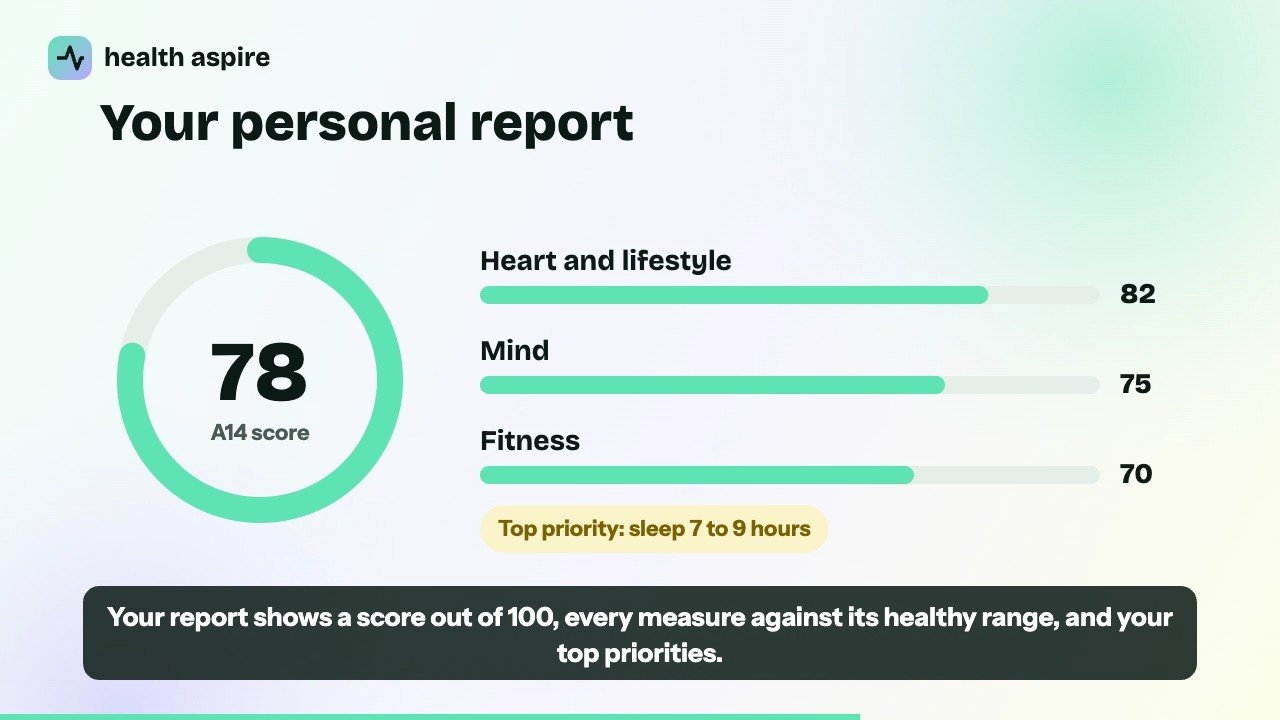
How your health check after 40 is scored
- Heart and lifestyle: each of the 8 Life’s Essential 8 measures gets 0 to 100 points from the American Heart Association’s published cut-offs, and the section score is their average. In other words, the AHA rates 80 or more as high, 50 to 79 as moderate and under 50 as low cardiovascular health.
- Mind and connection: the calculator converts the PHQ-4 total (0 to 12) and the UCLA-3 loneliness score (3 to 9) to a 0 to 100 scale. Mood and anxiety count for 75% and loneliness for 25%. In addition, a PHQ-2 or GAD-2 subscore of 3 or more counts as a positive screen.
- Physical fitness: resting heart rate earns points on bands that follow the risk gradient in a meta-analysis of 1.2 million people. Similarly, the tool places your VO2 max against the FRIEND registry percentiles for your age and sex, and it compares your 30-second chair stand with the CDC STEADI cut-offs.
- Finally, your A14 score weights heart and lifestyle at 60%, mind at 20% and fitness at 20%. If you skip a section, you get a partial score instead.
The report also reads your answers together. For example, short sleep combined with high blood sugar triggers a specific explanation, because these two measures influence each other. Likewise, a high resting pulse combined with low activity gets its own advice. To learn more, read our guide to facts about aging after 40.
Health check after 40: FAQ
Is the A14 Protocol a medical test?
No. It is an educational screening tool based on medical guidelines, so it cannot diagnose a condition. Instead, share the report with your doctor, who can interpret it with your full history and exams.
What if I don’t know my blood pressure or cholesterol?
Tick “I don’t know” and the calculator scores the measures you have, as long as you enter at least 5 of the 8. However, your report will flag the missing numbers, because blood pressure, cholesterol and blood sugar are the measures most likely to be silently off after 40.
Why is my VO2 max estimate not scored?
The Uth formula estimates VO2 max from resting heart rate, but it is only a rough guide. Therefore, the report shows it for interest only. If your watch or a lab test gives you a VO2 max, enter it and the tool will score it against the FRIEND registry norms.
How often should I repeat a health check after 40?
Every 6 months is a good rhythm, or soon after a new blood test. In fact, small changes in sleep, activity and diet usually show up in your score within a few months.
Is my data stored?
No. Your browser does all the calculations. In addition, your answers leave your device only if you choose to email yourself the report, and then only to create that email.
Sources
- American Heart Association: Life’s Essential 8 (Lloyd-Jones and colleagues, Circulation, 2022): View source
- PHQ-4 anxiety and depression screen (Kroenke and colleagues, Psychosomatics, 2009): View source
- UCLA-3 loneliness scale (Hughes and colleagues, Research on Aging, 2004): View source
- FRIEND cardiorespiratory fitness reference standards (Kaminsky and colleagues, Mayo Clinic Proceedings, 2022): View source
- Resting heart rate and mortality meta-analysis (Zhang, Shen and Qi, CMAJ, 2016): View source
- CDC STEADI 30-Second Chair Stand assessment: View source
- Heart Rate Ratio Method for estimating VO2 max (Uth and colleagues, European Journal of Applied Physiology, 2004): View source
- Age-predicted maximal heart rate (Tanaka and colleagues, Journal of the American College of Cardiology, 2001): View source
The A14 Protocol is for education, so it does not replace medical advice, diagnosis or treatment. However, if you have symptoms or a result flagged in red, contact your doctor. Also, in an emergency, call 911. If you have thoughts of harming yourself, call or text 988.