HDL Cholesterol Levels: What Your Number Really Means After 40
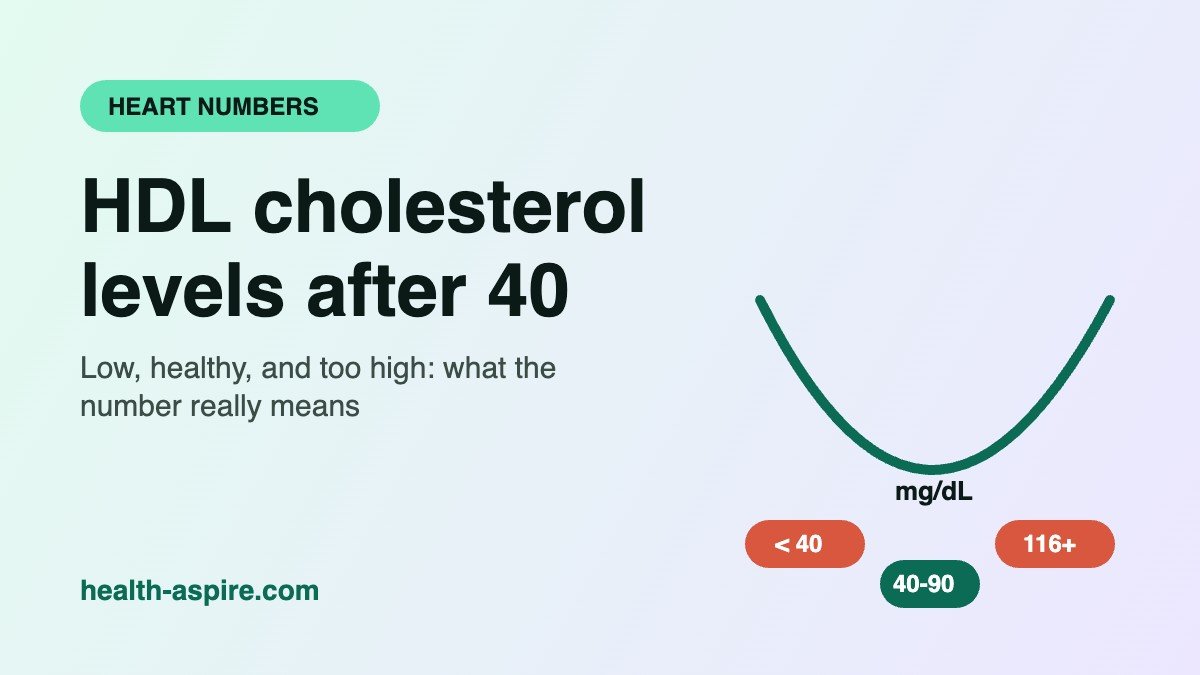
Healthy HDL cholesterol levels are at least 40 mg/dL for men and at least 50 mg/dL for women, and 60 mg/dL or higher has long been counted in your favor. That is the short answer. The longer one matters more after 40: HDL is a useful warning light when it is low, but a very high number is not a shield, and pills that push HDL up have not prevented heart attacks.
However, most guides stop at the first sentence. Below, we put the different cut-offs side by side, show how common low HDL really is in American adults today, and walk through three example readers so you can see what the same number means in different bodies.
What is HDL cholesterol?
HDL cholesterol is the cholesterol carried inside high-density lipoprotein particles. First, these particles pick up extra cholesterol from tissues, including artery walls, and bring it back to the liver. This cleanup job is why HDL earned the “good cholesterol” nickname. Still, your lab report shows how much cholesterol those particles carry, not how well they work.
That last point explains most of the confusion. For example, two people can both show an HDL of 55 mg/dL while their particles do very different amounts of cleanup. In other words, the number is a rough signal about your metabolism, not a direct measure of protection.
HDL cholesterol levels chart: every cut-off in one place
In practice, different organizations draw the lines in slightly different places. US labs usually flag HDL under 40 mg/dL as low for everyone, while sex-specific targets set women higher at 50 mg/dL. In addition, large Danish studies add a third line: above roughly 97 mg/dL in men and 116 mg/dL in women, risk starts to climb again.
| HDL (mg/dL) | mmol/L | Who uses this line | What it means in everyday terms |
|---|---|---|---|
| Under 40 | Under 1.03 | NCEP ATP III (all adults); metabolic syndrome criteria (men) | Low. Counts as a heart risk factor and often travels with high triglycerides and belly fat. |
| Under 50 (women) | Under 1.29 | Metabolic syndrome criteria; MedlinePlus | Low for a woman, even though many lab reports only flag under 40. |
| 60 and over | 1.55 and over | NCEP ATP III | Historically called protective; subtracts one risk factor in the old ATP III count. |
| About 73 (men), 93 (women) | 1.9 and 2.4 | Copenhagen cohorts, 116,508 adults | Where all-cause death rates were lowest in that study. |
| 97 to 115 (men) | 2.5 to 2.99 | Copenhagen cohorts | 36% higher death risk than the lowest-risk group. |
| 116 and over (men); 135 and over (women) | 3.0 and over; 3.5 and over | Copenhagen cohorts | About twice the risk in men (68% higher in women). Worth a conversation, not celebration. |
Which line applies to you?
So the healthy zone is a wide middle band, not “the higher the better.” For most adults over 40, an HDL somewhere between the sex-specific floor and the 80s is a comfortable place to be.
How common are low HDL cholesterol levels after 40?
Low HDL cholesterol levels are far more common in men. In the latest CDC national survey (August 2021 to August 2023), about 1 in 5 men aged 40 to 59 had HDL under 40 mg/dL, compared with 1 in 14 women. After 60, the share drops a little, but men still outnumber women more than three to one.
There is good news in the same report, too. Among all adults, the age-adjusted share with low HDL fell from 22.2% in 2007 to 2008 to 14.2% in 2021 to 2023. The change since 2017 to 2020 was not statistically significant, though.
Three example readers, three different stories
In short, an HDL number only makes sense next to the rest of your panel. These are made-up examples, run through the cut-offs above and the harmonized metabolic syndrome rules, to show how context changes the meaning.
| Example | Key numbers | What the HDL is telling us | Sensible next question for the doctor |
|---|---|---|---|
| Mark, 52 | HDL 38, triglycerides 210, waist 41 inches | Low HDL plus high triglycerides plus a large waist makes 3 of 5 metabolic syndrome criteria. | “Should we check my fasting glucose and blood pressure for metabolic syndrome?” |
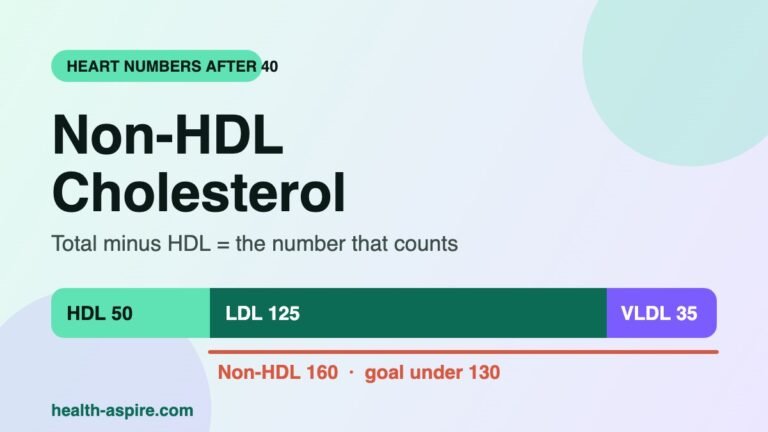
| Linda, 58 | HDL 72, total cholesterol 260, LDL 165 | A healthy HDL, but her non-HDL is 260 minus 72 = 188 mg/dL, which is borderline high. | “My HDL is good. Does my LDL still need a plan?” |
| Tom, 66 | HDL 118, three drinks most evenings | Above the 116 mg/dL line where Danish men had about twice the death risk. | “Could alcohol, thyroid or a medicine explain this, and should I cut back?” |
Notice the pattern. For Mark, low HDL is a clue to a bigger metabolic picture. In Linda’s case, a good HDL does not cancel out a high LDL. Meanwhile, Tom’s high number is a reason to ask questions, not a reason to relax.
What do low HDL cholesterol levels mean?
Most of the time, low HDL signals a cluster of habits and conditions rather than a problem with HDL itself. For instance, the usual suspects are smoking, too little movement, extra belly fat, insulin resistance or type 2 diabetes, and high triglycerides. Some genes and medicines lower HDL as well, so your doctor will look at the whole picture.
Even so, the link with heart disease is real. In a pooled analysis of 302,430 people from 68 studies, every 15 mg/dL higher HDL was tied to a 22% lower risk of coronary heart disease. Coronary events ran at 6.4 per 1,000 people per year in the lowest third of HDL versus 2.4 in the highest third.
However, association is not cause. For example, a large genetic study found that people born with gene variants that raise HDL did not have fewer heart attacks. That result, together with the drug trials below, is why doctors now treat low HDL as a marker to investigate rather than a number to chase.
Can HDL cholesterol levels be too high?
Yes. In two Copenhagen cohorts that followed more than 116,000 adults, both very low and very high HDL were linked with higher death rates, a U-shaped curve. Men with HDL of 116 mg/dL or more had about double the risk of men in the lowest-risk range. Women above 135 mg/dL had 68% higher risk.
In some cases, very high HDL comes from heavy drinking, certain gene variants, an overactive thyroid, some liver conditions or medicines. Because this was an observational study, it cannot prove that the HDL itself causes harm. Still, it is a clear reason not to treat a sky-high HDL as permission to ignore LDL, blood pressure or blood sugar.
How to raise HDL cholesterol levels the right way
The best way to raise HDL is to fix what is lowering it: stop smoking, move more, and lose belly fat if you carry extra. Admittedly, the gains in HDL itself are modest, often 2 to 5 mg/dL. Better still, the same steps lower triglycerides, blood pressure and blood sugar at the same time.
| What changed | Average HDL change | Did heart events drop? |
|---|---|---|
| Regular aerobic exercise (25 trials) | +2.5 mg/dL; about +1.4 for each extra 10 minutes per session | Not measured in these trials |
| Weight loss, once weight is stable (70 studies) | About +0.16 mg/dL per pound lost, so roughly +3 mg/dL for 20 pounds | Not measured in this review |
| Niacin added to a statin (AIM-HIGH, 3,414 patients) | Median 35 to 42 mg/dL | No. Stopped early for lack of benefit |
| Niacin plus laropiprant (HPS2-THRIVE, 25,673 patients) | +6 mg/dL versus placebo | No, and more serious diabetes problems |
How much exercise moves HDL?
Two details from the exercise review are worth knowing. First, the minimum dose that moved HDL was about 120 minutes a week. Second, longer sessions mattered more than how often or how hard people trained. As a result, a brisk 40-minute walk three times a week clears that bar.
Meanwhile, keep alcohol out of the plan. It does raise HDL, but that is not a reason to drink, and the Danish data suggest the highest HDL levels are not where you want to be anyway.
Where HDL fits in your heart risk score
In the end, HDL matters most as one input in a risk calculator. The American Heart Association’s PREVENT equations, for example, use total cholesterol and HDL together with age, blood pressure, diabetes, smoking and kidney function. Of course, a higher HDL lowers the estimate, but it does not undo high blood pressure, smoking or diabetes.
Because of this, the useful question is not “Is my HDL good?” but “What is my overall 10-year risk, and what moves it most?” For most people over 40, the bigger levers are usually LDL, blood pressure, smoking and blood sugar.
What to do next
- Put your HDL, total cholesterol and blood pressure into our free heart attack risk calculator to see how much HDL really moves your number.
- Use Before Your Check-up to list your numbers and questions for your next visit.
- Subtract HDL from your total to get your non-HDL cholesterol, the number many experts watch more closely.
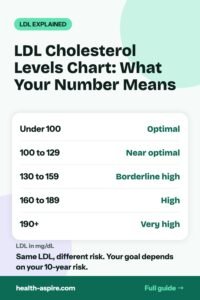
- Check where your LDL stands in our guide to LDL cholesterol levels.
- If low HDL comes with high triglycerides, read how to lower triglycerides, since the two usually improve together.
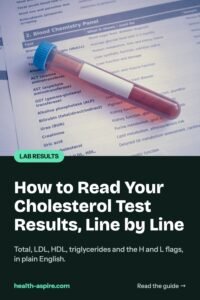
- Read the full panel line by line in cholesterol test results explained.
FAQ
Is an HDL of 35 dangerous?
An HDL of 35 mg/dL is low for both men and women. It is not an emergency. Instead, it is a signal to check triglycerides, blood sugar, waist size and blood pressure, and to look hard at smoking and activity. Your doctor will judge it alongside your LDL and overall risk.
Is HDL of 90 good or bad?
For most people, an HDL around 90 mg/dL is fine. In other words, it sits inside the healthy range for HDL cholesterol levels. In the Copenhagen studies, the lowest death rates were near 73 mg/dL for men and 93 mg/dL for women. Risk only rose clearly above about 97 mg/dL in men and 116 mg/dL in women.
Do I need to fast for an HDL test?
Usually not. HDL barely changes after a normal meal. Therefore, a nonfasting lipid panel gives a reliable HDL reading. Your doctor may still ask you to fast if your triglycerides were very high on a previous test.
Are there medicines to raise HDL?
Some drugs raise HDL, but none has been shown to prevent heart attacks by doing so. In fact, niacin raised HDL in two large trials without reducing heart events. That is why doctors focus medicines on LDL and overall risk, not on the HDL number.
Sources
- Carroll M.D., Fryar C.D., Gwira J.A., Iniguez M. Total and High-density Lipoprotein Cholesterol in Adults: United States, August 2021 to August 2023. NCHS Data Brief No. 515 (CDC, 2024)
- Madsen C.M., Varbo A., Nordestgaard B.G. Extreme high high-density lipoprotein cholesterol is paradoxically associated with high mortality in men and women: two prospective cohort studies (European Heart Journal, 2017)
- National Cholesterol Education Program. Third Report of the Expert Panel on Detection, Evaluation, and Treatment of High Blood Cholesterol in Adults (ATP III) Final Report (Circulation, 2002)
- Alberti K.G., et al. Harmonizing the Metabolic Syndrome (Circulation, 2009)
- The Emerging Risk Factors Collaboration. Major Lipids, Apolipoproteins, and Risk of Vascular Disease (JAMA, 2009)
- Voight B.F., et al. Plasma HDL cholesterol and risk of myocardial infarction: a mendelian randomisation study (The Lancet, 2012)
- AIM-HIGH Investigators. Niacin in Patients with Low HDL Cholesterol Levels Receiving Intensive Statin Therapy (New England Journal of Medicine, 2011)
- HPS2-THRIVE Collaborative Group. Effects of Extended-Release Niacin with Laropiprant in High-Risk Patients (New England Journal of Medicine, 2014)
- Kodama S., et al. Effect of Aerobic Exercise Training on Serum Levels of High-Density Lipoprotein Cholesterol (Archives of Internal Medicine, 2007)
- Dattilo A.M., Kris-Etherton P.M. Effects of weight reduction on blood lipids and lipoproteins: a meta-analysis (American Journal of Clinical Nutrition, 1992)
- Khan S.S., et al. Development and Validation of the American Heart Association’s PREVENT Equations (Circulation, 2024)
- Jacobson T.A., et al. National Lipid Association recommendations for patient-centered management of dyslipidemia: Part 1 (Journal of Clinical Lipidology, 2014)
- Nordestgaard B.G., et al. Fasting is not routinely required for determination of a lipid profile (European Heart Journal, 2016)
- MedlinePlus. HDL: The “Good” Cholesterol (National Library of Medicine)
- Cleveland Clinic. HDL Cholesterol: causes of low and high HDL
This guide is for education and is not medical advice. Talk to your doctor about your own numbers and treatment. See our medical disclaimer.
Free weekly email
A short, honest health email. Every Thursday.
The week’s most useful research for life after 40, explained in plain English, plus one step picked for what matters to you. No spam, no selling your email, unsubscribe in one click.