How Many Cups of Tea a Day Is Too Much? 486,000 People Answer
How many cups of tea a day is too much? If you keep the kettle going from breakfast to mid-afternoon, you have probably wondered whether cup number five is still doing you any good, or quietly working against you.
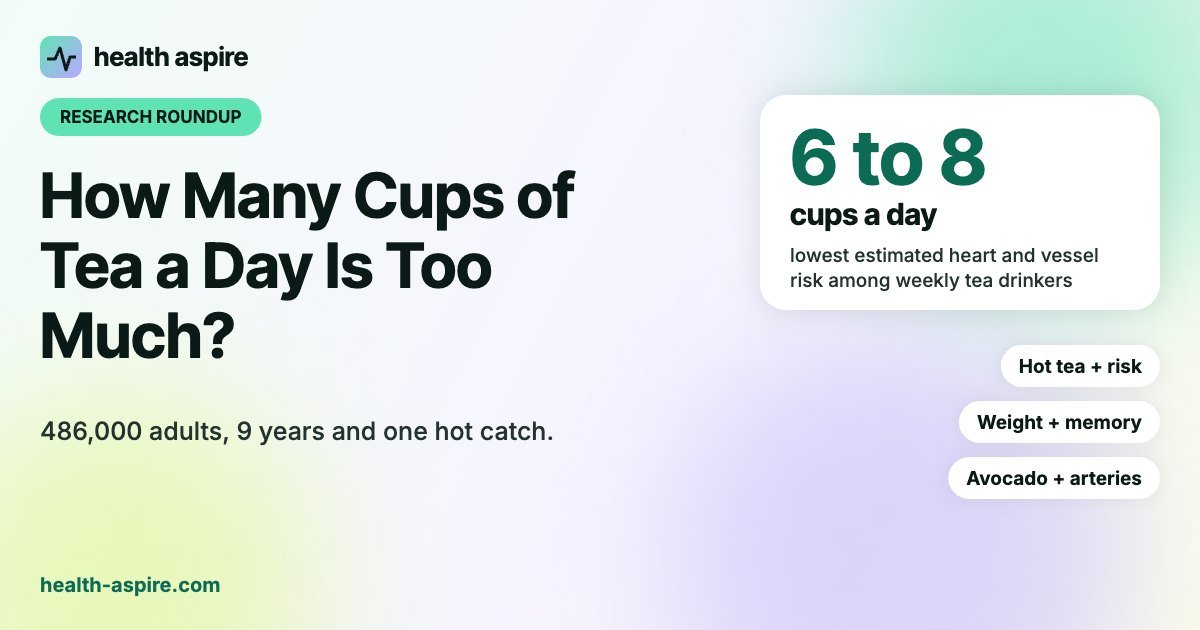
A study of 485,934 adults in China, published on October 21 in the Journal of Internal Medicine, gives one of the most detailed answers so far. Over about nine years, people who drank tea habitually had roughly 11% lower risk of heart and blood vessel disease than people who didn’t. The lowest estimated risk sat at about 6 to 8 cups a day.
There was a catch, though, and it has nothing to do with how many cups you drink. It is how hot you drink them.
What the tea study actually did
The researchers, from the Chinese Academy of Medical Sciences, Peking University and partner institutions, used data from the China Kadoorie Biobank. Participants described their tea habits in detail: how often they drank it, which type, how strong they brewed it and how hot they liked it.
Over an average follow-up of 9.05 years, 14,863 people developed vascular disease, a broad group that covers heart disease, stroke and other problems of the blood vessels. The team looked at the total and at 12 separate subtypes, using statistical models that account for other factors that shape heart risk.
This was an observational study. Nobody was told to drink tea, so it can show a link, not proof that tea itself protects your arteries. Keep that in mind for everything below.
How many cups of tea a day is too much for your heart?
In this study, the relationship between tea and vascular risk was not a straight line. Among people who drank tea at least weekly, risk was lowest at about 6 to 8 cups a day. That is a statistical sweet spot, not a target. For most healthy adults, the more practical ceiling is caffeine, not tea itself.
Here is the everyday math. Mayo Clinic lists about 48 mg of caffeine in an 8-ounce cup of brewed black tea and about 29 mg in green tea. The FDA cites 400 mg a day as an amount not generally associated with negative effects for most adults. Eight 8-ounce cups of black tea comes to roughly 384 mg, just under that line. Eight big mugs, or tea on top of two coffees, can take you well past it.
The published abstract doesn’t define the size of a “cup,” and a cup in this study may not match a 12-ounce American mug. So treat 6 to 8 as a rough guide, not a measured dose.
Caffeine sensitivity also varies a lot from person to person. If an afternoon cup costs you sleep, or you have a heart rhythm problem or take medicines that interact with caffeine, your right number is lower. Decaf black tea has about 2 mg per cup.
Is black tea or green tea better for your heart?
In this study, black tea showed more consistent links with lower vascular risk than green tea. That doesn’t make green tea bad. It means the black tea results held up more steadily across the different heart and blood vessel outcomes the team tracked. Tea brewed at moderate strength was also linked to lower risk.
Why black tea might come out ahead isn’t known. Black and green tea come from the same plant, but processing changes the mix of natural compounds in the leaf. The researchers did not test whether those compounds explain the difference, so be skeptical of anyone using this study to sell a tea extract or supplement.
Is it bad to drink very hot tea?
Very hot tea appears to carry its own risk. People who said they drank their tea “burning hot” had about a 16% higher risk of vascular disease in this study. Separately, the World Health Organization’s cancer agency, IARC, classifies drinking beverages hotter than 65°C (149°F) as probably carcinogenic to humans, mainly for cancer of the esophagus.
The heart finding is new and needs confirming in other groups. The cancer link has been studied for longer. Either way, the fix costs nothing: let a fresh cup sit for a few minutes, or add a splash of cold milk or water, before you drink. A simple rule of thumb: if you have to sip carefully so you don’t burn your lip, it is still too hot.
Tea worked best alongside two other habits
The strongest result in the paper wasn’t about tea alone. People who drank tea habitually, did not smoke and were highly physically active had the lowest risk of all, about 45% lower than the comparison group in the analysis.
The researchers also found that tea and exercise overlapped rather than simply adding up. In plain terms, tea is a pleasant extra, not a substitute for moving your body or quitting cigarettes.
What we don’t know yet
- This is an observational study. Regular tea drinkers may differ from non-drinkers in diet, income or daily routine in ways statistics can’t fully remove.
- Everyone in it lived in China, where tea types, brewing styles and diets differ from those in the US.
- Tea habits were self-reported, and “burning hot” was a self-described category, not a measured temperature.
- The abstract doesn’t say anything about sugar, honey or milk, which matter for many American tea drinkers.
What to do with this
- If you already enjoy tea, nothing here suggests cutting back from a few cups a day. Unsweetened is the best way to drink it.
- Count your total caffeine from all sources, including coffee, soda and energy drinks, and aim to stay under about 400 mg a day unless your doctor has advised less.
- Let it cool. A few minutes between pouring and drinking takes away the one clear downside in this study.
- Don’t force yourself up to 8 cups to chase a number. The links were seen across habitual tea drinkers, not only at the top.
- Spend most of your effort on the bigger levers: not smoking and staying active. Our guide to cardio for heart health after 40 shows how much movement is enough.
- Check where you stand with our free heart attack risk calculator and the blood pressure checker, then explore the heart health hub.
Also new this week
Higher weight over the years was linked to faster memory decline
University of Georgia researchers used 24 years of data from the US Health and Retirement Study on 8,252 adults who started out with healthy thinking skills, average age 59. A higher cumulative average BMI was linked to faster decline in memory, executive function and overall cognition. The link was strongest about eight years later, and stronger in people 65 and older than in those aged 50 to 65. It shows an association, not cause. For a quick check that goes beyond BMI, try our waist-to-height ratio calculator, and see brain health after 40.
Source: Xu Q. et al., Journal of Neurology, 2026. Read the study
An avocado and a cup of mango a day improved artery function
In an 8-week randomized feeding trial at Illinois Institute of Technology, 82 adults with prediabetes (average age 45) ate one avocado and one cup of mango daily, or energy-matched low-fat, low-fiber foods. Flow-mediated dilation, a measure of how well arteries widen, rose by about one percentage point on the fruit diet and fell on the control diet. Diastolic blood pressure improved too, but only in men, and weight did not change significantly. The trial was funded by the National Mango Board and the Hass Avocado Board, which had no role in the design or findings, according to the researchers.
Source: Preiss C. et al., Journal of the American Heart Association, 2026. Read the study
Potassium may deserve as much attention as cutting salt
A peer-reviewed report in The American Journal of Clinical Nutrition, led by Naomi Fukagawa, argues that blood pressure advice should give potassium equal weight with sodium. Potassium helps the kidneys clear sodium and supports normal blood vessel function, yet intake remains far below optimal in many countries. Beans, potatoes, leafy greens, bananas and yogurt are easy sources. If you have kidney disease or take certain blood pressure medicines, ask your doctor before using potassium salt substitutes or supplements. Our blood pressure chart by age explains which numbers to aim for.
Source: Fukagawa N.K. et al., The American Journal of Clinical Nutrition, 2026. Read the study
Sources
- Ye Z. et al., Journal of Internal Medicine, 2026. Read the study · ScienceDaily summary
- Mayo Clinic. Caffeine content for coffee, tea, soda and more
- US Food and Drug Administration. Spilling the beans: how much caffeine is too much?
- IARC Monographs, 2016, via PAHO. IARC evaluates drinking coffee, maté and very hot beverages
- Xu Q. et al., Journal of Neurology, 2026. Read the study · ScienceDaily summary
- Preiss C. et al., Journal of the American Heart Association, 2026. Read the study · ScienceDaily summary
- Fukagawa N.K. et al., The American Journal of Clinical Nutrition, 2026. Read the study · ScienceDaily summary
This article explains new research for education. It is not medical advice. Talk to your doctor before making changes to your treatment. See our medical disclaimer.
Free weekly email
A short, honest health email. Every Thursday.
The week’s most useful research for life after 40, explained in plain English, plus one step picked for what matters to you. No spam, no selling your email, unsubscribe in one click.