MCH Blood Test: What Low or High MCH Means, With the Math
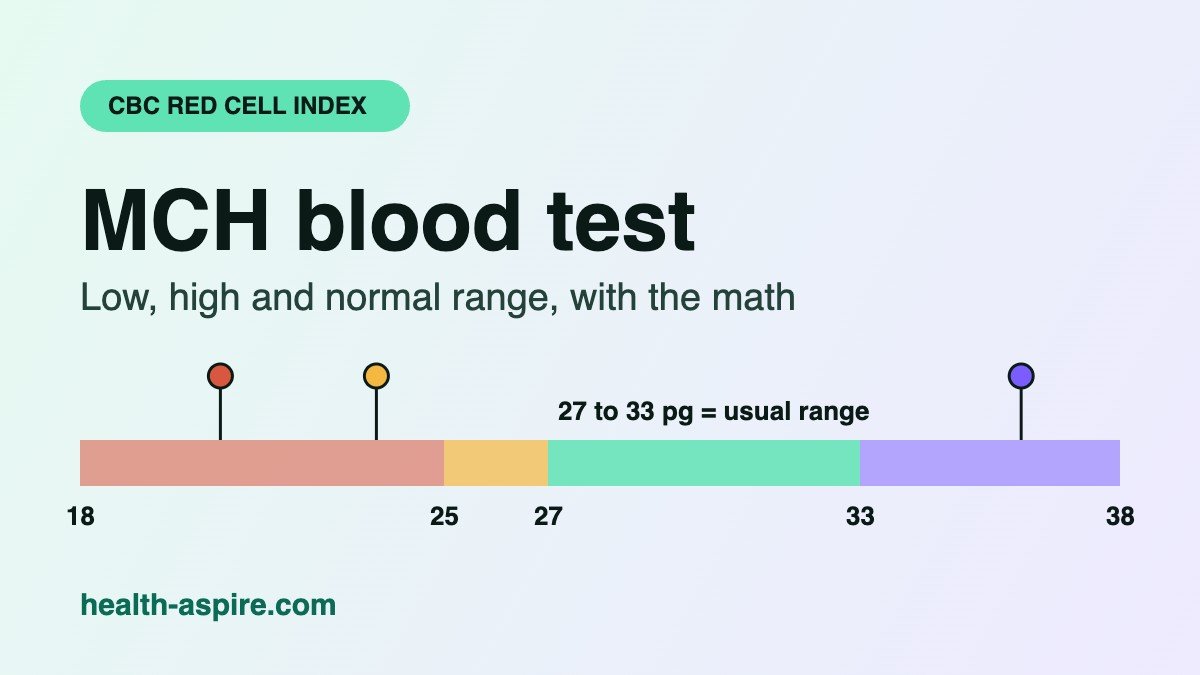
An MCH blood test tells you the average weight of hemoglobin inside one red blood cell. MedlinePlus puts the normal adult range at 27 to 33 picograms (pg) per cell for men and 26 to 33 pg for women. Low MCH most often means iron-poor cells or an inherited trait such as thalassemia. High MCH, by contrast, usually travels with large cells from low B12 or folate, alcohol or certain medicines.
Here is what most guides leave out. You can work out your own MCH from two other lines on the same report, and labs do not agree on where “low” starts. So this guide gives you the formula, the cut-offs from five sources side by side, three worked example reports, and a step-by-step guide to the questions worth asking.
What is an MCH blood test?
An MCH blood test is not ordered on its own. Instead, MCH (mean corpuscular hemoglobin) is one of the red cell indices printed on every CBC blood test. No fasting is needed. Also, the analyzer does not measure it directly; it calculates it from your hemoglobin and red blood cell count.
Because it is calculated, MCH tends to move with MCV, the size of your cells. After all, bigger cells hold more hemoglobin, so they weigh more. In fact, the Clinical Methods textbook notes that in small-cell anemias, MCH “closely parallels” MCV. Meanwhile, MCHC adjusts for size, which is why it can stay normal while MCH drops.
MCH blood test normal range: five sources side by side
Most sources place normal MCH between about 27 and 33 pg per cell, yet the exact edges differ. MedlinePlus lists 26 to 33 pg for women and 27 to 33 pg for men. Cleveland Clinic uses 27 to 33 pg for all adults. Screening programs, on the other hand, use their own cut-offs to decide who needs more testing.
| Source | MCH cut-off (pg per cell) | Same value in fmol per cell (SI) | What the source uses it for |
|---|---|---|---|
| MedlinePlus (NIH) | Women 26 to 33; men 27 to 33 | 1.61 to 2.05; 1.68 to 2.05 | Normal adult range |
| Cleveland Clinic | 27 to 33 | 1.68 to 2.05 | Normal adult range, both sexes |
| Clinical Methods (NIH Bookshelf) | 29 ± 2 (average ± 1 SD) | 1.80 ± 0.12 | Textbook normal value |
| England’s sickle cell and thalassemia screening handbook | Under 27 | Under 1.68 | Prompts testing for thalassemia carrier status |
| Same handbook | Under 25 | Under 1.55 | Flags possible alpha-zero thalassemia or iron deficiency |
| Korom et al., 2020 (1,733 adults) | 28 or less | 1.74 or less | Flagged 88.2% of people with iron deficiency anemia, vs 52.9% for small cell size |
Notice the gap. For example, a result of 26.5 pg is “normal” for a woman by MedlinePlus, yet it would prompt carrier testing in a screening program. For this reason, your own lab’s range, and the rest of the CBC, matter more than any single number.
How to check your MCH blood test result yourself
To calculate MCH, multiply your hemoglobin (g/dL) by 10, then divide by your red blood cell count (millions per microliter). For instance, a hemoglobin of 14.0 and an RBC count of 4.80 give 29.2 pg. Similarly, the analyzer does the same math, so a quick check shows which number is driving an odd result.
The Mentzer index: a second clue for low MCH
In addition, a second number helps when MCH is low. The Mentzer index is your MCV divided by your RBC count. Under 13 leans toward thalassemia trait; over 13 leans toward iron deficiency. Still, it is only a hint. A 2015 meta-analysis of 70 studies and 21,331 patients found it caught 82% of thalassemia cases with 85% specificity, so it cannot replace a real test.
Three worked MCH blood test examples
Next, here are three made-up readers run through both formulas, so you can see how the numbers fit together.
| Example reader (made up) | Hemoglobin | RBC count | MCV | MCH = Hb × 10 ÷ RBC | Mentzer = MCV ÷ RBC | What it suggests asking about |
|---|---|---|---|---|---|---|
| Denise, 54 | 10.2 g/dL | 4.30 M/µL | 74 fL | 23.7 pg (low) | 17.2 (over 13) | Iron pattern: low MCH, fairly low RBC count. Ask about ferritin and where iron might be going. |
| Arjun, 47 | 12.6 g/dL | 6.10 M/µL | 64 fL | 20.7 pg (low) | 10.5 (under 13) | Very small cells but a high RBC count: the thalassemia trait pattern. Ask whether hemoglobin testing (HPLC or electrophoresis) makes sense. |
| Frank, 66 | 12.8 g/dL | 3.55 M/µL | 106 fL | 36.1 pg (high) | Not used for high MCH | Large, heavy cells. Ask about B12, folate, alcohol, thyroid and current medicines. |
What does a low MCH blood test result mean?
A low MCH means each red cell carries less hemoglobin than usual. MedlinePlus calls this hypochromic anemia and links it most often to low iron. Thalassemia trait is the other common cause. In addition, long-term inflammation from kidney disease, infection or cancer can also play a part, according to Cleveland Clinic.
Low MCH is also an early warning. In the Korom study of 1,733 adults with iron deficiency anemia, a low MCH flagged far more people than small cell size did. In other words, MCH can dip before MCV does. After 40, the usual reasons are heavy periods before menopause and slow bleeding from the gut, which is why doctors look for a source.
Low MCH: iron or thalassemia trait?
In most cases, ferritin settles it. The American Gastroenterological Association’s 2020 guideline recommends a ferritin cut-off of 45 ng/mL to diagnose iron deficiency in people with anemia. It also notes that inflammation can push ferritin up, so CRP or transferrin saturation may be added. If ferritin is normal and MCH stays low, thalassemia trait becomes more likely.
What does a high MCH blood test result mean?
A high MCH usually means your red cells are larger than normal, so each one holds more hemoglobin. MedlinePlus links it to low folate or vitamin B12, chemotherapy and liver disease. Likewise, alcohol, an underactive thyroid and some medicines are other common causes. On its own, a mildly high MCH often causes no symptoms.
Which cause is most likely depends on who you are. A 2009 review in American Family Physician pooled studies of macrocytosis, the large-cell state behind most high MCH results. The share of cases from each cause shifted a lot by group:
| Cause of large red cells | Finnish outpatients | Finnish and US patients | Finnish adults over 75 |
|---|---|---|---|
| Alcohol | 65% | 36% | 15% |
| Low B12 and/or folate | 9% | 21% | 28% |
| Medications | 3% | 11% | 2% |
| Underactive thyroid | 1% | 5% | 12% |
The pattern is useful after 60. In the oldest group, low B12 or folate and thyroid problems together explained 40% of cases, while alcohol mattered less. So if you are older and your MCH has crept up, a B12 level and a TSH are reasonable first questions. If you drink most days, our guide on whether 2 drinks a day is too much is worth a read.
A step-by-step guide to your MCH blood test
To begin, use this guide to turn your result into a few clear questions. It follows the sources above rather than making a diagnosis. First, though, check your hemoglobin: if it is normal and MCH is only slightly outside the range, the finding is often minor.
| If your report shows | Then ask your doctor about | Based on |
|---|---|---|
| MCH under 27 pg plus low hemoglobin | Ferritin; under 45 ng/mL points to iron deficiency, then where the iron is going | AGA guideline, 2020 |
| MCH under 27 pg, normal ferritin, Mentzer under 13 | Hemoglobin testing for thalassemia trait, especially before family planning | UK screening handbook; Hoffmann et al., 2015 |
| MCH under 25 pg with normal ferritin | Whether alpha thalassemia testing is needed | UK screening handbook |
| MCH over 33 pg with MCV over 100 fL | A blood smear, reticulocyte count and B12 level; then folate, liver tests and TSH if still unclear | Kaferle and Strzoda, 2009 |
| Odd MCH but normal hemoglobin, MCV and RDW | Repeating the CBC to see whether it is a trend | Clinical Methods (indices are calculated, so errors carry over) |
What to do next
- Put your hemoglobin and RBC count into the formula above and check that your MCH matches the report.
- Read MCH next to MCV, MCHC, RDW and your hematocrit, then find the matching row in the step-by-step guide.
- Write down your questions with our free Before Your Check-up planner so nothing gets missed at the visit.
- Keep our lab markers cheat sheet handy for the rest of your blood work, including the liver function test.
MCH blood test FAQ
Is an MCH of 26 bad?
Not necessarily. For example, for a woman, 26 pg is still inside the MedlinePlus range, although screening programs would call it low. So look at the rest of the CBC. If hemoglobin and MCV are normal, it may simply be worth a ferritin check or a repeat test later.
What is the difference between MCH and MCHC?
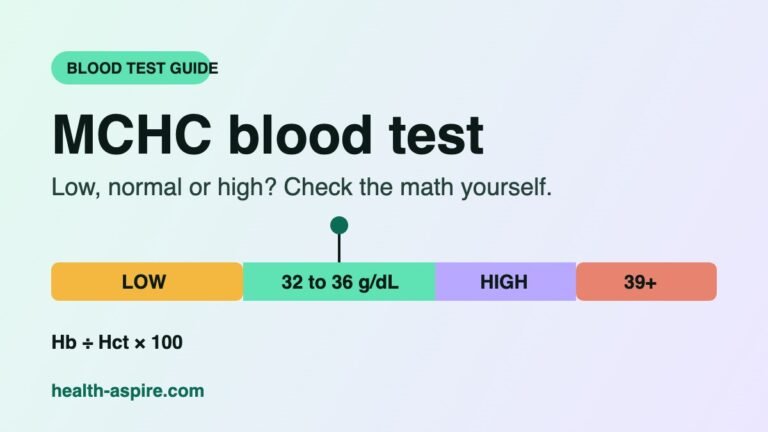
Put simply, MCH is the weight of hemoglobin in an average cell. MCHC, by contrast, is how concentrated that hemoglobin is for the cell’s size. As a result, small cells often have a low MCH but a normal MCHC. Our MCHC guide explains that number in detail.
Can dehydration change MCH?
Usually very little. That is because dehydration concentrates hemoglobin and the red cell count together, and MCH is a ratio of the two. However, lab problems that affect either number, such as very fatty or clotted samples, can distort it, because the index is calculated rather than measured.
Should I take iron for a low MCH?
Only once the cause is clear. Of course, iron helps when iron deficiency is the problem. However, it does nothing for thalassemia trait, and extra iron is not harmless. Ask for ferritin first, and let your doctor guide the dose and the search for any blood loss.
For the rest of your CBC and metabolic markers, browse our metabolism and blood test guides.
Sources
- Hoffmann J.J.M.L., Urrechaga E., Aguirre U. Discriminant indices for distinguishing thalassemia and iron deficiency in patients with microcytic anemia: a meta-analysis (Clinical Chemistry and Laboratory Medicine, 2015)
- Ko C.W., Siddique S.M., Patel A., et al. AGA Clinical Practice Guidelines on the Gastrointestinal Evaluation of Iron Deficiency Anemia (Gastroenterology, 2020)
- Korom V.G., Lueff S., Liposits A., et al. Is iron deficiency anemia always microcytic? (Polish Archives of Internal Medicine, 2020)
- Kaferle J., Strzoda C.E. Evaluation of Macrocytosis (American Family Physician, 2009)
- UK Sickle Cell and Thalassaemia Screening Programme. Interpretation and reporting of antenatal screening results (GOV.UK)
- Sarma P.R. Red Cell Indices. In: Walker H.K., Hall W.D., Hurst J.W., eds. Clinical Methods, 3rd edition (Butterworths, 1990)
- MedlinePlus. RBC indices (US National Library of Medicine)
- Cleveland Clinic. MCH Blood Test
This guide is for education and is not medical advice. Talk to your doctor about your own numbers and treatment. See our medical disclaimer.
Free cheat sheet + weekly email
A short, honest health email. Every Thursday.
The week’s most useful research for life after 40, explained in plain English, plus one step picked for what matters to you. No spam, no selling your email, unsubscribe in one click.
Free gift: our 1-page Lab Markers Cheat Sheet (PDF), the 15 numbers on routine blood and urine tests that matter most after 40. It arrives as soon as you confirm your email.