TSH Levels by Age: What Your Thyroid Number Means After 40
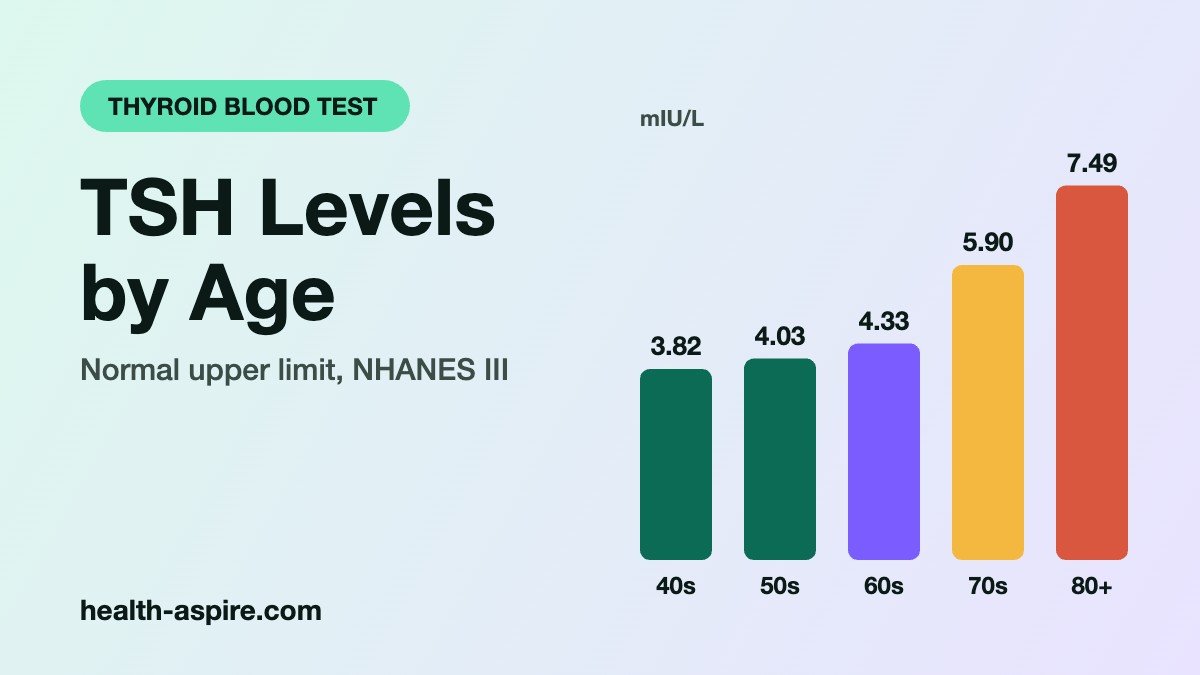
Most labs call TSH levels normal between about 0.4 and 4.5 mIU/L, and MedlinePlus lists 0.4 to 4.8. That single range hides a large age effect. In a national US survey of healthy adults with no thyroid antibodies, the top of the normal spread rose from 3.56 mIU/L in people in their 20s to 7.49 mIU/L in people 80 and older.
This matters after 40, because a slightly high TSH is one of the most common flags on a routine blood panel. So below you will find the full chart by decade, how heart risk changes across TSH bands, what large trials found about treating mild cases, and three example readers worked through the guidelines.
What are normal TSH levels?
Normal TSH levels for most adults sit between roughly 0.4 and 4.5 mIU/L, though every lab sets its own range. TSH, or thyroid-stimulating hormone, comes from the pituitary gland. It acts like a thermostat signal: when thyroid hormone runs low, TSH climbs, and when thyroid hormone runs high, TSH drops.
As a result, a high TSH points to an underactive thyroid and a low TSH points to an overactive one. For this reason, doctors usually read it next to free T4, the main hormone the thyroid releases. In the large NHANES III survey, the typical (geometric mean) TSH in healthy Americans was 1.40 mIU/L.
Also, a quick note on units. Your report may say mIU/L, µIU/mL or mU/L. In other words, they are the same number, so a 3.2 in one unit is a 3.2 in the others. Unlike cholesterol or glucose, TSH has no mmol/L version.
TSH levels by age: the full NHANES chart
TSH levels rise steadily with age in healthy people. In the NHANES III reference group, the median went from 1.26 mIU/L at ages 20 to 29 to 1.90 at 80 and older. Meanwhile the upper limit (the 97.5th percentile) roughly doubled, from 3.56 to 7.49 mIU/L. Yet most lab reports still print one adult range for everyone.
For that reason, the table below puts both groups from the same analysis side by side. The last column shows what one common result, a TSH of 5.0, would mean at each age.
| Age | Median TSH (mIU/L) | Upper limit, no thyroid antibodies | Upper limit, all disease-free adults | A TSH of 5.0 at this age is… |
|---|---|---|---|---|
| 20 to 29 | 1.26 | 3.56 | 4.02 | Above both limits |
| 30 to 39 | 1.29 | 3.69 | 4.57 | Above both limits |
| 40 to 49 | 1.40 | 3.82 | 5.75 | Above the antibody-free limit only |
| 50 to 59 | 1.50 | 4.03 | 5.73 | Above the antibody-free limit only |
| 60 to 69 | 1.67 | 4.33 | 7.48 | Above the antibody-free limit only |
| 70 to 79 | 1.76 | 5.90 | 9.80 | Within range for age |
| 80 and older | 1.90 | 7.49 | 9.36 | Within range for age |
Why TSH levels rise with age
So why two upper limits? The wider group includes people who carry thyroid antibodies, an early sign of Hashimoto thyroiditis, and their TSH tends to drift up. Consequently, the antibody-free limit is the cleaner picture of a healthy thyroid. Even so, the authors found that 70% of older people with a TSH above 4.5 were inside the normal range for their age.
In addition, MedlinePlus notes that some labs now use an upper limit of about 7 for older adults. If yours does not, the chart above helps you ask a better question: is my number high for my age, or only high for a 30-year-old?
What do high TSH levels mean?
A high TSH usually means the thyroid is underactive and the pituitary is pushing harder to make up for it. If free T4 is still normal, doctors call it subclinical (mild) hypothyroidism. By contrast, if free T4 is low, it is overt hypothyroidism. In NHANES III, 4.3% of Americans had the mild form and 0.3% had the overt form.
However, one high reading is not a verdict. TSH runs about 50% higher at night and in the early morning, so two tests on different days can differ by up to half the reference range. Likewise, recovery from a recent illness, some medicines and biotin supplements can also push a result off course. That is why a mild elevation is usually rechecked, often with free T4 and thyroid antibodies, before anyone talks about treatment.
Antibodies also change the outlook. For example, in a Cleveland Clinic Journal of Medicine review, people with mild hypothyroidism and thyroid peroxidase (TPO) antibodies progressed to overt disease at about 4.3% a year, compared with 2.6% a year without them. Even so, many mild cases with TSH between 4 and 6 settle back to normal on their own.
Do high TSH levels affect your heart?
It can, but mostly at the higher end. In a pooled analysis of 11 cohorts with 55,287 adults, people with a TSH of 4.5 to 6.9 mIU/L had the same rate of heart events as people with normal thyroid function. Then risk edged up at 7.0 to 9.9 and was clearly higher at 10 to 19.9 mIU/L.
Put another way, TSH levels of 5 or 6 did not move heart risk at all in these data. A TSH between 10 and 19.9 came with nearly double the rate of heart events (hazard ratio 1.89) and a higher rate of heart deaths (hazard ratio 1.58). On the other hand, total deaths from all causes were not higher.
TSH bands, heart signals and what guidelines say
| TSH (mIU/L) | Heart signal in large studies | What guidelines say | In everyday terms |
|---|---|---|---|
| Under 0.1 | Higher risk of atrial fibrillation and heart death (Collet 2012) | Needs a full workup for the cause | A real signal; do not ignore it |
| 0.1 to 0.4 | Atrial fibrillation risk 68% higher across all low-TSH results | Repeat the test and look for a cause | Often a medicine dose or a nodule |
| 0.4 to 4.5 | Reference group | Normal for most adults | Nothing to do |
| 4.5 to 6.9 | No rise in heart events (hazard ratio 1.00) | BMJ 2019: strong advice against thyroid hormone for most adults | Often drifts back down; recheck |
| 7.0 to 9.9 | Events not clearly higher (1.17); heart deaths higher (1.42) | Case by case: symptoms, antibodies, age | A gray zone worth a real talk |
| 10 to 19.9 | Heart events 1.89 times higher; heart deaths 1.58 | AACE/ATA 2012: consider treatment | The band where treatment is usually discussed |
| 20 and above | Not included in the heart analysis | Outside the BMJ advice; usually treated | Clearly underactive |
Should a mildly high TSH be treated after 65?
For most people with a TSH under 10 and no strong symptoms, the best trials say thyroid pills do not make them feel better. The largest one, the TRUST trial, randomized 737 adults aged 65 and older (average age 74) with a persistent TSH of 4.60 to 19.99 mIU/L to levothyroxine or a placebo for one year.
At first glance, the pills worked on the lab number. TSH fell to 3.63 mIU/L with levothyroxine versus 5.48 with placebo. However, symptom scores did not budge at all. On a 100-point hypothyroid symptom scale, the difference between groups was 0.0 points, and on the tiredness scale it was 0.4 points. A change of 9 points would have counted as noticeable.
After that, a BMJ guideline panel pooled 21 trials with 2,192 people and issued a strong recommendation against thyroid hormone for most adults with subclinical hypothyroidism. Notably, it does not apply to women trying to become pregnant or to anyone with a TSH above 20, and it may not fit people with severe symptoms or adults 30 and younger.
What do low TSH levels mean?
A low TSH usually means there is too much thyroid hormone in the body, from an overactive thyroid or from taking more thyroid medicine than you need. In NHANES III, 0.7% of Americans had the mild (subclinical) form of hyperthyroidism and 0.5% had the overt form, so it is far less common than a high TSH.
Common causes include Graves disease, thyroid nodules that make hormone on their own, a recent load of iodine from CT contrast, and medicines such as steroids or opioids. Still, the heart is the main concern. In a pooled analysis of 52,674 adults, a low TSH came with a 68% higher risk of atrial fibrillation and a 29% higher risk of heart death, and both risks were greater when TSH fell below 0.10 mIU/L.
If you take levothyroxine and your TSH comes back low, the dose may simply be too high. Even then, do not change it yourself; bring the result to the doctor who prescribes it.
Three example readers, worked through the numbers
These are made-up examples, not real patients. Each one runs a realistic result through the age chart, the heart data and the guidelines above.
Example 1: Linda, 58, TSH 5.2, normal free T4, no symptoms. First, her number is above the antibody-free limit for her decade (4.03) but below the wider limit (5.73). In the heart data, 4.5 to 6.9 showed no extra risk, and the BMJ panel advises against treatment. Because of that, a sensible next step is a repeat TSH with free T4 in a few months, plus a question about TPO antibodies.
Example 2: Robert, 76, TSH 7.1 on two tests, feels tired. First, his age limit is 5.90, so he is modestly high for his age. He looks almost exactly like a TRUST participant, and that trial found no change in tiredness with treatment. Therefore, his visit should also cover other common causes of fatigue, such as poor sleep, anemia and medicine side effects, with periodic TSH checks.
Example 3: Maria, 49, TSH 11.8 on a repeat test, LDL creeping up. To begin with, she is above every age limit and sits in the 10 to 19.9 band, where heart events ran 1.89 times higher. The AACE/ATA guideline says treatment should be considered at this level. Next, she can ask about antibodies, about starting treatment and about rechecking her LDL once her thyroid is back in range.
How to get an accurate TSH blood test
An accurate TSH blood test mostly comes down to timing and honesty about what you take. Because TSH swings through the day, testing at a similar time, ideally in the morning, makes results easier to compare. Also, tell your clinician about every pill and supplement, especially biotin.
- Biotin: this common hair and nail supplement can distort thyroid results. MedlinePlus advises talking to your provider before the test if you take it.
- Recent illness: TSH can rise temporarily while you recover from a serious illness, so a reading taken then may not reflect your usual level.
- Medicines: steroids, dopamine, lithium, amiodarone and some others can shift TSH. Never stop a medicine on your own to “clean up” a test.
- Dose changes: if you take levothyroxine, a recheck is usually done at least 6 weeks after any dose change, because TSH needs that long to settle.
What to do next
- Find your age row in the chart above and compare your result with both upper limits, not only the range printed on your report.
- Use our free Before Your Check-up planner to list your TSH, free T4 and any symptoms, so the visit covers the questions that matter to you.
- If your TSH is high, look at your cholesterol too, since thyroid function and LDL are linked. Our free LDL calculator and our guide to reading your cholesterol test results can help.
- If you feel tired, ask whether a CBC blood test was done too, because anemia is a common cause of fatigue.
- TSH is often ordered alongside a comprehensive metabolic panel. Our lab markers cheat sheet and the metabolism hub put the other common numbers in one place.
TSH levels FAQ
Is a TSH of 4.5 normal at 60?
For many people, yes. In NHANES III, the upper limit for healthy antibody-free adults aged 60 to 69 was 4.33, while the wider disease-free group reached 7.48. Thus a 4.5 is borderline at that age. It is worth a repeat test and, if it stays there, a check for thyroid antibodies.
What TSH level is dangerous?
In short, no single number flips a switch. Still, a TSH of 10 or higher is where heart risk clearly rose in pooled studies and where guidelines say treatment should be considered. Meanwhile, at the other end, a TSH below 0.1 carried the highest risk of atrial fibrillation. Both deserve prompt follow-up.
Should TSH be checked every year after 50?
Advice differs. On one hand, the American Thyroid Association has suggested screening from age 35 every 5 years, while on the other hand, other groups recommend testing only when there are symptoms or risk factors. Ask your doctor whether your own history, such as a family history of thyroid disease, makes regular checks worthwhile.
Sources
- Surks M.I., Hollowell J.G. Age-specific distribution of serum thyrotropin and antithyroid antibodies in the US population (Journal of Clinical Endocrinology and Metabolism, 2007)
- Hollowell J.G., Staehling N.W., Flanders W.D., et al. Serum TSH, T4, and thyroid antibodies in the United States population, NHANES III (Journal of Clinical Endocrinology and Metabolism, 2002)
- Rodondi N., den Elzen W.P., Bauer D.C., et al. Subclinical hypothyroidism and the risk of coronary heart disease and mortality (JAMA, 2010)
- Collet T.H., Gussekloo J., Bauer D.C., et al. Subclinical hyperthyroidism and the risk of coronary heart disease and mortality (Archives of Internal Medicine, 2012)
- Stott D.J., Rodondi N., Kearney P.M., et al. Thyroid hormone therapy for older adults with subclinical hypothyroidism, the TRUST trial (New England Journal of Medicine, 2017)
- Bekkering G.E., Agoritsas T., Lytvyn L., et al. Thyroid hormones treatment for subclinical hypothyroidism: a clinical practice guideline (BMJ, 2019)
- Garber J.R., Cobin R.H., Gharib H., et al. Clinical practice guidelines for hypothyroidism in adults, AACE and ATA (Endocrine Practice, 2012)
- Azim S., Nasr C. Subclinical hypothyroidism: when to treat (Cleveland Clinic Journal of Medicine, 2019)
- MedlinePlus. TSH test (U.S. National Library of Medicine)
- Therapeutics Initiative, University of British Columbia. Thyroid testing for primary hypothyroidism (Therapeutics Letter 154, 2025)
This guide is for education and is not medical advice. Talk to your doctor about your own numbers and treatment. See our medical disclaimer.
Free cheat sheet + weekly email
A short, honest health email. Every Thursday.
The week’s most useful research for life after 40, explained in plain English, plus one step picked for what matters to you. No spam, no selling your email, unsubscribe in one click.
Free gift: our 1-page Lab Markers Cheat Sheet (PDF), the 15 numbers on routine blood and urine tests that matter most after 40. It arrives as soon as you confirm your email.