Ferritin Levels: Normal Range vs Guideline Cut-offs
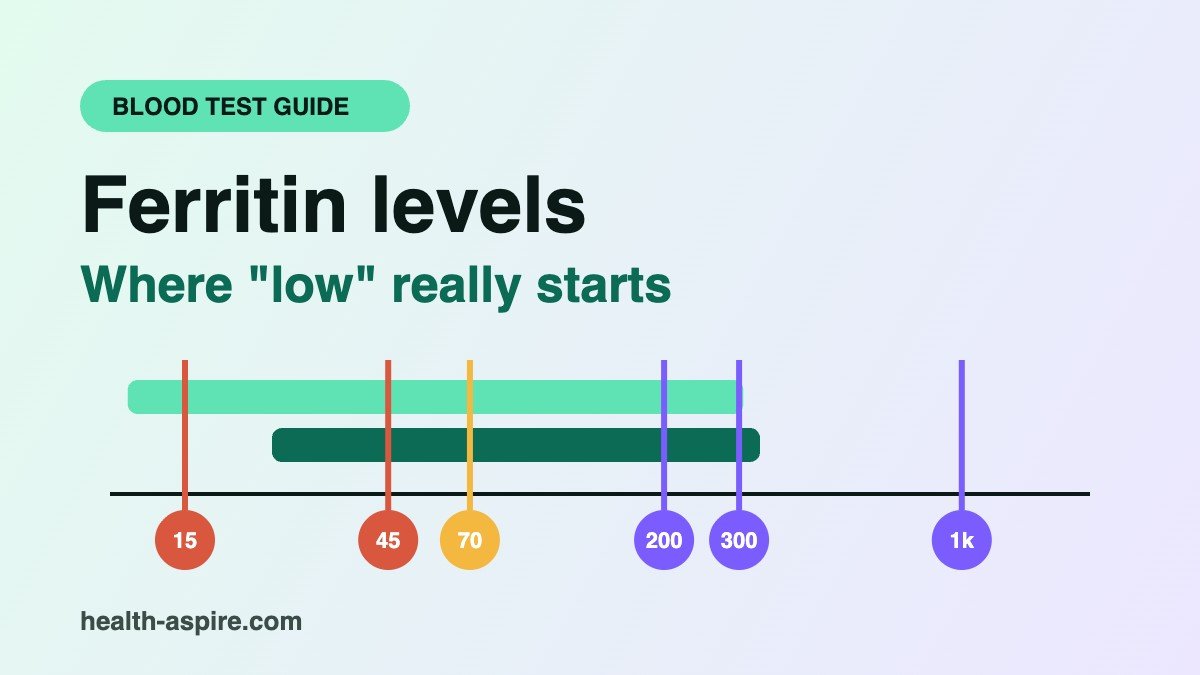
Most labs call ferritin levels normal anywhere from about 11 to 307 ng/mL for women and 24 to 336 ng/mL for men, the ranges Mayo Clinic lists. Yet the guideline doctors use to diagnose low iron draws the line far higher: the American Gastroenterological Association (AGA) says a ferritin under 45 ng/mL means iron deficiency. On the high side, a result above 200 to 300 ng/mL is a reason to look further, not a diagnosis.
That gap matters after 40. A 52-year-old woman with a ferritin of 22 sees no red flag on her report, even though by the AGA cut-off her iron stores are empty. Meanwhile, a man with a ferritin of 480 may fear iron overload when a fatty liver is the likelier cause. So below we put every cut-off on one scale, run four example readers through the guidelines, and list the questions worth taking to your doctor.
Ferritin levels on one scale: lab ranges vs guideline cut-offs
Lab reference ranges describe what the lab usually sees in people it considers healthy, so they differ from lab to lab. Guideline cut-offs, by contrast, mark where iron deficiency or overload actually begins. Therefore, the chart puts both on the same scale. Look at the low end: the green bars start well below the line where guidelines say iron runs out.
Ferritin levels cut-offs in numbers
Here are the same lines as numbers, with the European unit and the reason each group drew its line where it did. In the US, results come in ng/mL, which is exactly the same number as µg/L. However, a few labs use pmol/L; the CDC conversion is ng/mL × 2.247.
| Ferritin (ng/mL, same as µg/L) | pmol/L | What it signals | Who says so |
|---|---|---|---|
| Under 15 | Under 34 | Iron deficiency in healthy adults | WHO 2020; CDC |
| Under 25 | Under 56 | Point where red cell production starts to suffer in non-pregnant women | Mei et al., NHANES, 2021 |
| Under 30, with transferrin saturation under 20% | Under 67 | Iron deficiency when there is no inflammation | Jimenez et al., 2015 review |
| Under 45 | Under 101 | Iron deficiency (strong recommendation) | AGA 2020 |
| Under 70 | Under 157 | Possible iron deficiency in adults with infection or inflammation | WHO 2020 |
| Under 100 | Under 225 | Iron deficiency in inflammatory bowel disease or heart failure | Jimenez et al., 2015 review |
| Over 150 (menstruating women); over 200 (men, other women) | Over 337; over 449 | Possible iron overload risk in healthy adults, needs a workup | WHO 2020 |
| Over 200 (premenopausal women); over 300 (men, postmenopausal women) | Over 449; over 674 | Elevated: check transferrin saturation next | ACG 2019 |
| Over 500 | Over 1,124 | Iron overload risk in people who are unwell | WHO 2020 |
| Over 1,000 | Over 2,247 | In hemochromatosis, higher risk of advanced liver scarring | ACG 2019 |
In other words, “low” starts anywhere from 15 to 45 ng/mL for a healthy adult, depending on the source. Still, the choice is not academic. According to a Columbia University summary of the Mei study, moving the line from 15 to 25 raises the share of premenopausal US women counted as iron deficient from about 17% to about 30%.
What is ferritin, and what do ferritin levels measure?
Ferritin is the protein that stores iron inside your cells, and a little of it leaks into your blood. As a result, your blood ferritin level works as a rough gauge of your iron reserves. In short, low means the tank is running dry. High can mean extra iron, but more often it means inflammation, liver strain or a metabolic problem is pushing the number up.
For low iron, no other single test is as useful. In fact, the World Health Organization’s 2020 guideline recommends ferritin as the test for iron deficiency in otherwise healthy people. The catch is that ferritin climbs during infection and inflammation. That is why WHO uses a higher line, 70 ng/mL, for adults who are unwell, and why it says ferritin should never be used alone to judge iron overload.
What is a normal ferritin level after 40?
For most adults over 40, a ferritin between about 45 and 200 ng/mL for women, or 45 and 300 ng/mL for men, sits clear of the guideline flags on both sides. That window is our reading of where the AGA and ACG lines fall, not an official “optimal” range. Below 45, the AGA calls it iron deficiency.
Why menopause and age change the meaning
Menopause changes the picture for women. First, once periods stop, the monthly iron loss stops too. Accordingly, the ACG guideline uses the same upper limit, 300 ng/mL, for postmenopausal women as for men. Second, it also changes what a low result means. A review in Gastroenterology & Hepatology names gut conditions, taken together, as the main cause of iron deficiency anemia in men and postmenopausal women.
For that reason, the AGA strongly recommends an upper endoscopy plus a colonoscopy for men and postmenopausal women with iron deficiency anemia, even without symptoms. If celiac disease is suspected, it suggests a blood test first. And if both scopes come back clear, it recommends a noninvasive test for H. pylori, the stomach bacterium.
Four example readers, checked against the guidelines
To be clear, these four people are made up, but the numbers and rules are real. Each result also includes transferrin saturation (TSAT), the share of your blood’s iron carrier that is loaded with iron. Usually it is printed on the same iron panel, and it is the best tie-breaker when ferritin is hard to read.
| Example | Ferritin | TSAT | Lab flag? | What the guidelines say | Question for the doctor |
|---|---|---|---|---|---|
| Linda, 52, postmenopausal, tired, normal hemoglobin | 22 | 15% | No (inside 11 to 307) | Under Mei’s 25 and the AGA’s 45: iron deficiency without anemia | “What is causing my iron loss, and does my gut need checking?” |
| Mark, 58, rheumatoid arthritis flare | 62 | 14% | No | Above 45, but under WHO’s 70 for inflammation, and TSAT under 20%: low iron still likely | “Could inflammation be hiding low iron?” |
| Dave, 47, waist 42 inches, slightly raised ALT, 2 to 3 drinks a day | 480 | 31% | High | Above the ACG’s 300 for men, but TSAT under 45%, so the ACG trigger for gene testing is not met; other causes come first | “Is this my liver or my weight rather than iron overload?” |
| Karen, 61 | 640 | 58% | High | Ferritin above 300 plus TSAT of 45% or more: the ACG says do HFE gene testing. Under 1,000, the risk of advanced liver scarring is lower | “Should I have HFE gene testing?” |
What the examples teach
Linda is the reader most guides fail, because her report looks fine. Dave, on the other hand, is the most common high-ferritin story. A 2023 international consensus led by Luca Valenti found raised ferritin in 5.9% to 19% of apparently healthy people, depending on ethnicity. In particular, when it travels with insulin resistance, the authors call it metabolic hyperferritinemia. Typically, TSAT stays normal, and a persistently high TSAT rules that label out.
What do low ferritin levels mean?
Low ferritin levels mean your iron stores are running down, usually from blood loss, low intake or poor absorption. Ferritin often falls before hemoglobin does, so a normal CBC blood test does not rule out low iron. Then the next questions are always why it is low and whether you need treatment.
Later, as the shortage drags on, the red cells themselves change. They get smaller, which shows up as a low MCV, and more uneven in size, which raises the RDW. Still, the cause matters more than the number. For example, before menopause, heavy periods are a frequent culprit. After 40, and especially in men, slow bleeding in the gut has to be ruled out, which is exactly why the AGA guideline exists.
What do high ferritin levels mean?
High ferritin levels most often reflect inflammation, liver fat, alcohol or insulin resistance rather than true iron overload. Fortunately, transferrin saturation settles it. Below 45%, hemochromatosis is unlikely. However, a TSAT of 45% or higher together with raised ferritin is the ACG’s signal to order HFE gene testing for hereditary hemochromatosis.
Even so, the ACG guideline lists fatty liver disease, alcohol-related liver disease, hepatitis C and cancer as other causes of high ferritin. So a high result usually leads to a liver function test, a look at alcohol intake and a check on insulin sensitivity. If hemochromatosis is confirmed, treatment is simple and old-fashioned: regular blood removal until ferritin reaches 50 to 100 ng/mL, then a maintenance level near 50.
What to do next
- Find your number on the chart and the cut-off table above, and check whether your transferrin saturation was tested too.
- If your ferritin is under 45 ng/mL, ask what is causing it before you reach for iron pills.
- If it is high, ask for transferrin saturation and liver tests, and measure your waist with our waist-to-height ratio calculator, since metabolic causes are common.
- Write your questions down with Before Your Check-up, our free visit planner.
- See how ferritin fits with your other results in our lab markers cheat sheet.
Ferritin levels FAQ
Is a ferritin level of 20 normal?
Many lab ranges say yes, since they start as low as 11 to 15 ng/mL for women. However, the AGA guideline defines iron deficiency as a ferritin under 45 ng/mL, and the NHANES analysis by Mei and colleagues puts the physiologic line for women at 25. So, overall, 20 deserves a conversation.
What ferritin level is dangerously high?
Put simply, there is no single number. WHO flags overload risk above 500 ng/mL in people who are unwell. In confirmed hemochromatosis, the ACG notes that a ferritin over 1,000 ng/mL means a higher risk of advanced liver scarring, so a liver biopsy is suggested for staging.
Can ferritin be normal if I am low in iron?
Yes. Inflammation lifts ferritin, and as a result it can mask an empty tank. That is why WHO uses 70 ng/mL as the line for adults with infection or inflammation, and why a transferrin saturation under 20% is a useful second clue.
Do ferritin levels change after menopause?
The rules do. Without monthly blood loss, the ACG guideline treats postmenopausal women like men, with 300 ng/mL as the upper limit. In addition, a low ferritin after menopause points more toward a gut cause, which the AGA wants investigated.
Sources
- World Health Organization. WHO guideline on use of ferritin concentrations to assess iron status in individuals and populations (WHO, 2020)
- Ko C.W., Siddique S.M., Patel A., et al. AGA Clinical Practice Guidelines on the Gastrointestinal Evaluation of Iron Deficiency Anemia (Gastroenterology, 2020)
- Kowdley K.V., Brown K.E., Ahn J., Sundaram V. ACG Clinical Guideline: Hereditary Hemochromatosis (American Journal of Gastroenterology, 2019)
- Mei Z., Addo O.Y., Jefferds M.E., et al. Physiologically based serum ferritin thresholds for iron deficiency in children and non-pregnant women: a US NHANES serial cross-sectional study (Lancet Haematology, 2021)
- Valenti L., Corradini E., Adams L.A., et al. Consensus Statement on the definition and classification of metabolic hyperferritinaemia (Nature Reviews Endocrinology, 2023)
- Jimenez K., Kulnigg-Dabsch S., Gasche C. Management of Iron Deficiency Anemia (Gastroenterology & Hepatology, 2015)
- Centers for Disease Control and Prevention. National Report on Biochemical Indicators of Diet and Nutrition: Iron indicators (CDC, 2026)
- Columbia University Irving Medical Center. Are we underestimating the prevalence of iron deficiency?
- Mayo Clinic. Ferritin test
- Cleveland Clinic. Ferritin Test
This guide is for education and is not medical advice. Talk to your doctor about your own numbers and treatment. See our medical disclaimer.
Free cheat sheet + weekly email
A short, honest health email. Every Thursday.
The week’s most useful research for life after 40, explained in plain English, plus one step picked for what matters to you. No spam, no selling your email, unsubscribe in one click.
Free gift: our 1-page Lab Markers Cheat Sheet (PDF), the 15 numbers on routine blood and urine tests that matter most after 40. It arrives as soon as you confirm your email.