PSA Levels by Age Chart: How to Read Your Result
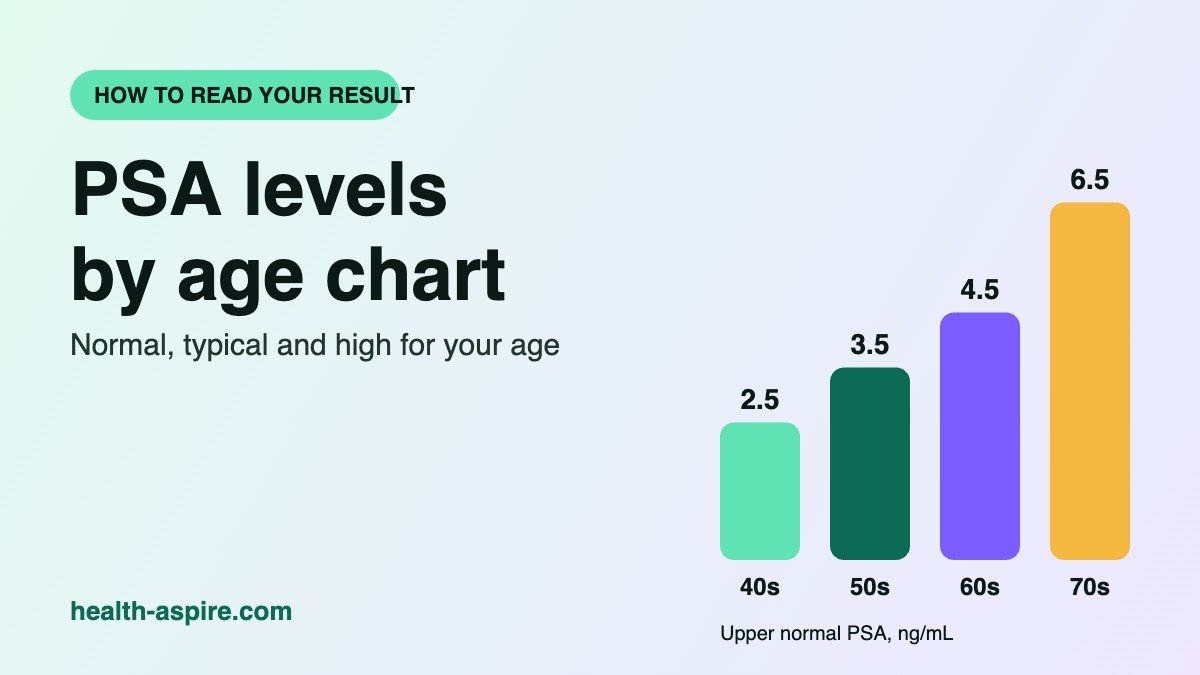
A PSA levels by age chart shows the upper limit doctors long treated as normal: about 2.5 ng/mL in your 40s, 3.5 in your 50s, 4.5 in your 60s and 6.5 in your 70s. Those limits come from a 1993 Mayo Clinic study of healthy men. However, a number under the line is not a guarantee, and a number over it is not a diagnosis.
My father died of a heart attack at 45, so he never reached the age when men start getting PSA results. While researching this guide, I noticed that most charts stop at “normal” and say nothing about what a low number means. Yet that is half the story. In a large Swedish study, men whose PSA was 1 ng/mL or lower at age 60 had about a 0.2% risk of dying of prostate cancer by 85. So below you will find a fuller chart, the guideline steps that come next, and three worked examples.
PSA levels by age chart: normal, typical and high for your age
On the classic PSA levels by age chart, the upper normal limit is 2.5 ng/mL for men 40 to 49, 3.5 for 50 to 59, 4.5 for 60 to 69 and 6.5 for 70 to 79. However, most men sit far below those limits. In midlife, the typical PSA is under 1 ng/mL, and the top 10% starts around 1.6 to 2.4.
| Age | Upper “normal” (Mayo, 95th percentile) | Typical PSA (median, unscreened men) | High for your age (top 10% or top quarter) | What current guidelines say |
|---|---|---|---|---|
| 40 to 49 | 0 to 2.5 ng/mL | 0.68 (ages 45 to 49) | 1.6 or higher (ages 45 to 49) | AUA: offer a baseline PSA at 45 to 50, or from 40 to 45 if you are Black, carry a risk gene or have a strong family history |
| 50 to 59 | 0 to 3.5 ng/mL | 0.85 (ages 51 to 55) | 2.4 or higher (ages 51 to 55) | AUA: screen every 2 to 4 years from 50 to 69. USPSTF: an individual decision from 55 |
| 60 to 69 | 0 to 4.5 ng/mL | About 1.0 (age 60) | Over 2.0 (age 60, top quarter) | USPSTF: individual decision up to 69. AUA: the interval can be personalized from your PSA and risk |
| 70 to 79 | 0 to 6.5 ng/mL | Not measured | Not measured | USPSTF: no routine screening from 70. AUA: may stop or space out tests after 75 if PSA is under 3 |
The middle columns are the ones a typical PSA levels by age chart leaves out. For example, a 47-year-old with a PSA of 2.0 is under the 2.5 “normal” line, yet he is in the top 10% for his age. In the Malmö study, that top tenth at ages 45 to 49 accounted for 44% of later prostate cancer deaths. Meanwhile, a 60-year-old at 0.8 is below the median, the group with a 0.2% risk of dying from prostate cancer by 85.
PSA also rises slowly with age because the prostate grows. In the Mayo study, a healthy 60-year-old’s PSA went up about 3.2% a year, or roughly 0.04 ng/mL. So a slow drift is expected, while a sudden jump deserves a repeat test.
Why a normal PSA does not mean zero risk
Because prostate cancer can be found at almost any PSA level. In the Prostate Cancer Prevention Trial, 2,950 men aged 62 to 91 whose PSA had never gone above 4.0 had a biopsy anyway. Cancer turned up in 15.2% of them, and the share climbed steadily as PSA rose.
Keep two things in mind, though. First, these were older men biopsied on purpose, so many of the cancers were small and slow. Second, the USPSTF estimates that 20% to 50% of cancers found by screening are overdiagnosed, meaning they would never have caused harm. That is why guidelines no longer lean on one cut-off. Instead, they weigh your age, your trend and your other risks.
How we chose the numbers in this guide
Every figure here had to pass three tests:
- It comes from a guideline body (USPSTF, AUA/SUO, National Cancer Institute) or a peer-reviewed study in a major journal.
- We read the original study or guideline, not a summary of it.
- The people studied resemble our readers: men aged 40 and older.
We left out the race-specific ranges some sites print, because we could not trace them to a current guideline. Instead, we show what the AUA guideline actually does for Black men, which is to offer screening earlier, from age 40 to 45. Also, no company paid to be mentioned, and nothing on this page is for sale.
How to read a PSA levels by age chart in 5 steps
Read a PSA result in context, never alone. Check the units, think about what could have pushed it up, check your medicines, compare it with your age and your last result, and then repeat a new high reading before anything else. In fact, the AUA guideline asks doctors to take that last step.
- Check the number and units. PSA is reported in ng/mL (some labs write µg/L, which is the same thing). The lab flag usually uses 4.0 as the line, which does not change with age.
- Ask what happened in the last 2 days. According to the National Cancer Institute, ejaculation and hard exercise such as cycling can raise PSA for a short time, so it advises avoiding them for 2 days before the test. A prostate infection, inflammation or a recent biopsy can keep it high for a month or two. An enlarged prostate (BPH) raises it too.
- Check your medicines. Finasteride and dutasteride, used for an enlarged prostate, lower PSA. Older studies suggested doubling the result for men on these drugs, but the AUA notes the effect varies from man to man. So make sure whoever reads your result knows you take one.
- Compare with your age and your history. Use the PSA levels by age chart above, then look at your previous result. Still, the AUA says a rising PSA (PSA velocity) should not, on its own, trigger a scan or biopsy.
- Repeat a new high result first. The AUA guideline says to repeat a newly raised PSA before ordering other markers, an MRI or a biopsy. If it stays high, next steps may include a percent free PSA test, a validated risk calculator or an MRI. For example, in men with PSA between 4 and 10, a free PSA cut-off of 25% or lower caught 95% of cancers while avoiding 20% of unneeded biopsies.
PSA levels by age chart: three worked examples
The same number can mean different things at different ages. These three profiles are made up (examples, not real patients). We ran each one through the PSA levels by age chart and the AUA and USPSTF guidance above, so you can follow the reasoning rather than just read a verdict.
Example 1: Marcus, 46, Black, first PSA 0.6 ng/mL. Because he is Black, the AUA says screening should be offered from 40 to 45, so a first test now is on time. Moreover, 0.6 sits just under the Malmö median for ages 45 to 49 (0.68), where the 15-year risk of the cancer spreading was 0.09%. A fair question for his doctor: can my next test wait 2 to 4 years?
Example 2: Dave, 57, PSA 3.1 ng/mL, rode 40 miles the day before. On the classic chart, 3.1 is under the 3.5 limit for his 50s. However, it is well above the top-10% line for ages 51 to 55 (2.4), and the long ride may have nudged it up. So the AUA path is a repeat test after 2 days without cycling or ejaculation. Then, if it stays near 3, he can talk with his doctor about free PSA, a risk calculator or an MRI.
Example 3: Frank, 76, takes finasteride, PSA 1.4 ng/mL. The drug lowers PSA, so his true level may be closer to 2.8 by the old doubling rule, although the AUA says the effect varies. Even so, the AUA says testing may stop or be spaced out after 75 when PSA is under 3, and the USPSTF advises against routine screening from 70. Therefore, his conversation is mostly about his overall health and whether more tests would help him at all.
The most trusted places to check PSA levels by age
Start with sources that have nothing to sell and show their evidence. For PSA, that means the National Cancer Institute, the USPSTF, the AUA guideline and MedlinePlus. Each is run by a government agency or a medical society, cites its research, and explains both the benefits and the harms of testing.
- National Cancer Institute: PSA test fact sheet. Best for what raises or lowers PSA and for honest false-positive numbers: about 6% to 7% of men get a false-positive result in any given screening round.
- USPSTF: prostate cancer screening. Best for the trade-off in plain numbers. For every 1,000 men aged 55 to 69 screened for about 13 years, about 1.3 avoid death from prostate cancer and about 3 avoid cancer that spreads. The 2018 advice is still current while an update is in progress.
- AUA/SUO Early Detection of Prostate Cancer guideline (2023, amended 2026). Best for when to start, how often to repeat, and what to do after a high result. It is written for doctors, so read it with yours.
- MedlinePlus: PSA test. Best for a plain-English explanation of the test and how to prepare for it.
Red flags in PSA charts and websites
Be wary of any page that treats a single PSA number as a yes or no answer about cancer. Also be wary of pages that sell something to bring your PSA down, since a product that changes the number can make your results harder to read. Watch for these signs:
- It shows a PSA levels by age chart but calls every PSA under 4.0 “safe.” The trial data above shows otherwise.
- It sells a supplement, tea or “prostate formula” to lower PSA.
- It tells you to act on one high result without a repeat test.
- It uses PSA velocity alone to say you need a biopsy.
- It has no named author, no date and no sources.
Where Health Aspire fits
We are a small, free, ad-free site for adults over 40, and our editor is not a doctor. So we do not diagnose, and we do not tell you whether to be screened. Our job is to help you walk into your appointment with your numbers in order and good questions ready. For that, our free Before Your Check-up planner and our lab markers cheat sheet are the two tools that fit best.
What to do next
- Write down every PSA result you have with its date, and note any finasteride or dutasteride use.
- Use our free Before Your Check-up planner to bring your PSA history, family history and questions to your next visit.
- Run the free health check after 40 to see what else is worth reviewing at your age.
- Make sense of the rest of your blood work with our lab markers cheat sheet and our CBC blood test guide.
- For the bigger picture, read our health assessment after 40.
FAQ
What PSA level is normal for a 60-year-old?
On the classic chart, up to 4.5 ng/mL counts as normal for men 60 to 69. However, the typical 60-year-old is at about 1 ng/mL or lower. In the Malmö study, men at or below 1 ng/mL at 60 had a 0.5% risk of the cancer spreading and a 0.2% risk of dying from it by 85.
Is a PSA of 4 bad?
Not by itself. A PSA of 4.0 is the traditional line many labs flag, and the National Cancer Institute notes some doctors use a higher cut-off for older men. Also, only about 25% of men who have a biopsy because of a raised PSA turn out to have cancer. The usual first step is a repeat test.
At what age should men stop PSA testing?
It depends on your health more than your birthday. The USPSTF recommends against routine screening from age 70. The AUA says that after 75, men with a PSA under 3 may stop or test less often, decided together with their doctor.
Sources
- Oesterling J.E., Jacobsen S.J., Chute C.G., et al. Serum prostate-specific antigen in a community-based population of healthy men: establishment of age-specific reference ranges (JAMA, 1993)
- Thompson I.M., Pauler D.K., Goodman P.J., et al. Prevalence of prostate cancer among men with a prostate-specific antigen level of 4.0 ng per milliliter or less (New England Journal of Medicine, 2004)
- Vickers A.J., Cronin A.M., Björk T., et al. Prostate specific antigen concentration at age 60 and death or metastasis from prostate cancer: case-control study (BMJ, 2010)
- Vickers A.J., Ulmert D., Sjoberg D.D., et al. Strategy for detection of prostate cancer based on relation between prostate specific antigen at age 40-55 and long term risk of metastasis (BMJ, 2013)
- Catalona W.J., Partin A.W., Slawin K.M., et al. Use of the percentage of free prostate-specific antigen to enhance differentiation of prostate cancer from benign prostatic disease (JAMA, 1998)
- US Preventive Services Task Force. Screening for prostate cancer: recommendation statement (JAMA, 2018)
- Wei J.T., Barocas D., Carlsson S., et al. Early detection of prostate cancer: AUA/SUO guideline part I, prostate cancer screening (Journal of Urology, 2023; amended 2026)
- National Cancer Institute. Prostate-Specific Antigen (PSA) Test fact sheet
- MedlinePlus. Prostate-Specific Antigen (PSA) Test (US National Library of Medicine)
This guide is for education and is not medical advice. Talk to your doctor about your own numbers and treatment. See our medical disclaimer.
Free weekly email
A short, honest health email. Every Thursday.
The week’s most useful research for life after 40, explained in plain English, plus one step picked for what matters to you. No spam, no selling your email, unsubscribe in one click.