MCHC Blood Test: Low, High and Normal Range, With the Math
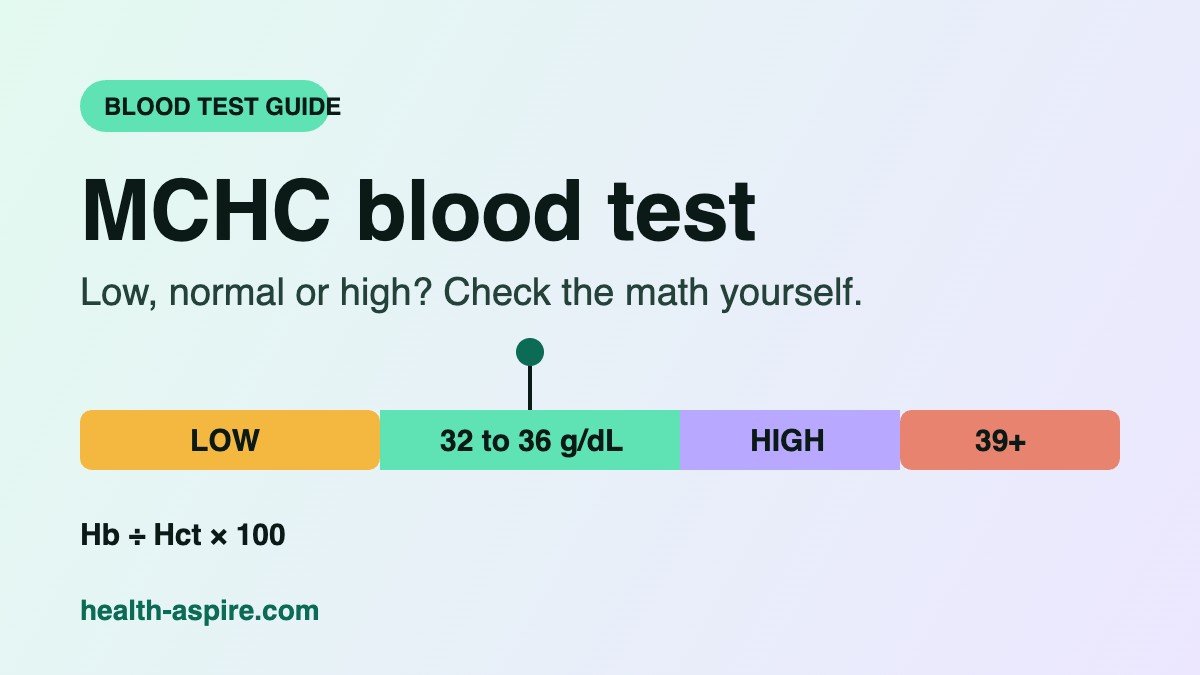
An MCHC blood test tells you how concentrated the hemoglobin is inside your red blood cells. Most labs, for example, call 32 to 36 g/dL normal. A low result usually points to pale, iron-poor cells. A high result, on the other hand, is often a lab artifact, and less often a sign of hereditary spherocytosis.
Admittedly, MCHC is the line on a CBC that almost nobody explains well. I wrote this after noticing that most guides list the same causes but skip the part that would help you most: you can check the math yourself from two other numbers on the same report. So, below you will find the formula, three worked example reports, and a decoder that reads MCHC together with MCV and RDW.
What is an MCHC blood test?
An MCHC blood test is not a separate test. Rather, it is one of the red cell indices printed on every CBC blood test, and no fasting is needed. MCHC stands for mean corpuscular hemoglobin concentration: the average amount of hemoglobin packed into a given volume of red cells, reported in grams per deciliter.
Think of each red cell as a water balloon filled with red dye. MCV is the size of the balloon. Then, MCH is how much dye is inside. MCHC, in turn, is how strong the color is. As a result, small balloons can still be fully colored, and that is exactly why MCHC and MCV do not always move together.
How to check your own MCHC: the formula and three examples
You can calculate MCHC by dividing your hemoglobin (g/dL) by your hematocrit (%) and multiplying by 100. For example, a hemoglobin of 14.0 and a hematocrit of 42% give 33.3 g/dL. The analyzer does the same math. Because of this, a quick check helps you see which number is really driving an odd result.
Three worked MCHC blood test examples
A second route gives the same answer: MCH divided by MCV, times 100. For instance, an MCH of 29 pg and an MCV of 87 fL give 33.3 g/dL, which matches the textbook average of 34 ± 2 g/dL in Clinical Methods. Next, here are three made-up example readers run through the formula.
| Example reader (made up) | Hemoglobin | Hematocrit | MCHC = Hb ÷ Hct × 100 | Other clues on the CBC | What it suggests asking about |
|---|---|---|---|---|---|
| Linda, 52 | 11.2 g/dL | 36.0% | 31.1 g/dL (low) | MCV 76 fL, RDW 16.5% | Pale, small, uneven cells: the classic iron pattern. Ask about ferritin and iron studies. |
| Rosa, 64 | 13.4 g/dL | 40.2% | 33.3 g/dL (normal) | MCV 78 fL, RDW 15.8% | Normal MCHC does not rule out early iron deficiency or thalassemia trait. Ask what explains the small cells. |
| Mark, 58 | 15.1 g/dL | 41.0% | 36.8 g/dL (high) | Lab note: sample lipemic; triglycerides over 2,000 mg/dL | Very fatty blood can inflate hemoglobin readings. Ask whether the lab can correct or repeat the sample. |
Why a normal MCHC blood test can miss iron deficiency
Notice the point Rosa makes. Her cells are small, and yet MCHC sits in the middle of the range. According to Clinical Methods, MCHC measured on electronic counters is mostly normal in microcytic anemias. Therefore, a normal MCHC is reassuring only when MCV and RDW look normal too.
MCHC blood test normal range, in every unit you might see
The usual MCHC range is 32 to 36 g/dL, according to MedlinePlus. However, labs abroad often print the same value in g/L (320 to 360), and some European labs use mmol/L. Still, always compare with the range on your own report, since each lab sets its own limits.
| MCHC in g/dL (US) | Same value in g/L | Same value in mmol/L | Plain-English meaning |
|---|---|---|---|
| Under 32 | Under 320 | Under 19.9 | Low: cells are paler than usual (hypochromic) |
| 32 to 36 | 320 to 360 | 19.9 to 22.3 | Usual range |
| 36 to 39 | 360 to 390 | 22.3 to 24.2 | High: check for a lab artifact first, then dense cells such as spherocytes |
| Over 39 | Over 390 | Over 24.2 | Almost always an artifact; ask for a repeat or corrected result |
What does a low MCHC blood test result mean?
A low MCHC, under 32 g/dL, means your red cells carry less hemoglobin than usual for their size, so they look pale under the microscope. Most often, this reflects low iron. Besides that, thalassemia trait is the other common cause. Doctors confirm the reason with other tests rather than MCHC alone.
Low MCHC and iron: what the data show
First, MedlinePlus links low hemoglobin content per cell (hypochromia) mainly to low iron, and links small cells to low iron, thalassemia or, rarely, lead poisoning. Meanwhile, a 2020 study from Hungary looked at 1,733 adults with iron deficiency anemia. Overall, it found that a low MCH flagged far more of them than small cell size did.
In other words, hemoglobin content tends to drop before cell size does. However, MCHC is the slowest of the three hemoglobin-and-size numbers to react, so it often stays normal in mild cases. That is why a low MCHC deserves a look, while a normal one never closes the question if MCH, MCV or RDW are off. Also, our RDW guide explains why uneven cell size is often the earliest clue.
Why is my MCHC high?
By contrast, a high MCHC, above 36 g/dL, is unusual, because red cells cannot hold much more hemoglobin than they normally do. Clinical Methods puts it bluntly: there are no hyperchromic anemias. So when MCHC reads high, the first suspect is the sample or the measurement, not your blood.
A 2025 review by the French-speaking Cellular Haematology Group (GFHC) lists the usual culprits. The most common ones are worth knowing, because your lab report may hint at them:
- Fatty (lipemic) blood: very high triglycerides, typically above about 2,000 mg/dL, cloud the sample and inflate the hemoglobin reading. If that applies to you, see our guide on how to lower triglycerides.
- Cold agglutinins: antibodies make cells clump in a cool tube, so the cell count comes out too low. Warming the sample to body temperature for 30 minutes and rerunning it usually fixes the result.
- Hemolysis in the tube: cells broken during a hard draw or rough handling release hemoglobin into the plasma.
- Very high bilirubin, low sodium or severe dehydration: each can distort the readings that MCHC is calculated from.
When a high MCHC blood test result is real
That said, real high values do exist, though they are less common. Hereditary spherocytosis, an inherited condition that makes red cells round and dense, affects about 1 in 2,000 to 1 in 5,000 people, according to British hematology guidelines. Moreover, mild cases can come with normal hemoglobin, so a raised MCHC is sometimes the first hint. Similarly, sickle cell disease can also raise it.
MCHC blood test decoder: reading it with MCV and RDW
In practice, MCHC rarely tells the story alone. Instead, doctors read it alongside cell size (MCV), size variation (RDW) and any lab comments. This decoder pulls the patterns from four sources into one place, so you know which question to bring to your appointment.
| Pattern on your CBC | What it often means | Question to ask your doctor |
|---|---|---|
| Low MCHC + low MCV + high RDW | Pale, small, uneven cells; most often iron deficiency | “Should we check ferritin and iron saturation?” |
| Normal MCHC + low MCV | Small cells with normal color; early iron deficiency or thalassemia trait both fit | “What explains my small cells?” |
| High MCHC + lab note (lipemic, hemolyzed, clumped) | Probably a measurement artifact | “Can the lab correct or repeat this sample?” |
| High MCHC + low hematocrit + normal hemoglobin + high MCV | Classic cold agglutinin pattern in the tube | “Was the sample warmed and rerun?” |
| High MCHC + spherocytes on smear + family history of spherocytosis | Possible hereditary spherocytosis | “Is a blood smear or specialist test needed?” |
| MCHC over 39 g/dL | Almost never real | “Is this result valid?” |
Does age change MCHC after 40?
In general, age by itself does little to MCHC, since the textbook range is the same for adults of every age. What changes after 40 is the background: iron loss from heavy periods before menopause, slow bleeding from the gut later in life, and more medicines and chronic conditions. Consequently, a new drop in MCHC at 55 deserves a real explanation, not a shrug.
What to do next
- Put your hemoglobin and hematocrit into the formula above and see whether your MCHC matches the report.
- Read MCHC alongside MCV and RDW using the decoder table, then note the matching question.
- If you see a high MCHC, look for a lab comment such as “lipemic” or “hemolyzed” before worrying.
- Bring your questions to your next visit with our free Before Your Check-up planner.
- Keep our lab markers cheat sheet handy for the rest of your blood work, including the comprehensive metabolic panel.
MCHC blood test FAQ
Is a slightly low MCHC, like 31.5, something to worry about?
On its own, a value just under the range is often minor, and labs differ slightly. Still, it is worth asking about, especially if MCV is low, RDW is high or you feel more tired than usual. For example, your doctor may simply check ferritin. Repeating the CBC later also shows whether it is a trend.
Can dehydration cause a high MCHC?
Yes, in the tube. According to the 2025 GFHC review, severe dehydration and low blood sodium can distort the cell volume measurements that MCHC depends on. As a result, the number can come out falsely high. Afterward, rehydration and a repeat test usually settle the question.
What is the difference between MCH and MCHC?
MCH is the average weight of hemoglobin in one red cell, in picograms. MCHC, by contrast, is the hemoglobin concentration, so it adjusts for cell size. For instance, a small cell can have a low MCH but a normal MCHC. For this reason, both lines appear on your CBC.
Does iron fix a low MCHC?
If iron deficiency is the cause, treating it usually brings hemoglobin and the red cell indices back over time. However, iron is not right for everyone, and thalassemia trait can look similar. So confirm the cause with your doctor before starting supplements.
Sources
- Girard S., Berda-Haddad Y., Brouzes C., et al. Breaking Free From MCHC Interferences? French-Speaking Cellular Haematology Group (GFHC) Review of Causes, Rising Trends and Practical Solutions (International Journal of Laboratory Hematology, 2025)
- Korom A., Lueff S., Liposits G., et al. Is iron deficiency anemia always microcytic? (Polish Archives of Internal Medicine, 2020)
- Bolton-Maggs P.H.B., Langer J.C., Iolascon A., et al. Guidelines for the diagnosis and management of hereditary spherocytosis, 2011 update (British Journal of Haematology, 2012)
- Sarma P.R. Red Cell Indices. In: Walker H.K., Hall W.D., Hurst J.W., eds. Clinical Methods, 3rd edition (Butterworths, 1990)
- MedlinePlus. RBC indices (US National Library of Medicine)
This guide is for education and is not medical advice. Talk to your doctor about your own numbers and treatment. See our medical disclaimer.
Free weekly email
A short, honest health email. Every Thursday.
The week’s most useful research for life after 40, explained in plain English, plus one step picked for what matters to you. No spam, no selling your email, unsubscribe in one click.