Am I Having a Heart Attack? A Heart Attack Quiz for Women
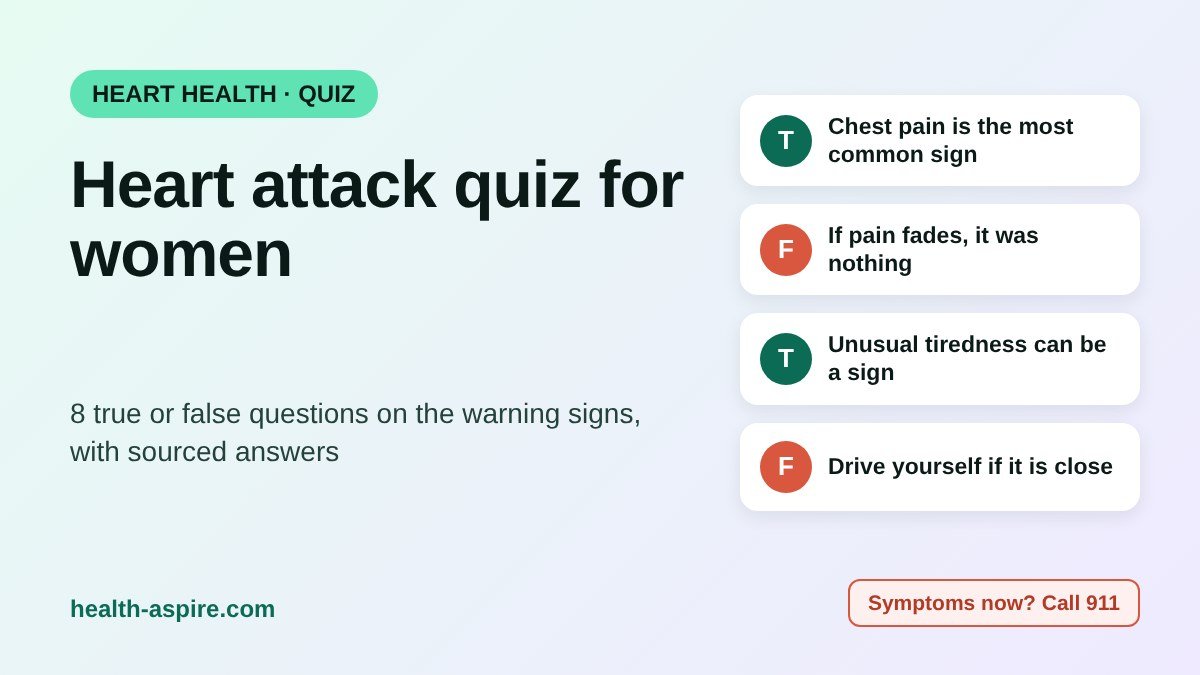
If you have symptoms right now, call 911 instead of taking this heart attack quiz for women.Chest pain or pressure, shortness of breath, a cold sweat, nausea, or pain in the jaw, neck, back, arm or stomach can all be signs of a heart attack. Do not drive yourself to the hospital.
Am I having a heart attack? If you are asking that with symptoms right now, no quiz can answer it, so call 911. This heart attack quiz for women is for a calmer moment. It tests what you know about the warning signs before you ever need them, because most women cannot name more than one or two.
That gap is real and measurable. For example, in a 2019 American Heart Association (AHA) national survey, only about half of US women named chest pain as a heart attack sign. Fewer than 1 in 3 named shortness of breath. Yet among women who actually had a heart attack, those were among the most common symptoms. Below, we line up both sets of numbers, then let you test yourself with 8 true or false questions.
87%
Women aged 18 to 55 with a heart attack who had chest pain (VIRGO study)
62%
Of those women who also had 3 or more other symptoms, vs 55% of men
44%
US women in 2019 who knew heart disease is their leading cause of death, down from 65% in 2009
Sources: Lichtman and colleagues, Circulation 2018 (VIRGO study, 2,009 women and 976 men); Cushman and colleagues, Circulation 2021 (AHA 2019 national survey).
Can a heart attack quiz for women tell you if you are having one?
No. A heart attack quiz for women can teach you the signs, but it cannot tell you what is happening inside your arteries. Only an ECG and blood tests can do that. So if you feel possible symptoms, even mild ones, call 911 first. The National Heart, Lung, and Blood Institute (NHLBI) says to call even if you are not sure.
Many online “female heart attack quizzes” score your answers and suggest you are probably fine. However, that is risky. Symptoms vary from woman to woman, and some heart attacks cause mild symptoms or none at all. For that reason, our quiz never gives a score about your body. Instead, it checks your knowledge, and every answer links back to the evidence.
What women know vs what actually happens
Here is the core problem in one table. On the left is the share of US women who could name each warning sign in the AHA 2019 survey. On the right is how often women who really had a heart attack reported that symptom. Keep in mind that the two studies asked different people, so read it as a gap in awareness, not a perfect match.
| Warning sign | Women who named it as a sign (2019 survey) | Women who had it during a heart attack | What that means |
|---|---|---|---|
| Chest pain or discomfort | 51.5% | 87.0% (ages 18 to 55) | The most common sign in women too, yet half did not name it |
| Pain spreading to the jaw, neck, arm, shoulder or upper back | 38.3% | 64.9% (ages 18 to 55) | Nearly 2 in 3 had it; fewer than 2 in 5 knew it |
| Shortness of breath | 27.9% | 52.8% (ages 18 to 55) | More than half had it; about 1 in 4 knew it |
| Nausea, indigestion or stomach discomfort | 9.3% (nausea only) | 61.5% (any of the three) | Often mistaken for a stomach problem |
| Unusual fatigue | 6.6% | 43% (separate study of 515 women) | Can also show up days or weeks before |
The awareness gap in one chart
The pattern is clear. In fact, for every common sign, far more women had it than could name it. In short, the signs are not rare or mysterious. They are simply not well known.
The heart attack quiz for women: 8 true or false questions
First, answer each statement in your head. Then tap “Show the answer.” There is no score and no verdict about your health. If you want to share the heart attack quiz for women with a sister, mother or friend, the facts below are the useful part.
Questions 1 to 4: the symptoms
1.Chest pain is rare when women have a heart attack.
Show the answer
False. Chest pain or discomfort is the most common heart attack symptom in women, just as in men, according to the AHA. In the VIRGO study, 87% of women aged 18 to 55 had it. It may feel like pressure, squeezing or fullness rather than sharp pain.
2.Women often have several other symptoms on top of chest pain.
Show the answer
True. In VIRGO, 61.9% of women had 3 or more symptoms besides chest pain, compared with 54.8% of men. Stomach discomfort, palpitations and pain in the jaw, neck or arms were all more common in women.
3.If the pain goes away, it was not a heart attack.
Show the answer
False. The AHA says chest discomfort may last more than a few minutes or go away and come back. The NHLBI adds that symptoms may come and go over several hours. Pain that fades is still a reason to call 911.
4.Unusual tiredness can be a warning sign.
Show the answer
True. The NHLBI lists feeling unusually tired for no reason, sometimes for days, and says it is more common in women. In an NIH-funded study of 515 women, 70.7% recalled unusual fatigue in the weeks before their heart attack.
Questions 5 to 8: what to do and the big picture
5.Nausea or indigestion is always a stomach problem, never the heart.
Show the answer
False. In VIRGO, 61.5% of women having a heart attack reported indigestion, nausea or stomach discomfort. The AHA lists nausea and stomach discomfort among the warning signs.
6.If the hospital is close, it is fine to drive yourself.
Show the answer
False. The NHLBI says not to drive to the hospital or let someone else drive you. Call 911, because paramedics can start checks and treatment on the way.
7.You can have a heart attack with mild symptoms or none at all.
Show the answer
True. The NHLBI notes it is possible to have mild symptoms or even no symptoms and still have a heart attack. Silent heart attacks are more common in older adults and people with diabetes.
8.Most US women know heart disease is their leading cause of death.
Show the answer
False. In the AHA 2019 survey, only 44% knew it, down from 65% in 2009. Meanwhile, the CDC reports heart disease caused 304,970 deaths among US women in 2023, about 1 in 5 female deaths.
How did you do? Whatever your result, the takeaway is still the same. Any of these signs, alone or together, is a reason to call 911 rather than wait.
What does a heart attack feel like for women?
For most women, it feels like pressure, squeezing, fullness or pain in the center of the chest. That feeling often comes with other symptoms, such as shortness of breath, a cold sweat, nausea or lightheadedness. In addition, some women describe pressure in the upper back, or pain in one or both arms, the neck, jaw or stomach.
The AHA also lists anxiety and unusual tiredness or weakness as symptoms that women may have. For a full walk-through by age, see our guide to heart attack symptoms in women. Meanwhile, the AHA page on symptoms in women and the NHLBI symptom page are good places to check the official wording.
Why women wait too long
Still, knowing the signs is only half of it. In VIRGO, 54.7% of women did not think their symptoms were heart related. They were also more likely than men to blame stress or anxiety, at 20.9% vs 11.8%.
Moreover, reaching out did not always help. About 29.5% of the women had seen a clinician for similar symptoms before they were admitted. Of those, 53.4% said the provider did not think the problem was their heart. By contrast, that figure was 36.7% for men. So if a symptom feels new or wrong to you, it is fair to ask directly whether it could be your heart.
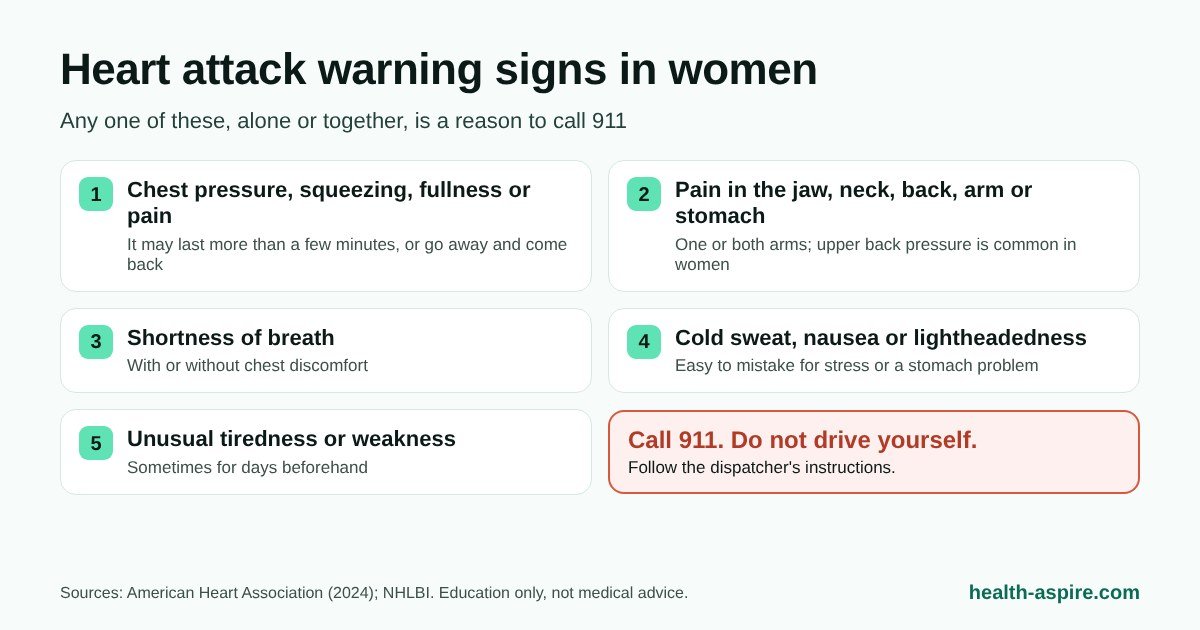
Your 5-line heart attack checklist for women
Unlike the quiz above, this short list is about action. That is why it fits on a phone screen. Save it, print it, or share it with the women in your life.
- Know the big four: chest pressure or pain, pain spreading to the jaw, neck, back or arms, shortness of breath, and a cold sweat or nausea.
- Respect the quieter signs: unusual tiredness, lightheadedness and stomach discomfort can be part of a heart attack.
- Do not wait it out: symptoms that come and go still count, so call 911 right away.
- Do not drive: let paramedics bring you in, and follow what the 911 dispatcher tells you.
- Say everything: describe every symptom in the ER, including the ones that seem unrelated.
What to do next
- Check your long-term numbers with our free heart attack risk calculator. It estimates risk over years, not whether symptoms today are a heart attack.
- Get ready for your next appointment with Before Your Check-up, including questions about your heart.
- Learn why every minute of a heart attack matters, and why normal results do not always rule one out in heart attack with normal cholesterol.
- For more, start at our heart health hub.
Heart attack quiz for women: FAQ
Is there a reliable “am I having a heart attack” quiz for women?
No quiz can tell you whether you are having a heart attack, because only medical tests can. Instead, a good quiz, like the one above, teaches the warning signs ahead of time. If you have symptoms now, skip the quiz and call 911.
What is often the first sign of a heart attack in a woman?
There is no single first sign. Overall, chest discomfort is the most common symptom. However, some women notice unusual fatigue, poor sleep or shortness of breath days or weeks earlier. In one NIH-funded study, about 95% of women said they noticed new or different symptoms a month or more before.
Can a woman have a heart attack without chest pain?
Yes. Most women do have chest pain or discomfort, but not all. In the same NIH-funded study of 515 women, 43% did not have chest pain during their heart attack. Shortness of breath, weakness and fatigue were common instead.
Sources
- Lichtman JH, Leifheit EC, Safdar B, et al. Sex differences in the presentation and perception of symptoms among young patients with myocardial infarction: evidence from the VIRGO study. Circulation. 2018;137(8):781-790. doi.org/10.1161/CIRCULATIONAHA.117.031650
- Cushman M, Shay CM, Howard VJ, et al. Ten-year differences in women’s awareness related to coronary heart disease: results of the 2019 American Heart Association national survey. Circulation. 2021;143(7):e239-e248. doi.org/10.1161/CIR.0000000000000907
- McSweeney JC, et al. Women’s early warning symptoms of acute myocardial infarction. Circulation. 2003. Summary by the National Institute of Nursing Research (NIH). ninr.nih.gov
- American Heart Association. Heart attack symptoms in women. Reviewed December 2024. heart.org
- National Heart, Lung, and Blood Institute. Heart attack: symptoms. nhlbi.nih.gov
- Centers for Disease Control and Prevention. Women and heart disease. cdc.gov
This guide is for education and is not medical advice. Talk to your doctor about your own numbers and treatment. See our medical disclaimer.
Free cheat sheet + weekly email
A short, honest health email. Every Thursday.
The week’s most useful research for life after 40, explained in plain English, plus one step picked for what matters to you. No spam, no selling your email, unsubscribe in one click.
Free gift: our 1-page Lab Markers Cheat Sheet (PDF), the 15 numbers on routine blood and urine tests that matter most after 40. It arrives as soon as you confirm your email.