How Long Does a Heart Attack Last? Minutes vs Hours
How long does a heart attack last? There is no fixed length. The warning signs often last more than a few minutes, or they fade and then return. Meanwhile, the blockage behind them keeps damaging heart muscle until doctors reopen the artery. So the real answer depends less on your body and more on how fast you call 911.
That is the part most people get wrong. Many wait to see if the pain passes. In fact, in one US study of adults who reached an emergency room with possible heart attack symptoms, the typical wait from the first symptom to arrival was almost 7 hours. Below, we put real numbers on that clock, so you know exactly why minutes matter.
6.7 hours
Median time from first symptom to arrival at the ER in a 5-site US study
26%
Share of those patients who arrived within 2 hours of their first symptom
90 minutes
Target from first medical contact to an opened artery, per current US guidance
Figures from DeVon and colleagues, Critical Pathways in Cardiology 2020 (975 adults, 5 US sites), and the 2025 ACC/AHA acute coronary syndromes guideline as summarized by NIH StatPearls.
How long does a heart attack last, and what decides it?
A heart attack lasts as long as the artery stays blocked. The symptoms may last minutes, come and go over several hours, or barely show at all. However, the damage does not stop when the pain eases. It stops when blood flow returns, which usually takes emergency treatment such as a stent or a clot-dissolving drug.
Think of it this way. The symptoms are the alarm, and the blocked artery is the fire. The American Heart Association (AHA) notes that some heart attacks are sudden and intense, while others start slowly with mild discomfort. Likewise, the National Heart, Lung, and Blood Institute (NHLBI) says symptoms may come and go over several hours. Some heart attacks even happen with very mild symptoms or none at all.
That is why no doctor will tell you “if it lasts under X minutes, you are fine.” The CDC puts it plainly: the more time that passes without treatment to restore blood flow, the greater the damage to the heart muscle. In the US, someone has a heart attack every 40 seconds.
Chest pain timing: what the pattern can mean
Chest discomfort from the heart follows a few patterns, and timing is one clue doctors use. We pulled the official descriptions from the AHA and NHLBI into one table. Still, treat it as background only. You cannot safely sort these at home, so any new or unexplained chest discomfort is a reason to call 911.
| Pattern | How long it lasts | Rest or medicine helps? | What to do |
|---|---|---|---|
| Heart attack | More than a few minutes, or goes away and comes back; may come and go over several hours | Not reliably | Call 911 now |
| Unstable angina | Longer than 20 minutes, or goes away and comes back | No | Call 911 now |
| Vasospastic angina (artery spasm) | Around 15 minutes | Medicine helps | Needs a doctor’s diagnosis; call 911 if it does not ease |
| Microvascular angina | A long time | Not easily relieved by medicine | Needs a doctor’s diagnosis; call 911 if it does not ease |
| Stable angina (already diagnosed) | Goes away within 5 minutes | Yes, rest or prescribed medicine | Call 911 if it does not ease with rest or medicine, or feels different |
Notice the overlap. A heart attack can feel like angina that simply refuses to stop, and unstable angina is an emergency in its own right. In other words, the length of the pain is a warning sign, not a verdict.
How long does a heart attack last if untreated?
Without treatment, the blockage can continue, and so does the damage. Pain may fade while heart muscle keeps dying. As a result, waiting to see whether symptoms pass is the riskiest choice. Survival and recovery are better the sooner treatment starts, so the safe answer is always to get emergency care right away.
Symptoms that ease can feel like good news. Yet the NHLBI warns that symptoms can come and go, and some people only learn later, from an ECG or a heart scan, that they had a heart attack. Fading pain, therefore, tells you nothing about whether the artery has reopened.
The heart attack clock: hospital targets vs real life
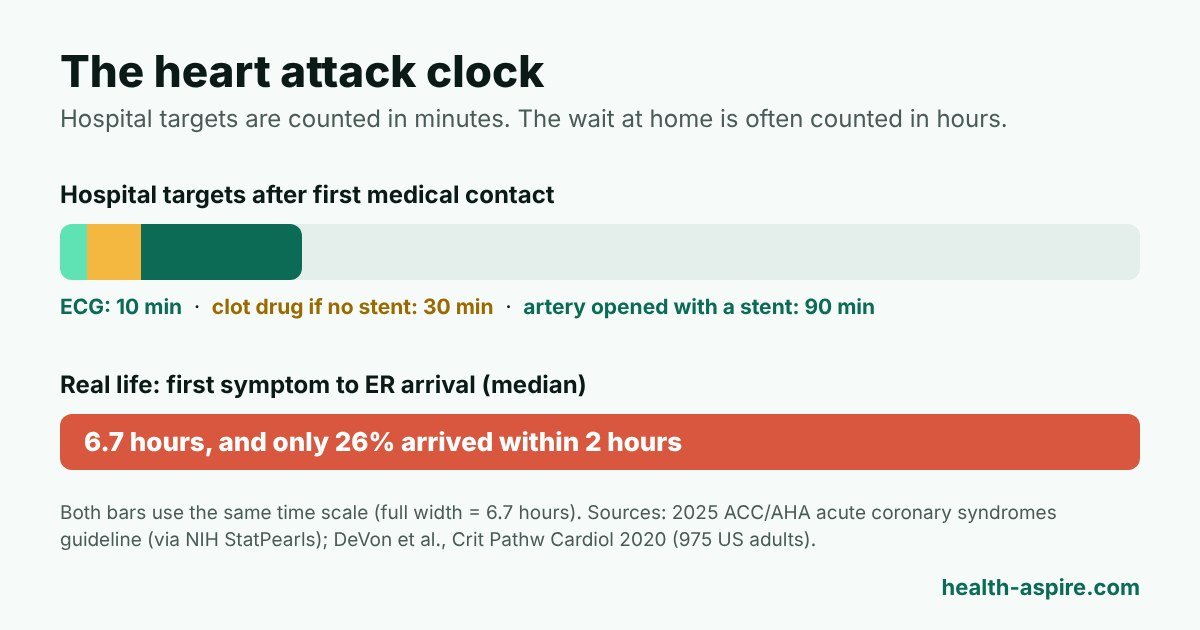
Hospitals work against a strict clock once you reach them. The trouble is the hours before that. The table below lines up the official US time targets with what actually happened in a study of 975 adults who arrived at five US emergency departments with possible heart attack symptoms.
| Step | Target or finding | Source |
|---|---|---|
| 12-lead ECG after first medical contact | Within 10 minutes | 2025 ACC/AHA guideline (via StatPearls) |
| Opening the artery with a stent at a PCI hospital | 90 minutes or less from first medical contact | 2025 ACC/AHA guideline (via StatPearls) |
| Opening the artery when transfer to another hospital is needed | 120 minutes or less | 2025 ACC/AHA guideline (via StatPearls) |
| Clot-dissolving drug when a stent is not possible in time | Within 30 minutes of first medical contact | 2025 ACC/AHA guideline (via StatPearls) |
| Real life: time from first symptom to ER arrival | Median 6.7 hours (middle half: 1.9 to 24.9 hours) | DeVon et al., 2020 |
| Real life: arrived within 2 hours | 26.2% | DeVon et al., 2020 |
| Real life: came by ambulance | 44.4% (53.6% got there on their own) | DeVon et al., 2020 |
Put simply, the hospital part is measured in minutes, while the home part is often measured in hours. Moreover, the same study found that people who did not use an ambulance, and people whose main symptom was unusual fatigue, tended to wait longer. That is the gap you can close yourself.
Why every 30 minutes counts
Delay has a measurable cost. In a study of 1,791 people treated with emergency angioplasty for a major heart attack, each 30 minutes of delay raised the risk of death within a year by about 7.5%. The chart below shows what that rate adds up to if it held steady.
For example, a 2-hour wait at home “to see if it passes” would, by this estimate, raise the one-year risk of death by about a third. Of course, real risk varies from person to person. Still, the direction never changes: earlier treatment means less damage.
Can heart attack symptoms come and go?
Yes. Both the AHA and NHLBI say heart attack discomfort can go away and then return, sometimes over several hours. Symptoms can also start slowly and feel mild. So a pain that stops and starts again is not a sign of safety. Instead, it is one of the classic warning patterns and a reason to call 911.
Also, chest pain is not the only signal. The AHA lists discomfort in the arms, back, neck, jaw or stomach, shortness of breath, cold sweats, nausea, a racing or irregular heartbeat, unusual tiredness and lightheadedness. Women are more likely to have some of the less typical signs, which we cover in our guide to heart attack symptoms in women.
What to do in the first minutes
Call 911 at the first warning sign, even if you are not sure. The AHA calls this almost always the fastest way to get lifesaving treatment. Do not drive yourself, and do not let someone else drive you, the NHLBI advises. Instead, an ambulance is the safest way to the hospital.
- Call first, decide later. Paramedics can start treatment on arrival, and they are trained in resuscitation if the heart stops.
- Note the time symptoms began, and tell the paramedics.
- Follow the dispatcher’s instructions, including whether to take aspirin. Never let anything delay the call.
- Do not wait for the pain to pass. Pain that eases or returns still needs emergency care.
Arriving by ambulance can also mean faster treatment once you reach the hospital, the AHA notes.
What to do next
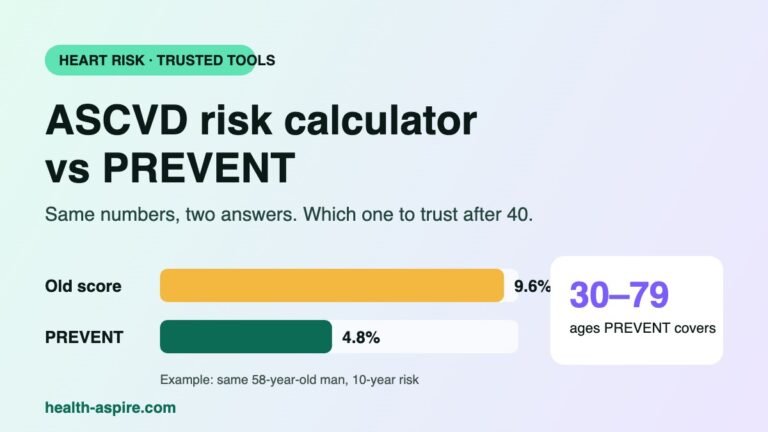
- Know your own risk before an emergency. Our free heart attack risk calculator uses the AHA PREVENT equations to estimate your 10-year risk.
- Use Before Your Check-up to list your numbers and questions, for example: “Which heart symptoms should make me call 911?”
- Normal cholesterol does not rule out a heart attack. Read why in heart attack with normal cholesterol, and ask whether a coronary calcium scan fits your situation.
- For the bigger picture, start at our heart health hub.
FAQ
How long does chest pain last during a heart attack?
Usually more than a few minutes. It may also go away and come back, sometimes over several hours. There is no safe minimum, though. If chest discomfort is new, unexplained or does not ease with rest, call 911 rather than timing it.
Can a heart attack go away on its own?
The pain can, but that does not mean the heart is safe. Symptoms often fade and return while the artery stays narrowed or blocked. Only medical tests, such as an ECG and blood tests, can show what is happening, so get checked right away.
Can you have a heart attack and not know it?
Yes. The NHLBI notes that heart attacks can happen with very mild symptoms or none at all. Some people only find out later, when an ECG or heart scan shows old damage. If that happens to you, ask your doctor what it means for your treatment.
Is it ever too late to go to the hospital?
No. Earlier is better, but getting checked late is still far safer than not getting checked. Doctors can find out what happened and treat what they find. So if you waited, do not let guilt stop you. Call 911 now.
Sources
- Rao SV, et al. 2025 ACC/AHA/ACEP/NAEMSP/SCAI guideline for the management of patients with acute coronary syndromes. Circulation. 2025;151(13). doi.org/10.1161/CIR.0000000000001309
- DeVon HA, et al. Unusual fatigue and failure to utilize EMS are associated with prolonged prehospital delay for suspected acute coronary syndrome. Crit Pathw Cardiol. 2020;19(4):206-212. doi.org/10.1097/HPC.0000000000000245
- De Luca G, Suryapranata H, Ottervanger JP, Antman EM. Time delay to treatment and mortality in primary angioplasty for acute myocardial infarction: every minute of delay counts. Circulation. 2004;109(10):1223-1225. doi.org/10.1161/01.CIR.0000121424.76486.20
- Jain A, Singh A, Shah K, Grossman SA. Acute coronary syndrome. StatPearls, NCBI Bookshelf. Updated 2026. ncbi.nlm.nih.gov/books/NBK459157
- American Heart Association. Warning signs of a heart attack. heart.org
- National Heart, Lung, and Blood Institute. Heart attack: symptoms. nhlbi.nih.gov
- National Heart, Lung, and Blood Institute. Angina: symptoms. nhlbi.nih.gov
- Centers for Disease Control and Prevention. Heart attack symptoms, risk, and recovery. cdc.gov
This guide is for education and is not medical advice. Talk to your doctor about your own numbers and treatment. See our medical disclaimer.
Free cheat sheet + weekly email
A short, honest health email. Every Thursday.
The week’s most useful research for life after 40, explained in plain English, plus one step picked for what matters to you. No spam, no selling your email, unsubscribe in one click.
Free gift: our 1-page Lab Markers Cheat Sheet (PDF), the 15 numbers on routine blood and urine tests that matter most after 40. It arrives as soon as you confirm your email.