Is 2 Drinks a Day Too Much? New Data Puts a Number on It
Is 2 drinks a day too much? For years, the official American answer for men was no. Two drinks a day sat right at the edge of “moderate,” and a glass of red wine with dinner had a reputation as something close to a heart habit.
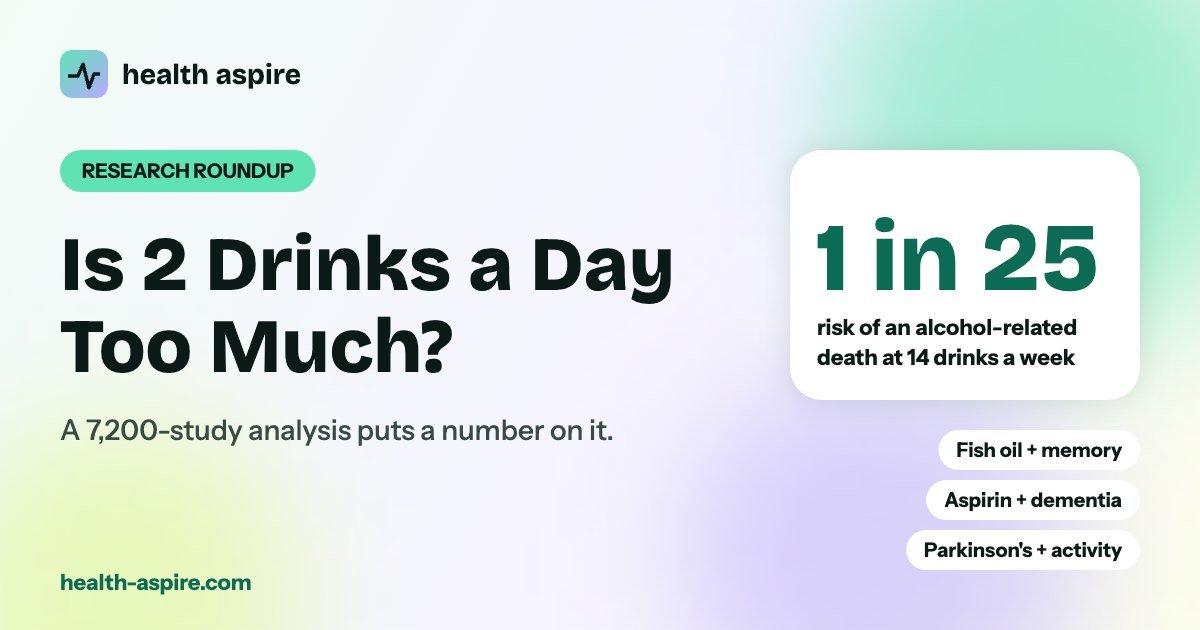
A large analysis commissioned by the US government now puts a number on what two a day costs. At an average of 14 drinks a week, the researchers estimate about a 1 in 25 risk of dying from a cause linked to alcohol. They also found no level of drinking where alcohol came out ahead for health overall.
Here is what the study did, how its numbers line up with the official drinking definitions, what it can’t tell you, and what is sensible to do if you are over 40 and enjoy a drink in the evening.
What the Alcohol Intake and Health Study actually did
The Alcohol Intake and Health Study was originally commissioned by the federal government to help shape the US Dietary Guidelines. The lead author is Kevin Shield, PhD, of the University of Toronto. The results appeared in the Journal of Studies on Alcohol and Drugs and were back in the headlines this week.
This was not a trial where people were told to drink. Medical experts first reviewed more than 7,200 scientific publications to estimate how alcohol changes the risk of each related condition, including cancers of the esophagus, mouth and breast, cardiovascular disease, liver disease and injuries. The team then applied those risks to large national health datasets and used statistical models to estimate the chance of serious illness and premature death at different drinking levels.
Think of it as a very detailed risk calculator built from thousands of studies, rather than one group of people followed over time.
Is 2 drinks a day too much, according to the numbers?
By this study’s estimate, two drinks a day is more than most people’s health can absorb for free. Averaging 14 drinks a week carried about a 1 in 25 risk of an alcohol-related death. Up to seven drinks a week was linked to only small increases in risk for most conditions, and risk climbed above one drink a day for men and women alike.
To make 1 in 25 concrete, picture 100 people who each have two drinks a night, year after year. On these numbers, about four of them would eventually die of something alcohol caused or helped cause. That is 4%. It is not a sentence for any one person, but it is far from a rounding error.
“Even low levels of alcohol use come with health risks,” Shield said in a release about the study. He also noted that the risk keeps rising the more someone drinks.
How two drinks a day compares with official drinking definitions
Two drinks a day is not just a study number. It also crosses an official line for women. The National Institute on Alcohol Abuse and Alcoholism (NIAAA) defines heavy drinking as four or more drinks on any day or eight or more a week for women, and five or more on any day or 15 or more a week for men.
| Weekly amount | What it looks like | NIAAA label | What the new study found |
|---|---|---|---|
| Up to 7 drinks | About one a day or less | Below the heavy-drinking line for men and women | Only small increases in risk for most conditions |
| 8 to 13 drinks | Between one and two a day | Heavy drinking for women; below the line for men | Risk rises once intake passes about one drink a day |
| 14 drinks | Two a day, every day | Heavy for women; one drink short of the men’s line | About a 1 in 25 risk of an alcohol-related death |
| 15 or more drinks | More than two a day | Heavy drinking for men and women | Risk keeps increasing with each extra drink |
What counts as one drink?
In the US, one standard drink holds about 14 grams of pure alcohol. That is a 12-ounce can of regular beer at 5% alcohol, a 5-ounce glass of wine at 12%, or a 1.5-ounce shot of 40% spirits. Your “two drinks” only match the study if each one is a standard drink.
That is where many of us quietly undercount. NIAAA points out that a 12-ounce craft beer at 10% alcohol is two standard drinks on its own, and that the glass or can you are served often does not match the standard size. Two generous pours of wine at home can easily add up to three or four standard drinks.
But isn’t a drink a day good for your heart?
The heart story is the part most people remember, and it is more complicated than it sounds. The study did see a possible lower risk of ischemic heart disease and stroke at low levels of drinking. However, those possible gains were outweighed by higher risks of cancer, liver disease and injury, so the team found no overall protective effect at any level.
Not every review lands in exactly the same place. The National Academies report used for the newest Dietary Guidelines found moderate drinking linked to lower overall death rates and lower heart disease deaths compared with never drinking, along with a higher breast cancer risk. Those were associations, not proof. Both bodies of evidence agree on one practical point, though: more alcohol is not better, and no one should start drinking for their heart.
What the guidelines say now
The 2025 to 2030 Dietary Guidelines for Americans, released on January 7, 2026, dropped the old numeric limits of two drinks a day for men and one for women. Instead, they tell Americans to drink less for better health. Shield argues that his study offers a clearer threshold than that. In an editorial alongside the study, Robert Vincent, a former official at the Substance Abuse and Mental Health Services Administration, wrote that its findings were sidelined. That is his opinion, but it explains why this paper keeps resurfacing.
Why drinking hits differently after 40
Age changes the math even when the glass stays the same. As AARP’s review of the new guidance explains, alcohol has stronger and longer-lasting effects as we get older because body composition, metabolism and brain sensitivity shift. The risks it lists include poorer sleep, falls, medication interactions and heart rhythm problems.
The guidelines also say some people should skip alcohol entirely, including anyone taking a medicine that interacts with it. Sleep medications, opioids, muscle relaxants and certain diabetes and blood-thinning drugs are among the common ones. If a nightcap is part of your sleep routine, our better sleep tips offer gentler options.
What we don’t know yet
- The estimates describe populations, not you. Genetics, lifestyle and drinking patterns all shift individual risk.
- The public summaries give one headline figure. They do not report separate numbers for men and women or for each disease.
- Some alcohol-linked conditions are still being studied. The link with pancreatic cancer, for example, was not fully captured.
- Pattern matters as well as total. A week of two drinks a night and a week with one big Saturday are not the same exposure, and binge drinking (five or more drinks for men or four or more for women in about two hours) carries its own risks.
What to do with this
- Count one honest week in standard drinks, including the big pours. Most people are surprised by the total.
- If you land above seven a week, moving toward one a day or less brings you into the range where this study saw only small increases in risk.
- Build in alcohol-free days rather than relying on willpower every evening.
- Ask your doctor or pharmacist whether any of your medicines interact with alcohol.
- Look at the bigger picture of your heart: run our free 10-year heart risk calculator, track readings with the Blood Pressure Diary, and bring your questions with Before Your Check-up. Our heart health hub covers the rest.
Also new this week
Fish oil raised brain omega-3 levels but did not protect memory
A two-year USC trial gave 365 adults aged 55 to 80, who rarely ate fish and were at higher risk for Alzheimer’s, either 2,000 mg of DHA a day or a placebo. DHA in the spinal fluid rose by about 17% after six months, so it clearly reached the brain. Yet memory scores and shrinkage of the hippocampus, the brain’s memory hub, were no better than with placebo. More on what does help in our brain health guide.
Source: Yassine H.N. et al., eBioMedicine, 2026. Read the study
Aspirin and dementia: a signal in one genetic group, with a bleeding cost
Researchers at Monash University reanalyzed the ASPREE trial of 13,541 older adults. Among people in the top fifth of a genetic score linked to platelet count, dementia developed in 1% of those on daily low-dose aspirin versus 3.3% on placebo. Major bleeding, however, roughly doubled, from 2.1% to 4.4%. The authors call the finding hypothesis-generating and say no one should start aspirin for dementia without talking to a doctor.
Source: Fransquet P.D. et al., Alzheimer’s & Dementia, 2026. Read the study
More active people with Parkinson’s declined more slowly
A University of Cincinnati study in Neurology followed 294 adults with mild to moderate Parkinson’s disease, average age 66, for up to seven years. People who reported more than eight hours of physical activity a week saw their thinking scores barely change, while the least active group (four hours or less) declined steadily. Activity was self-reported, so this shows a link rather than proof. Our strength hub is a good place to start moving more.
Source: Ryu D.W. et al., Neurology, 2026. Read the study
Sources
- George S., Shield K. et al., Journal of Studies on Alcohol and Drugs, 2026. Read the study · ScienceDaily summary
- National Institute on Alcohol Abuse and Alcoholism. Understanding alcohol drinking patterns · What is a standard drink?
- AARP, 2026. What the new Dietary Guidelines say about alcohol
- Yassine H.N. et al., eBioMedicine, 2026. Read the study · ScienceDaily summary
- Fransquet P.D. et al., Alzheimer’s & Dementia, 2026. Read the study · ScienceDaily summary
- Ryu D.W. et al., Neurology, 2026. Read the study · ScienceDaily summary
This article explains new research for education. It is not medical advice. Talk to your doctor before making changes to your treatment. See our medical disclaimer.
Free weekly email
A short, honest health email. Every Thursday.
The week’s most useful research for life after 40, explained in plain English, plus one step picked for what matters to you. No spam, no selling your email, unsubscribe in one click.