BUN Creatinine Ratio: What High or Low Really Means After 40
The BUN creatinine ratio divides your blood urea nitrogen (BUN) by your creatinine, both in mg/dL. Most lab reports treat about 10 to 20 as typical, and in national US data the middle half of adults sit between 11.4 and 18.6. After 40, a high ratio more often reflects lower muscle mass, a high-protein week or mild fluid loss than kidney damage. Your eGFR tells you more about the kidneys themselves.
Here is a pattern I see again and again in reader emails. The kidney numbers on a metabolic panel look fine, yet one small line is flagged in bold: BUN/Creatinine Ratio, 24, H. However, nobody explains it, so it sits there and worries you. So this guide puts that one number in context, with national data, the SI units used outside the US, and three worked example reports.
What is the BUN creatinine ratio?
The BUN creatinine ratio compares two waste products your kidneys clear. First, BUN comes from breaking down protein in the liver. Second, creatinine comes from muscle at a fairly steady rate. Because diet, fluids, bleeding and muscle size push them in different directions, the ratio hints at why a kidney number moved, not how well the kidneys filter.
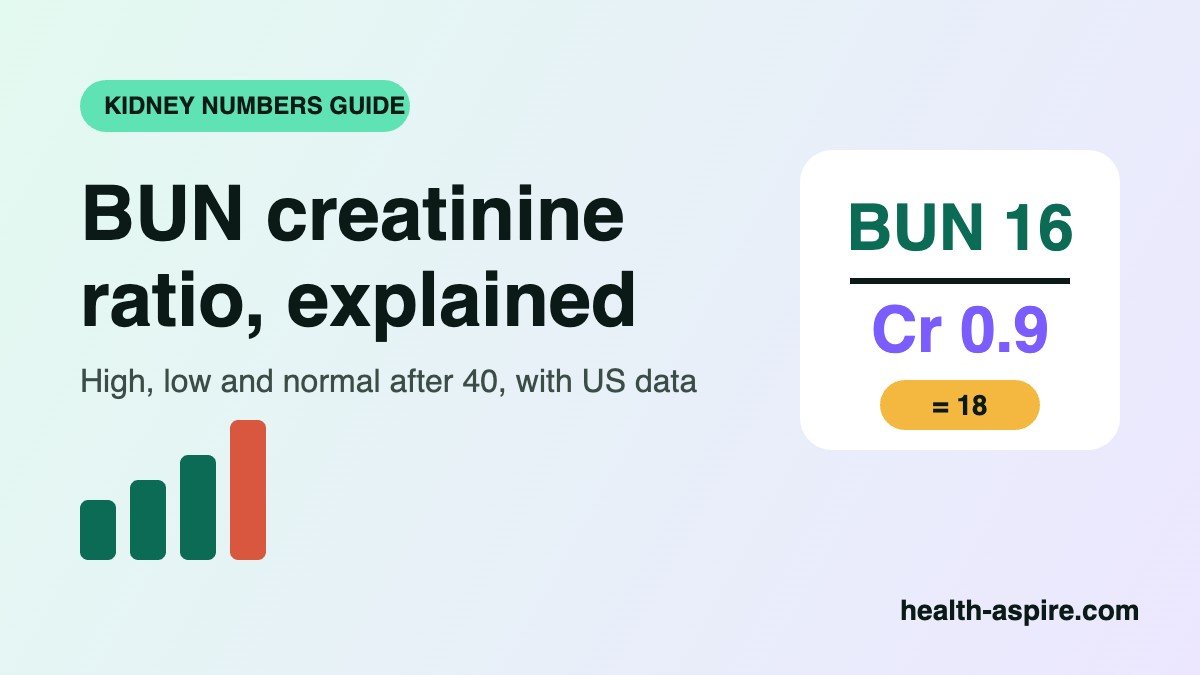
To calculate it, simply divide BUN by creatinine. For example, a BUN of 16 mg/dL and a creatinine of 0.9 mg/dL gives a ratio of about 18. Besides, both values come from the same tube as your comprehensive metabolic panel, so you rarely need a separate test.
BUN creatinine ratio normal range, in US and SI units
A BUN creatinine ratio between roughly 10 and 20 is what most US labs print as typical. However, the cut-offs people quote come from different places and mean different things. So we lined them up side by side and converted each one to the SI ratio (urea in mmol/L divided by creatinine in micromol/L) used on Canadian, UK and European reports.
| BUN/creatinine ratio (US units) | Same cut-off in SI units | Where the number comes from | What it usually reflects |
|---|---|---|---|
| Under 10 | Under 0.040 | Hosten, Clinical Methods (NIH Bookshelf) | Low protein intake, reduced urea production in advanced liver disease, or extra creatinine from muscle breakdown |
| 11.4 to 18.6 | 0.046 to 0.075 | Middle half of 42,038 US adults, NHANES 1999 to 2014 (Shen, 2022) | The usual range in the general population |
| 11.4 to 14.6 | 0.046 to 0.059 | Quartile with the lowest death rate over about 8 years in the same NHANES study | An association only; not a target to chase |
| Above 20 | Above 0.081 | Traditional “prerenal” threshold (StatPearls; Uchino, 2012) | Fluid loss, low blood flow to the kidneys, a high-protein diet, steroid medicines, or simply low creatinine |
| Above 30 | Above 0.121 | Srygley et al., JAMA 2012, in patients already bleeding | Points toward bleeding in the upper gut (stomach or esophagus), which raises BUN |
Table: original Health Aspire comparison. SI values computed with the standard factors (BUN mg/dL x 0.357 = urea mmol/L; creatinine mg/dL x 88.4 = micromol/L), which match the 20 = 0.081 conversion in Uchino 2012. Sources listed at the end.
Who has a high BUN creatinine ratio? What 42,038 Americans show
In national NHANES data, people with a high BUN creatinine ratio were, on average, older and more often women. Moreover, their creatinine was lower, while their kidney function was not worse. In fact, the top quarter had the highest average eGFR of the four groups. That fits a simple idea, namely: less muscle means less creatinine, and a smaller number on the bottom of the fraction.
There is also one more useful detail. Over about 8 years, death rates were lowest in the second quarter (ratio 11.4 to 14.6) and higher at both ends, a U shape. Even so, this is an observational link. In other words, a ratio of 22 does not make you sick, and lowering it on purpose is not a goal anyone has tested.
Three example reports, worked through
In practice, a ratio only makes sense next to its two parts and your eGFR. So here are three made-up readers (clearly examples, not real patients). We ran each one through the ratio, the SI conversion and the CKD-EPI 2021 eGFR equation, the same one our eGFR calculator uses.
| Example reader | BUN and creatinine | Ratio (US / SI) | eGFR (CKD-EPI 2021) | How to read it |
|---|---|---|---|---|
| Linda, 67, small frame, had a stomach bug last week | BUN 22 mg/dL (7.9 mmol/L); creatinine 0.8 mg/dL (71 micromol/L) | 27.5 / 0.111, flagged high | 81 | First of all, kidney filtering looks good for her age. The high ratio comes from a low creatinine (small muscle mass) plus a BUN nudged up by fluid loss. A sensible ask: repeat the panel once she is well and drinking normally. |
| Robert, 74, takes a water pill, tested during a heat wave | BUN 32 mg/dL (11.4 mmol/L); creatinine 1.4 mg/dL (124 micromol/L) | 22.9 / 0.092 | 53 | Here, however, eGFR is the real story: it falls in the 45 to 59 band. Meanwhile, the ratio hints that fluid loss may play a part, yet it cannot prove it. Next, a sensible ask: repeat the test, review the diuretic, and see whether eGFR recovers. |
| Diane, 58, eats very little protein | BUN 6 mg/dL (2.1 mmol/L); creatinine 0.75 mg/dL (66 micromol/L) | 8.0 / 0.032, flagged low | 92 | Filtering is normal. Instead, the low ratio comes from a low BUN, which usually tracks low protein intake. Then again, low urea can also come from advanced liver disease, so a sensible ask: check the liver lines on the same panel and talk about protein. |
Worked examples by Health Aspire. eGFR computed with the CKD-EPI 2021 creatinine equation (Inker, NEJM 2021) as published by the National Kidney Foundation; rounded to whole numbers.
What does a high BUN creatinine ratio mean?
A high BUN creatinine ratio (above 20) means BUN is high relative to creatinine. For example, the common reasons are fluid loss, reduced blood flow to the kidneys (as in heart failure), a high-protein diet, bleeding in the upper gut and steroid medicines. In adults over 40, a low creatinine from smaller muscle mass is an easily missed cause.
According to Hosten’s chapter in Clinical Methods, urea production rises with a high-protein diet, gastrointestinal bleeding and glucocorticoids. Creatinine, by contrast, barely moves with any of them. Meanwhile, creatinine production reflects lean body mass and declines with age. As a result, the same healthy kidneys can produce a higher ratio at 70 than at 40.
So when should a high ratio worry you? Mainly when it comes with symptoms. For instance, black or tarry stools, vomiting blood, dizziness on standing, or very little urine need same-day medical care, whatever the number says.
What does a low BUN creatinine ratio mean?
A low BUN creatinine ratio (under 10) usually means BUN is low. Hosten lists inadequate protein intake and reduced urea production in advanced liver disease first. Less often, by contrast, creatinine is high from muscle breakdown. In a healthy person with normal liver tests, a modest protein shortfall is the most common, and most fixable, explanation.
This matters after 40 because protein needs go up, not down, as we try to hold on to muscle. If your BUN is low and you suspect you eat little protein, our protein calculator gives a daily target to discuss with your doctor.
Is a high BUN creatinine ratio a reliable sign of dehydration?
Not on its own. Admittedly, a ratio above 20 is the textbook marker of “prerenal” kidney strain from low fluid or blood flow. Yet in a study of 20,126 hospital patients, about half of those with acute kidney injury crossed 20, and the high-ratio group was older and more often female. Consequently, the authors concluded the ratio did not work as a prerenal marker.
In that study (Uchino, Bellomo and Goldsmith, 2012), the high-ratio group also had lower baseline creatinine and higher hospital mortality. In other words, age and muscle mass were mixed in with fluid status. That is exactly why a doctor reads the ratio next to symptoms, blood pressure, medicines and a repeat test.
What to do next
- Put your creatinine, age and sex into our eGFR calculator. eGFR, not the ratio, is the number that tracks kidney filtering.
- Use Before Your Check-up to write down your medicines (water pills, steroids), supplements and how much you drank before the test.
- Taking creatine? It can raise creatinine and lower the ratio and eGFR on paper. Our creatine after 40 guide explains what to tell your doctor.
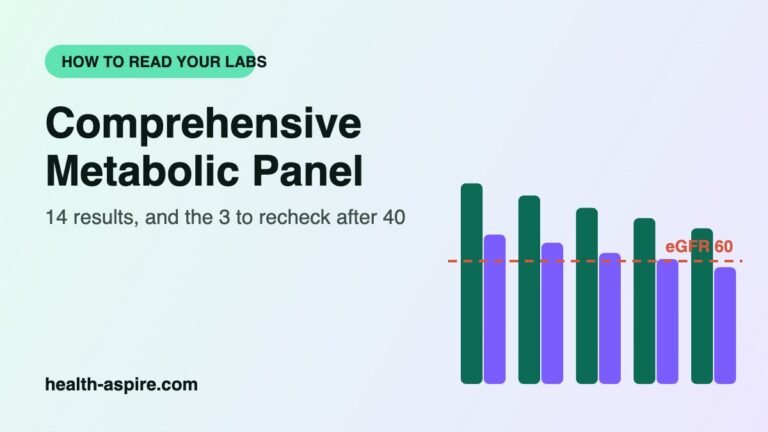
- Read the rest of the panel with our comprehensive metabolic panel guide, especially the liver lines if your ratio is low.
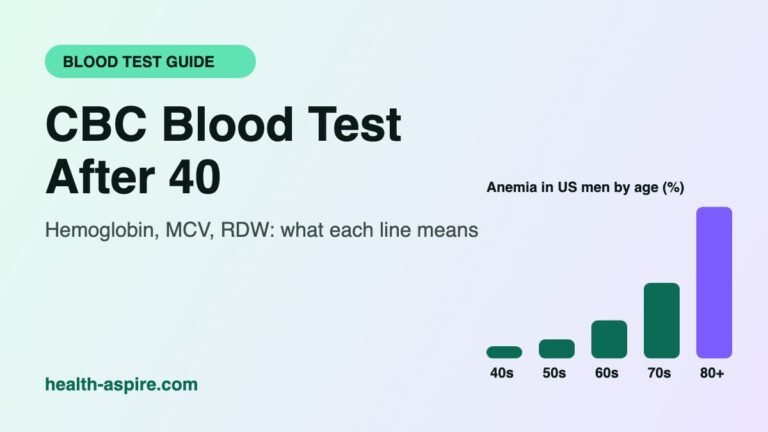
- If bleeding is a concern, the hemoglobin line on a CBC blood test shows whether you have lost blood.
FAQ
What is a normal BUN creatinine ratio for a 60-year-old?
To begin with, there is no separate age-specific cut-off. Most labs print about 10 to 20. However, NHANES data show the ratio drifts higher with age, mainly because creatinine falls as muscle mass falls. As a result, a 60-year-old with a ratio of 21 and a normal eGFR is usually not a concern.
Can drinking more water lower my BUN creatinine ratio?
If mild fluid loss raised your BUN, rehydrating usually brings it back down by the next test. On the other hand, extra water will not change a high ratio caused by low creatinine or a high-protein diet. Similarly, do not overload on water before a test; just drink normally.
Is a BUN creatinine ratio of 25 dangerous?
Usually not by itself. In fact, a ratio of 25 with BUN and creatinine near normal, a normal eGFR and no symptoms is common in older adults. However, it needs attention when eGFR is low, BUN is clearly high, or you have signs of bleeding or dehydration.
What is the BUN creatinine ratio in SI units?
In short, divide urea in mmol/L by creatinine in micromol/L. The traditional US cut-off of 20 equals about 0.081 in SI units. Also, some labs multiply by 1,000 and report it as about 81.
Sources
- Hosten A.O. BUN and Creatinine. In: Walker H.K., Hall W.D., Hurst J.W., eds. Clinical Methods, 3rd ed. (Butterworths, 1990; NIH Bookshelf)
- Shen S., Yan X., Xu B. The blood urea nitrogen/creatinine (BUN/cre) ratio was U-shaped associated with all-cause mortality in general population (Renal Failure, 2022)
- Uchino S., Bellomo R., Goldsmith D. The meaning of the blood urea nitrogen/creatinine ratio in acute kidney injury (Clinical Kidney Journal, 2012)
- Srygley F.D., Gerardo C.J., Tran T., Fisher D.A. Does this patient have a severe upper gastrointestinal bleed? (JAMA, 2012)
- Inker L.A., Eneanya N.D., Coresh J., et al. New Creatinine- and Cystatin C-Based Equations to Estimate GFR without Race (New England Journal of Medicine, 2021)
- StatPearls. Azotemia (NIH Bookshelf, archived chapter, last updated May 2023)
- MedlinePlus. BUN (Blood Urea Nitrogen) (US National Library of Medicine)
- National Kidney Foundation. Estimated Glomerular Filtration Rate (eGFR)
This guide is for education and is not medical advice. Talk to your doctor about your own numbers and treatment. See our medical disclaimer.
Free weekly email
A short, honest health email. Every Thursday.
The week’s most useful research for life after 40, explained in plain English, plus one step picked for what matters to you. No spam, no selling your email, unsubscribe in one click.