Comprehensive Metabolic Panel After 40: How to Read All 14 Results
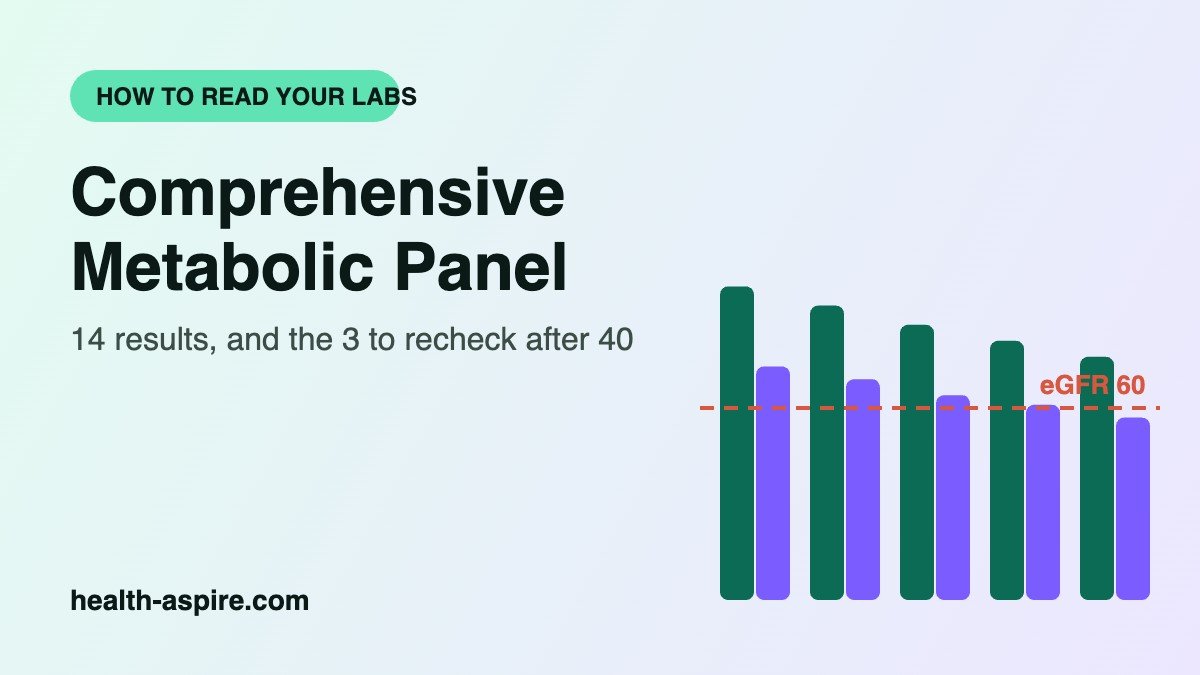
A comprehensive metabolic panel (CMP) is a single blood draw that reports 14 numbers about your blood sugar, kidneys, liver, electrolytes and blood proteins. In general, most results inside the lab’s printed range are fine. After 40, though, three lines deserve a second look even when they are not flagged: glucose, creatinine (through eGFR) and ALT.
When my own blood work came back with high cholesterol, I read the lipid numbers ten times and skimmed straight past the panel printed above them. Only later did I learn that a “normal” creatinine can still hide a kidney number below 60. This guide is the reading method I wish I had then, built only from guidelines and public sources you can check yourself.
What is a comprehensive metabolic panel?
A comprehensive metabolic panel is a routine blood test of 14 substances, often listed as “CMP” or “metabolic panel, 14” on your report. In other words, it checks how your body handles energy and fluid, and how well your kidneys and liver are working. As a result, doctors order it at check-ups, before surgery and to monitor medicines.
According to MedlinePlus, the 14 tests fall into five groups:
- Blood sugar and minerals: glucose, calcium.
- Electrolytes: sodium, potassium, chloride, carbon dioxide (bicarbonate).
- Kidneys: BUN (blood urea nitrogen), creatinine. Most labs also print eGFR, which is calculated from creatinine.
- Liver: ALT, AST, alkaline phosphatase (ALP), bilirubin.
- Proteins: albumin, total protein.
Comprehensive metabolic panel normal ranges vs. guideline cut-offs
The normal range on your report describes most healthy people tested by that lab. A guideline cut-off is different: it is the number where experts say something should happen next. For most CMP lines, however, the two agree. For three of them, the guideline line sits inside or below the lab’s range, which is why we put them side by side.
All 14 tests at a glance
| Test | Typical lab range (US units) | Same range in SI units | Guideline line that matters after 40 | In everyday terms |
|---|---|---|---|---|
| Glucose (fasting) | 70 to 100 mg/dL | 3.9 to 5.6 mmol/L | ADA: 100 to 125 is prediabetes; 126 or higher on two tests is diabetes | A 104 can look normal at a glance and still be prediabetes |
| Creatinine | 0.6 to 1.3 mg/dL | 53 to 115 µmol/L | KDIGO: eGFR under 60 for more than 3 months meets the definition of chronic kidney disease | Read the eGFR line, not just creatinine (see the next section) |
| ALT | 4 to 36 U/L | 0.07 to 0.60 µkat/L | ACG: healthy ALT is about 29 to 33 in men and 19 to 25 in women | A woman with ALT 32 is “normal” on many reports but above the healthy range |
| BUN | 6 to 20 mg/dL | 2.1 to 7.1 mmol/L | No separate cut-off; read with creatinine | Often rises a little with dehydration or a high-protein day |
| Potassium | 3.7 to 5.2 mEq/L | 3.7 to 5.2 mmol/L | Use the lab range | Some blood pressure medicines push it up or down |
| Sodium | 135 to 145 mEq/L | 135 to 145 mmol/L | Use the lab range | Diuretics are a common reason for a low value |
| Calcium | 8.5 to 10.2 mg/dL | 2.13 to 2.55 mmol/L | Use the lab range | Read it with albumin, since much calcium rides on albumin |
| Albumin | 3.4 to 5.4 g/dL | 34 to 54 g/L | Use the lab range | Low values can reflect liver, kidney or nutrition problems |
| AST, ALP, bilirubin | AST 8 to 33 U/L; ALP 20 to 130 U/L; bilirubin 0.1 to 1.2 mg/dL | Bilirubin 2 to 21 µmol/L | ACG: evaluate values above range by how high and which tests move together | One mildly high value is common; a pattern matters more |
Sources: lab ranges from the MedlinePlus Medical Encyclopedia (ranges vary slightly between labs, so your report wins); cut-offs from the ADA Standards of Care 2026, KDIGO 2024 and the ACG 2017 liver chemistry guideline. SI columns follow MedlinePlus.
Why the same creatinine reads differently at 70
First, creatinine is a waste product from muscle, and your kidneys clear it. The lab turns it into eGFR, an estimate of kidney filtering, using the CKD-EPI 2021 equation. Importantly, that equation includes age and sex. So the same creatinine gives a lower eGFR as you get older, and a lower one for women than for men.
We ran the published equation for four common creatinine values. Every number below comes straight from it:
| Creatinine (mg/dL) | Man, 40 | Man, 60 | Man, 80 | Woman, 40 | Woman, 60 | Woman, 80 |
|---|---|---|---|---|---|---|
| 0.8 | 115 | 101 | 89 | 95 | 84 | 74 |
| 1.0 | 98 | 86 | 76 | 73 | 64 | 57 |
| 1.1 | 87 | 77 | 68 | 65 | 58 | 51 |
| 1.3 | 71 | 63 | 56 | 53 | 47 | 42 |
eGFR in mL/min/1.73 m², calculated by Health Aspire with the race-free CKD-EPI 2021 creatinine equation (Inker et al., 2021). Values under 60 are below the KDIGO line. Creatinine of 1.3 mg/dL is about 115 µmol/L.
Three example readers (made up, for illustration)
- Example 1: Dana, 62, creatinine 1.1. Her report shows no flag, because 1.1 is inside the 0.6 to 1.3 range. Her eGFR, however, works out to about 57. Still, one value under 60 is not a diagnosis. Under KDIGO 2024, the next step is a repeat test in about three months plus a urine albumin test.
- Example 2: Mark, 48, fasting glucose 108. The lab range on some reports tops out at 99 or 100, so he may or may not see a flag. However, by ADA criteria, 108 falls in the prediabetes range. A reasonable next question for his doctor is whether to add an A1c test.
- Example 3: Rosa, 55, ALT 31, everything else normal. Her lab range runs to 36, so nothing is flagged. Under the ACG guideline, her value sits above the healthy range for women of 19 to 25. Of course, that alone does not mean disease. It is still a reason to ask about fatty liver risk, especially with a larger waist or high triglycerides.
How we chose these ranges and sources
We used four rules. First, lab ranges come from MedlinePlus, the National Library of Medicine’s patient site, because it is free, ad-free and cites its sources. Second, every action line comes from a named guideline written by a medical society: the American Diabetes Association, KDIGO for kidneys and the American College of Gastroenterology for liver tests. Third, we only added a cut-off when the guideline gives a number. Finally, nobody paid to be mentioned here, and we earn nothing from any lab.
How to read comprehensive metabolic panel results in 6 steps
Start with the flags, then check the three lines that hide behind normal ranges. After that, look at patterns and trends rather than single numbers. This order takes about ten minutes, and it gives you clear questions for your doctor.
- Check whether you fasted. A non-fasting glucose cannot be judged against fasting cut-offs.
- Read the H and L flags. Note how far outside the range each one is. After all, a value just past the edge is common.
- Find eGFR. If it is under 60, ask about a repeat test and a urine albumin-to-creatinine ratio.
- Compare glucose with the ADA lines. Anything from 100 to 125 fasting is worth an A1c conversation.
- Look at ALT against the ACG healthy range for your sex. In addition, check whether AST and ALT rise together.
- Put it next to last year’s report. A steady drift, such as eGFR falling year after year, often matters more than one result.
Red flags on a comprehensive metabolic panel
Most CMP surprises can wait for a routine follow-up. A few, however, cannot. For this reason, labs mark dangerous results as “critical” and usually phone your clinician directly. If your report says critical, or you see any of the items below, call your doctor the same day rather than waiting for the next visit.
- Any result labeled “critical” or “panic” value.
- Glucose under 54 mg/dL, which the ADA classes as clinically significant low blood sugar.
- Glucose of 200 mg/dL or more together with heavy thirst, frequent urination or weight loss, which meets the ADA definition of diabetes.
- A large, sudden drop in eGFR compared with your last test.
Comprehensive metabolic panel vs. basic metabolic panel
A basic metabolic panel (BMP) has 8 of the same tests: glucose, calcium, sodium, potassium, carbon dioxide, chloride, BUN and creatinine. The comprehensive metabolic panel adds the six liver and protein tests: albumin, total protein, ALP, ALT, AST and bilirubin. However, neither panel measures cholesterol or A1c; those are separate tests.
In practice, a BMP is common in hospitals and for quick medicine checks. A CMP is the usual choice at a yearly physical because it adds the liver.
Trusted places to look up a result
- MedlinePlus CMP guide: plain-English explanations of each test from the National Library of Medicine. Included because it is free, ad-free and government-run.
- MedlinePlus BMP guide: useful if your report says BMP instead.
- National Kidney Foundation, CKD-EPI 2021 equation: the exact formula most US labs use for eGFR. Included because it comes from the kidney experts who endorsed it.
Where Health Aspire fits
We are not a lab and not a doctor’s office. Our free eGFR calculator (ours) uses the same CKD-EPI 2021 equation as the table above, so you can check your own number and see your KDIGO stage. Similarly, our A1c calculator (also ours) converts between A1c and average glucose. In short, use them to prepare questions, not to diagnose yourself.
What to do next
- Enter your creatinine, age and sex in our free eGFR calculator.
- Use Before Your Check-up to list the questions this panel raised.
- Glucose 100 or higher? Read our A1C levels chart and how to improve insulin sensitivity.
- ALT above the healthy range? See whether two drinks a day is too much.
- Got a lipid panel the same day? Our guide to cholesterol test results walks through it.
FAQ
Do I need to fast for a comprehensive metabolic panel?
Often, yes. MedlinePlus says you may need to fast for several hours, and many clinics ask for 8 to 12 hours. That is because fasting matters mostly for glucose. Water is usually fine, but follow the instructions from your own clinic.
Does a comprehensive metabolic panel check for diabetes?
It checks glucose, which can point to prediabetes or diabetes. However, a diagnosis needs confirmation, usually a second test such as A1c. The ADA advises testing all adults from age 35, and the USPSTF recommends screening adults aged 35 to 70 with overweight or obesity.
Can one abnormal CMP result be ignored?
Not ignored, but kept in proportion. For example, dehydration, a hard workout, a big meal or a new medicine can nudge single values. That is why KDIGO requires low eGFR to last more than three months, and why doctors often simply repeat a borderline test.
My ALT is a little high. What will my doctor check?
The ACG guideline suggests looking at alcohol, medicines and supplements, viral hepatitis and fatty liver. For fatty liver, the AASLD recommends a FIB-4 score, which combines age, AST, ALT and platelets from a blood count, to estimate scarring risk.
Sources
- American Diabetes Association Professional Practice Committee. 2. Diagnosis and Classification of Diabetes: Standards of Care in Diabetes 2026 (Diabetes Care, 2026)
- KDIGO CKD Work Group. KDIGO 2024 Clinical Practice Guideline for the Evaluation and Management of Chronic Kidney Disease (Kidney International, 2024)
- Inker L.A., Eneanya N.D., Coresh J., et al. New Creatinine- and Cystatin C-Based Equations to Estimate GFR without Race (New England Journal of Medicine, 2021)
- Kwo P.Y., Cohen S.M., Lim J.K. ACG Clinical Guideline: Evaluation of Abnormal Liver Chemistries (American Journal of Gastroenterology, 2017)
- Rinella M.E., et al. AASLD Practice Guidance on the clinical assessment and management of nonalcoholic fatty liver disease (Hepatology, 2023)
- US Preventive Services Task Force. Screening for Prediabetes and Type 2 Diabetes (JAMA, 2021)
- MedlinePlus Medical Encyclopedia. Comprehensive metabolic panel (US National Library of Medicine)
This guide is for education and is not medical advice. Talk to your doctor about your own numbers and treatment. See our medical disclaimer.
Free weekly email
A short, honest health email. Every Thursday.
The week’s most useful research for life after 40, explained in plain English, plus one step picked for what matters to you. No spam, no selling your email, unsubscribe in one click.