Calcium Score Test: What Your CAC Number Means After 40
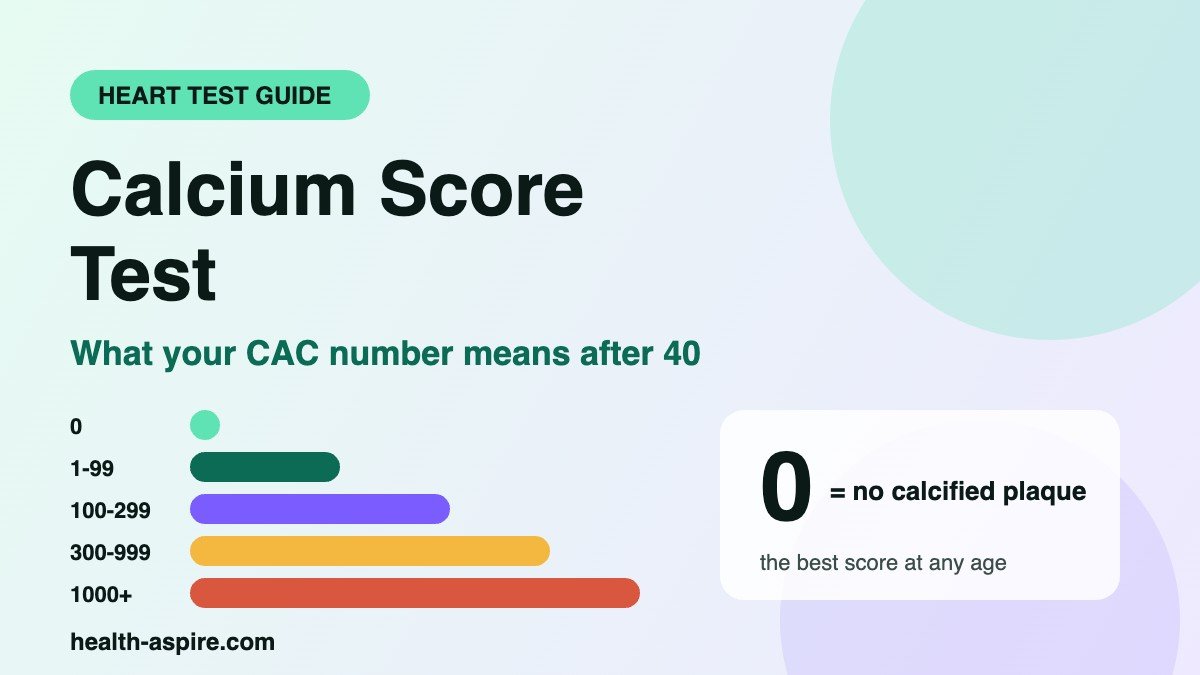
A calcium score test is a quick, low-dose CT scan that counts hardened plaque in the arteries that feed your heart. A score of 0 means no calcified plaque was found. Any number above 0 means plaque is there, and the higher it climbs, the higher your chance of a heart attack over the next ten years.
For many adults over 40, that makes it the best tie-breaker in medicine. If your risk calculator puts you in a gray zone and you are unsure about a statin, a calcium score turns “maybe” into a much clearer yes or no. In March 2026, the new ACC/AHA cholesterol guideline went a step further and tied specific LDL goals to each score range. Below, you will find what each number means, who should get the scan, what it costs and what to do next.
What does a calcium score test measure?
A calcium score test measures how much calcium sits in the walls of your coronary arteries. Calcium appears only where plaque has been building for years, so the score is a direct look at your own arteries. In contrast, a cholesterol test or a risk calculator can only estimate what might be happening inside them.
The scan is a non-contrast CT timed to your heartbeat. The software then adds up every calcified spot and reports a single number in Agatston units. Scores run from 0 to well over 1,000. You will often see it called a CAC score, a coronary calcium score or a heart scan. All of these names describe the same test.
Still, there is one important limit. The scan sees only calcified plaque. Softer, newer plaque does not show up, which is why a zero is reassuring but never a lifetime guarantee.
Calcium score test results: what each range means
In short, 0 is the best possible result, 1 to 99 means mild plaque, 100 to 299 is moderate, and 300 or more is extensive. The 2026 guideline now pairs each range with a cholesterol goal. It also uses your percentile, meaning how your score compares with people of your age, sex and background.
| CAC score (Agatston units) | What it means | 2026 guideline action (if risk was borderline or intermediate) | LDL goal / non-HDL goal |
|---|---|---|---|
| 0 | No calcified plaque found | Reasonable to hold off on a statin if you prefer, unless you have a high-risk feature (see below). Repeat the scan in 3 to 7 years. | No CAC-based goal |
| 1 to 99 and below the 75th percentile | Mild plaque | Start a moderate-intensity statin | Under 100 / under 130 mg/dL |
| 100 to 299, or 75th percentile and above | Moderate plaque; risk approaches that of high-risk patients | Statin is first-line | Under 70 / under 100 mg/dL |
| 300 to 999 | Extensive plaque | Statin; stronger statin or an add-on medicine may be considered | Under 70 / under 100 mg/dL (optional: under 55 / under 85) |
| 1,000 or more | Very extensive plaque | Managed like people who already have heart disease | Under 55 / under 85 mg/dL |
The calcium score ladder at a glance
Free printable · 2 pages
The Heart Numbers Checklist for 40+
Seven numbers that warn you years before symptoms, the healthy ranges, how often to test, and 5 questions to take to your doctor.
Free. You also get our short Thursday email. Unsubscribe in one click. Privacy
How well a calcium score predicts heart attacks
Those goals matter because the score tracks real outcomes. In the Multi-Ethnic Study of Atherosclerosis (MESA), which followed 6,814 adults aged 45 to 84 for over ten years, people with a score of 0 had 10-year event rates of just 1.3% to 5.6%, depending on age, sex and ethnicity. With a score above 300, by contrast, rates ran from 13.1% to 25.6% (Budoff et al., 2018).
Who should get a calcium score test?
The 2026 guideline supports a calcium score test for men aged 40 and up and women aged 45 and up whose 10-year PREVENT risk is borderline (3% to under 5%) or intermediate (5% to under 10%), when the statin decision is still unclear. In other words, it is a tool for the undecided middle, not a screening test for everyone.
If you do not know your number yet, our heart attack risk calculator gives you a starting estimate in about a minute. After that, bring the result to your doctor.
On the other hand, the scan usually adds little in these situations, according to Cleveland Clinic:
- You already have known heart disease or have had a stent or bypass.
- Your risk is already high, so treatment is clear without it.
- You have no risk factors at all.
- You have chest pain, shortness of breath or other symptoms. In that case, see a doctor promptly, because you need a different kind of test.
- You are pregnant.
Note that the US Preventive Services Task Force has not endorsed routine calcium scoring. Its 2018 review found the evidence insufficient to recommend it for everyone, and an update is in progress. Cardiology guidelines, however, have supported it for selected adults since 2018.
What a score of zero does and does not tell you
A zero is the best result you can get, and it carries real weight. About half of the MESA participants had no detectable calcium. For them, heart attacks and strokes over the next decade were uncommon. That is why the guideline lets a person with borderline or intermediate risk and a zero score reasonably put off a statin.
However, a zero does not cancel out every risk. The guideline lists exceptions where treatment may still make sense despite a zero score:
- Current smoking
- Diabetes, if you are over 40
- Familial hypercholesterolemia or very high LDL cholesterol
- A strong family history of early heart disease
In addition, a zero has a shelf life. Plaque keeps forming, and the scan cannot see the soft kind. For that reason, the guideline suggests repeating the scan in 3 to 7 years if you decided against medication.
Why your age and sex change what a calcium score test means
The same score can mean very different things at different ages. Calcium builds with time, so a score of 50 is more worrying in a 45-year-old woman than in a 75-year-old man. That is why reports often list a percentile, which compares you with people of the same age, sex and ethnicity.
A percentile at or above the 75th moves you into a higher-intensity goal in the 2026 guideline, even when the raw score is under 100. If your report shows only the score, ask whether your percentile was checked. The free MESA calculator from the study team is the tool many clinicians use for this.
How the test is done, what it costs and how much radiation it uses
The scan itself takes a few minutes, and the whole visit is about 10 to 15 minutes. You lie on a table, small EKG patches time the images to your heartbeat, and you hold your breath for 10 to 20 seconds. No needle or dye is involved. Cleveland Clinic advises skipping food, caffeine and tobacco for four hours beforehand.
Radiation is low: roughly what you get from natural sources over about a year. Even so, this is one reason the test is not meant to be repeated often.
Cost is the other catch. In the US, a calcium score test usually costs about $100 to $400, and most insurance plans do not cover it. Many hospitals, however, offer a lower cash price, so it is worth calling around. Also, if you have had a regular chest CT for another reason, check the report. Calcium spotted there counts as evidence of plaque, although “no calcium” on that kind of scan is not as reliable as a zero on a dedicated heart scan.
What to do after your calcium score
First, take the number to your doctor along with your full cholesterol panel and blood pressure. With a score above 0, the conversation usually turns to a statin and an LDL goal from the table above. With a zero, the focus moves to habits and a date for a repeat scan.
Either way, the score is a reason to act on the basics. Not smoking, keeping blood pressure in range, moving most days and eating more plants and fiber all help, whatever your number. A rising score is not a reason to scan again soon, though. Cleveland Clinic notes that a repeat scan does not show whether treatment is working.
What to do next
- Estimate your 10-year risk with our free heart attack risk calculator, then ask your doctor whether a calcium score would change your plan.
- Get the free Heart Numbers Checklist to track your LDL, blood pressure and other key numbers in one place.
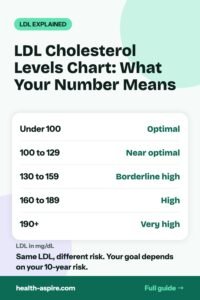
- Learn what your LDL cholesterol levels mean and how they compare with the new goals.
- Read about two blood tests that sharpen the picture: the apoB test and the Lp(a) test.
- Go through your full lipid panel with our guide to cholesterol test results explained, or browse the heart health hub.
FAQ
Is a calcium score test worth it?
For adults in the borderline or intermediate risk range who are unsure about a statin, yes, it is often worth it. A zero can reasonably delay medication, while a high score makes the case for treatment clear. For people with very low or already high risk, though, it rarely changes the plan.
Can you lower your calcium score?
Usually not, because calcified plaque does not simply melt away. The goal of treatment is fewer heart attacks and strokes, not a smaller number. Cleveland Clinic also notes that repeat scans are not a useful way to check whether treatment is working.
Does insurance cover a calcium score test?
Most plans do not, so expect to pay roughly $100 to $400 in cash. Coverage is slowly expanding, and some health systems run discounted screening programs. Check with your plan and local hospitals before you book.
What is a good calcium score for a 60-year-old?
Zero is the best score at any age. Above zero, what counts as “good” depends on your percentile for your age and sex. A score under 100 that also falls below the 75th percentile is in the mildest treatment group under the 2026 guideline.
Sources
- Blumenthal R.S., Morris P.B., Gaudino M., et al. 2026 ACC/AHA/AACVPR/ABC/ACPM/ADA/AGS/APhA/ASPC/NLA/PCNA Guideline on the Management of Dyslipidemia (Journal of the American College of Cardiology, 2026)
- Budoff M.J., et al. Ten-year association of coronary artery calcium with atherosclerotic cardiovascular disease events: the Multi-Ethnic Study of Atherosclerosis (European Heart Journal, 2018)
- US Preventive Services Task Force. Risk Assessment for Cardiovascular Disease With Nontraditional Risk Factors (JAMA, 2018)
- Cleveland Clinic. Calcium Score Screening (Heart Scan)
This guide is for education and is not medical advice. Talk to your doctor about your own numbers and treatment. See our medical disclaimer.
Free weekly email
A short, honest health email. Every Thursday.
The week’s most useful research for life after 40, explained in plain English, plus one step picked for what matters to you. No spam, no selling your email, unsubscribe in one click.