How to Lower Triglycerides: What Works, Ranked by Effect
If you want to know how to lower triglycerides, start with the three changes that move the number most: cut added sugar and sweet drinks, lose 5 to 10% of your body weight if you carry extra, and get about 150 minutes of brisk activity a week. According to the American Heart Association, these steps together can cut triglycerides by 20% to 50%, and sometimes more.
In fact, that is a big effect for a blood fat that often responds faster than LDL cholesterol. Below, you will find each step ranked by how much it tends to help, how long it takes, and when a doctor might add medicine. Also, all numbers come from US heart guidelines and major trials.
What your triglyceride number means
Triglycerides are the main fat your body stores and burns for energy. A fasting level under 150 mg/dL is normal, and under 100 mg/dL is optimal. From 150 to 199 is borderline high, 200 to 499 is high, and 500 or more is very high. Above 500, however, the concern shifts from heart risk to pancreatitis.
| Fasting triglycerides (mg/dL) | Category | What it usually means |
|---|---|---|
| Under 100 | Optimal | The AHA’s “optimal” level |
| 100 to 149 | Normal | No action needed beyond healthy habits |
| 150 to 199 | Borderline high | A signal to tighten up diet, activity and alcohol |
| 200 to 499 | High | Lifestyle first, plus a check for causes like diabetes or medications |
| 500 to 999 | Very high | Pancreatitis risk rises; doctors often add medicine |
| 1,000 or more | Severe | Needs prompt medical care and a very low-fat diet |
Triglycerides also matter beyond the number itself. High levels travel with cholesterol-rich “remnant” particles, low HDL and small, dense LDL. That is why cardiologists now treat a persistent level of 175 mg/dL or higher as a risk-enhancing factor. For the bigger picture, see our guide to reading your cholesterol test results.
How to lower triglycerides: the steps ranked by effect
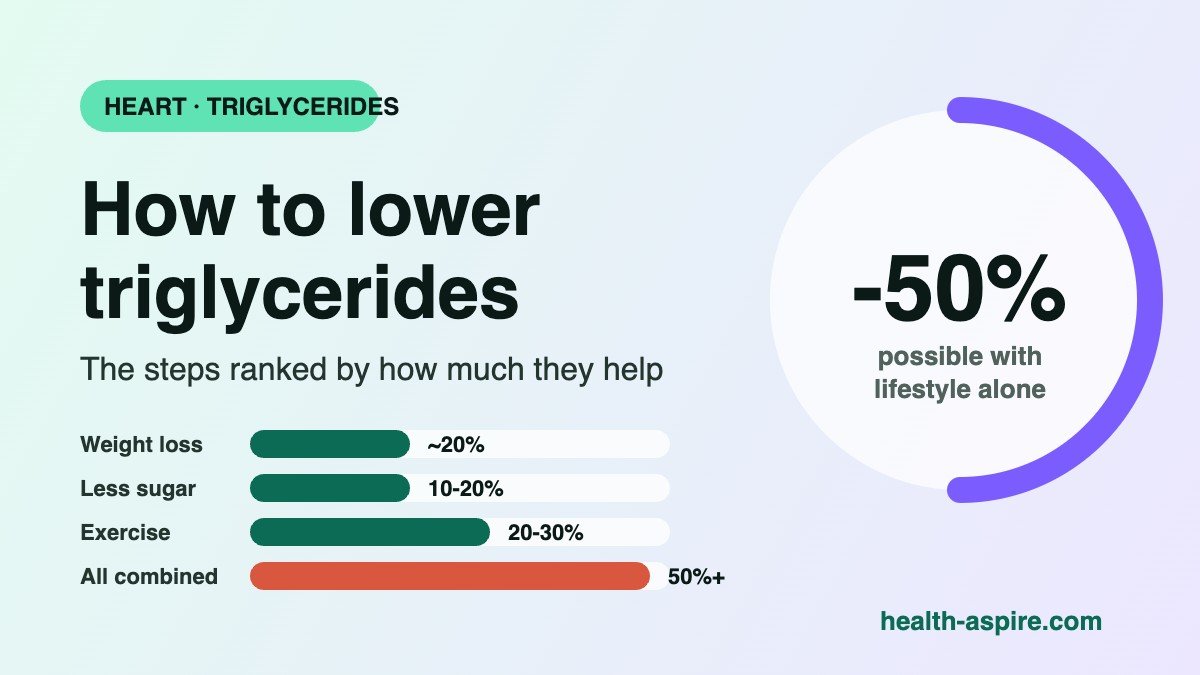
The biggest drops come from weight loss, less sugar and refined starch, regular aerobic exercise and little or no alcohol. Each step helps on its own. However, the effects stack, so people who combine them see the largest change. The chart shows typical ranges reported by the American Heart Association.
1. Cut added sugar and sweet drinks first
For many people, sugar is the fastest lever. That is because your liver turns extra sugar, especially fructose, into triglycerides. The AHA advises people with high levels to keep added sugar under 5 to 10% of calories. In practice, that means about 100 calories a day for women and 150 for men. A single can of regular soda uses up most or all of that.
It also suggests keeping total fructose under 50 to 100 grams a day and limiting sugar-sweetened drinks to 36 ounces a week. Sweet coffee drinks, juice and sweet tea count too. Next, look at refined starch. White bread, white rice and large pasta portions push triglycerides up in a similar way.
2. Lose 5 to 10% of your weight if you carry extra
For someone who weighs 200 lb, a 10 to 20 lb loss is enough. According to the AHA statement, a 5 to 10% weight loss predicts about a 20% drop in triglycerides. Belly fat matters most here; therefore, your waist is a better guide than the scale. Our waist-to-height ratio calculator shows where you stand in a minute.
3. Move most days of the week
Put simply, working muscles burn triglycerides for fuel. Both US heart groups recommend 150 minutes a week of moderate activity, such as brisk walking, or 75 minutes of vigorous activity. The AHA notes that regular aerobic exercise can add a further 20 to 30% drop. Even better, the effect builds when you pair it with weight loss.
4. Go easy on alcohol
Alcohol raises triglycerides in many people, and the effect is strongest when levels are already high. The 2021 ACC pathway advises limiting alcohol, and stopping it completely when triglycerides are very high or after a bout of pancreatitis. If your number is high and you drink most evenings, a 4-week break is a useful test.
5. Swap saturated fat for unsaturated fat, and eat fatty fish
To start, replace butter, fatty meat and pastries with olive oil, nuts and seeds. The AHA suggests keeping saturated fat under 7% of calories and trans fat under 1%. It also recommends fatty fish such as salmon, sardines, herring, lake trout and albacore tuna. Fish works best as a replacement for fatty meat, not an addition to it.
6. Check your medications and other causes
Sometimes, though, the cause is not your plate. The ACC lists diabetes, kidney disease, obesity and chronic inflammatory disease as common drivers. In addition, several drugs can raise triglycerides, including some beta-blockers and diuretics, steroids, oral estrogen and tamoxifen. Never stop a medicine on your own. Instead, ask your doctor whether one of yours could play a role.
Free printable · 2 pages
The Heart Numbers Checklist for 40+
Seven numbers that warn you years before symptoms, the healthy ranges, how often to test, and 5 questions to take to your doctor.
Free. You also get our short Thursday email. Unsubscribe in one click. Privacy
How fast can you lower triglycerides?
Triglycerides respond within weeks, much faster than LDL cholesterol. Guidelines recheck the level after 4 to 12 weeks of lifestyle change. Because the number swings from day to day, one reading is not the full story. A study cited by the AHA found a typical 23.5% variation between tests, compared with about 5% for total cholesterol.
So, if a result surprises you, repeat it before drawing conclusions. Fast as your lab instructs, skip alcohol the night before and avoid an unusually heavy meal the day before. For decisions about medicine, the ACC asks for at least two fasting tests taken 2 weeks or more apart.
Do fish oil supplements lower triglycerides?
Prescription omega-3 at 4 grams a day lowers triglycerides by 20 to 30% in most people, says a 2019 AHA advisory. Store-bought fish oil, by contrast, is a different story. It is not approved to treat high triglycerides, its dose and purity vary, and you would need many capsules to match the prescription amount.
The heart benefit also depends on the type. In the REDUCE-IT trial, about 8,000 people at high risk took prescription icosapent ethyl, a purified EPA. Over 4.9 years, it cut major heart events by 25%. On the other hand, it raised the risk of atrial fibrillation and bleeding a little. Meanwhile, the STRENGTH trial of a combined EPA and DHA product stopped early with no benefit.
When medicine enters the picture
Generally, for most people with borderline or high triglycerides, lifestyle comes first. If you have diabetes or heart disease, or your 10-year risk on the AHA PREVENT equations is 5% or more (intermediate or high risk in the 2026 ACC/AHA dyslipidemia guideline), a statin is usually the first drug, since it lowers overall heart risk. After that, doctors may consider icosapent ethyl or fenofibrate.
At 500 mg/dL and above, the goal changes to preventing pancreatitis. Here, doctors often use a low-fat diet plus medicine. At 1,000 or more, the ACC advises a very low-fat diet and prompt treatment. Your overall risk shapes all of these choices, so it also helps to know your LDL cholesterol level and your apoB.
What to do next
- Estimate your overall risk with our free heart attack risk calculator.
- Measure your waist and check our waist-to-height ratio calculator; belly fat tracks closely with triglycerides.
- For 8 weeks, cut sweet drinks, walk 30 minutes on most days and keep alcohol to a minimum.
- Then repeat a fasting lipid test and compare it with our cholesterol levels by age chart.
- If your triglycerides travel with high blood sugar, read insulin resistance and aging, and visit our heart health hub for more.
FAQ
Can you lower triglycerides in 24 hours?
Not in a lasting way. A single meal, a drink or skipping the fast can push a reading up for hours, so a proper overnight fast gives a truer number. Real change in your baseline level takes a few weeks of steady habits.
Does walking lower triglycerides?
Yes. For example, brisk walking counts as moderate activity, and 150 minutes a week is the target in US guidelines. Walking after meals is a simple way to fit it in. Moreover, the effect adds to any weight you lose.
Is a triglyceride level of 200 bad?
It is high, but it is usually not an emergency, so there is time to act. At 200 mg/dL, lifestyle change is the first step, along with a check for diabetes, kidney problems and medications that raise triglycerides. Then retest in a few months.
What is the fastest natural way to lower triglycerides?
For most people, cutting sugary drinks, sweets and alcohol brings the quickest drop. Adding daily walks and gradual weight loss then builds on it. Combined, these steps can lower triglycerides by half in some people.
Sources
- Miller M., et al. Triglycerides and Cardiovascular Disease: A Scientific Statement From the American Heart Association (Circulation, 2011)
- Virani S.S., et al. 2021 ACC Expert Consensus Decision Pathway on the Management of ASCVD Risk Reduction in Patients With Persistent Hypertriglyceridemia (Journal of the American College of Cardiology, 2021)
- Skulas-Ray A.C., et al. Omega-3 Fatty Acids for the Management of Hypertriglyceridemia: A Science Advisory From the American Heart Association (Circulation, 2019)
- Bhatt D.L., et al. Cardiovascular Risk Reduction with Icosapent Ethyl for Hypertriglyceridemia (New England Journal of Medicine, 2019)
This guide is for education and is not medical advice. Talk to your doctor about your own numbers and treatment. See our medical disclaimer.
Free weekly email
A short, honest health email. Every Thursday.
The week’s most useful research for life after 40, explained in plain English, plus one step picked for what matters to you. No spam, no selling your email, unsubscribe in one click.