ApoB Test: Normal Range, Goals and ApoB vs LDL Explained
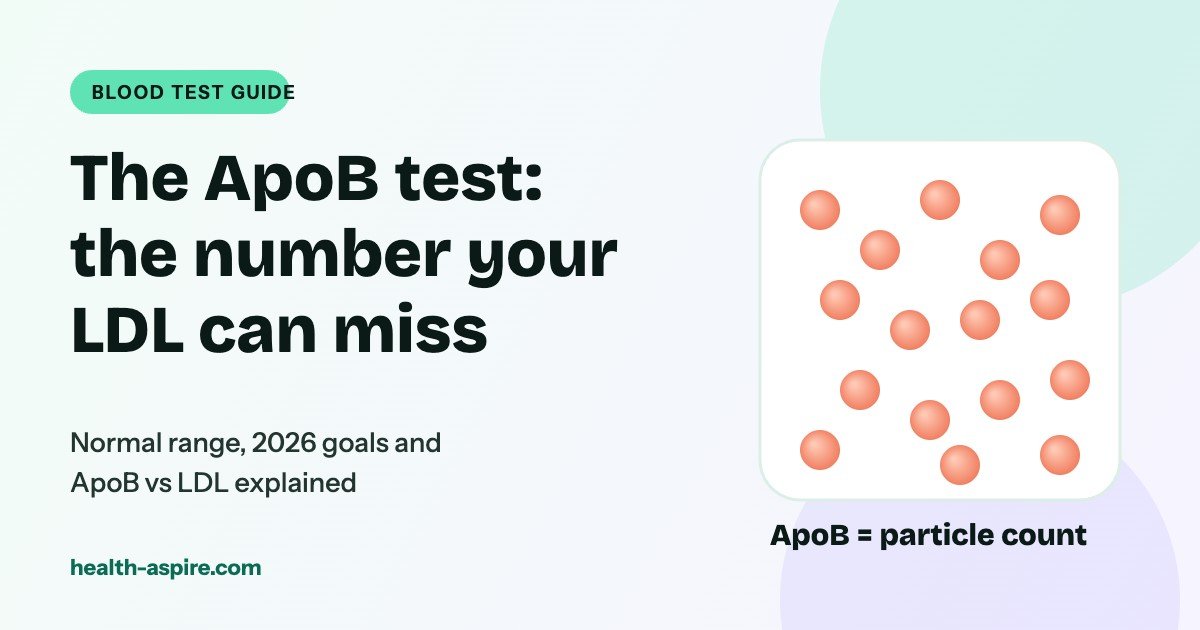
My LDL cholesterol was the number my doctor and I talked about. Then I learned there is a second number on the same blood draw that many cardiologists now consider more accurate, and almost nobody asks for it: ApoB. An apoB test counts the particles that actually carry cholesterol into your artery walls. Here is what it measures, what a normal ApoB level looks like, and when the test is worth asking for.
What does an apoB test measure?
Apolipoprotein B, or ApoB, is a protein wrapped around every particle that can carry cholesterol into the artery wall: LDL, VLDL, IDL and Lp(a). In addition, each of these particles carries exactly one ApoB molecule. So when a lab measures ApoB, it is effectively counting the harmful particles in your blood, rather than weighing the cholesterol inside them.
That difference matters because plaque is driven mainly by the number of particles that slip into the artery wall and get stuck there (Sniderman et al., 2019). As a result, more particles mean more chances to get stuck, even if each one carries less cholesterol.
ApoB test vs LDL test: why the numbers can disagree
For most people, LDL cholesterol and ApoB tell the same story. But in some people the particles are small and carry less cholesterol each. As a result, their LDL cholesterol looks fine while the particle count, and ApoB, is high. Doctors call this discordance, and it is most common in exactly the people over 40 who are hardest to read on a standard panel:
- People with high triglycerides
- People with type 2 diabetes, prediabetes or metabolic syndrome
- People with extra weight around the waist
- People whose LDL is already very low on treatment
In these situations, the 2026 guideline notes that ApoB can reveal remaining risk that a standard lipid panel underestimates. If your A1C or triglycerides are creeping up, ApoB is worth knowing.
| Test | What it measures | What it tells you |
|---|---|---|
| LDL cholesterol (LDL-C) | Cholesterol carried inside LDL particles | The standard number on every panel; good, but can miss small dense particles |
| Non-HDL cholesterol | Cholesterol in all harmful particles | Total cholesterol minus HDL; free on any panel and better than LDL when triglycerides are high |
| ApoB | The number of harmful particles | The most direct measure of particle burden; not affected by fasting |
| Lp(a) | One inherited type of particle | Set by your genes; measure at least once in life |
Lp(a) particles also carry ApoB, so they are counted in your ApoB result. But ApoB cannot tell you how much of it comes from Lp(a), which is why an Lp(a) test is still worth doing once.
What is a normal apoB level?
There is no single “normal” ApoB for everyone, just as there is no single normal LDL. Instead, what matters is your goal, which depends on your overall risk. The 2026 ACC/AHA dyslipidemia guideline gives optional ApoB goals that line up with its LDL goals:
| Your situation | LDL-C goal | Optional ApoB goal |
|---|---|---|
| Lower risk (10-year PREVENT risk under 10%) | under 100 mg/dL | under 90 mg/dL |
| Higher risk (10-year risk 10% or more, or diabetes with risk factors) | under 70 mg/dL | under 70 mg/dL |
| Heart disease, very high risk | under 55 mg/dL | under 55 mg/dL |
An ApoB of 130 mg/dL or higher is listed as a risk-enhancing factor, a reason to lean toward treatment when the decision is borderline. Still not sure which risk group you are in? Our free 10-year heart risk calculator uses the same PREVENT equations the guideline uses.
Who should get an apoB test?
The 2026 guideline says measuring ApoB may be useful to sharpen risk assessment and to guide treatment decisions, and is especially helpful in:
- Adults with triglycerides of 150 mg/dL or more
- Adults with diabetes or metabolic syndrome
- People who have reached their LDL or non-HDL goal, to check whether risk remains
- Anyone whose LDL and family history do not seem to match
The test is a standard blood draw and can be added to a routine cholesterol panel. Also, you do not need to fast for it. Similarly, many insurers cover it when there is a medical reason, so ask your doctor directly: “Can we add ApoB to my next lipid panel?”
High result on your apoB test? How to lower it
ApoB responds to the same things that lower LDL and triglycerides, which is good news: there is no separate plan to learn.
- Swap saturated fat for unsaturated fat. Less butter, fatty meat and pastries; more olive oil, nuts, fish and legumes. See our LDL guide for food swaps that work.
- Cut refined carbs, sugar and alcohol if your triglycerides are high, since high triglycerides often travel with a high ApoB.
- Lose a little weight around the waist if you carry extra. For example, even 5 to 10% can improve the whole lipid profile.
- Move most days. In fact, regular activity lowers triglycerides and improves insulin sensitivity.
- Medication when needed. First, statins, ezetimibe and PCSK9 inhibitors all lower ApoB. If your ApoB stays high after you reach your LDL goal, the guideline suggests considering stronger treatment, a decision to make with your doctor.
ApoB test FAQ
Is ApoB better than LDL?
For most people they give similar answers. However, ApoB is more accurate when the two disagree, which happens most often with high triglycerides, diabetes, extra belly fat or very low LDL on treatment.
Do I need to fast for an apoB test?
No. ApoB is measured directly and therefore is not meaningfully affected by a recent meal.
What is a good ApoB level after 40?
For someone at lower risk, under 90 mg/dL is the guideline goal. For people at higher risk, under 70 mg/dL, and under 55 mg/dL for those with heart disease at very high risk. Ultimately, your doctor decides your target with you.
Does ApoB include Lp(a)?
Yes. Each Lp(a) particle carries one ApoB, so it is counted. But ApoB cannot show how much comes from Lp(a), so measure Lp(a) separately once.
- LDL cholesterol levels chart
What LDL 100, 130, 160 and 190 mean.
- The Lp(a) test
The inherited heart risk most people never check.
- Cholesterol levels by age
Healthy ranges for adults over 40.
- Heart health after 40
All our heart guides and tools in one place.
Sources
- Blumenthal R.S., et al. 2026 ACC/AHA/Multisociety Guideline on the Management of Dyslipidemia (Circulation, 2026)
- American Heart Association. 2026 Guideline on the Management of Dyslipidemia (Science News summary)
- Sniderman A.D., et al. Apolipoprotein B Particles and Cardiovascular Disease: A Narrative Review (JAMA Cardiology, 2019)
- HCPLive. Expert Insights: Lp(a) and ApoB in the 2026 Dyslipidemia Guidelines
This guide is for education and is not medical advice. Talk to your doctor before changing your treatment. See our medical disclaimer.
Free weekly email
A short, honest health email. Every Thursday.
The week’s most useful research for life after 40, explained in plain English, plus one step picked for what matters to you. No spam, no selling your email, unsubscribe in one click.