Creatine After 40: Does It Work, Is It Safe, and 4 Myths That Hold People Back
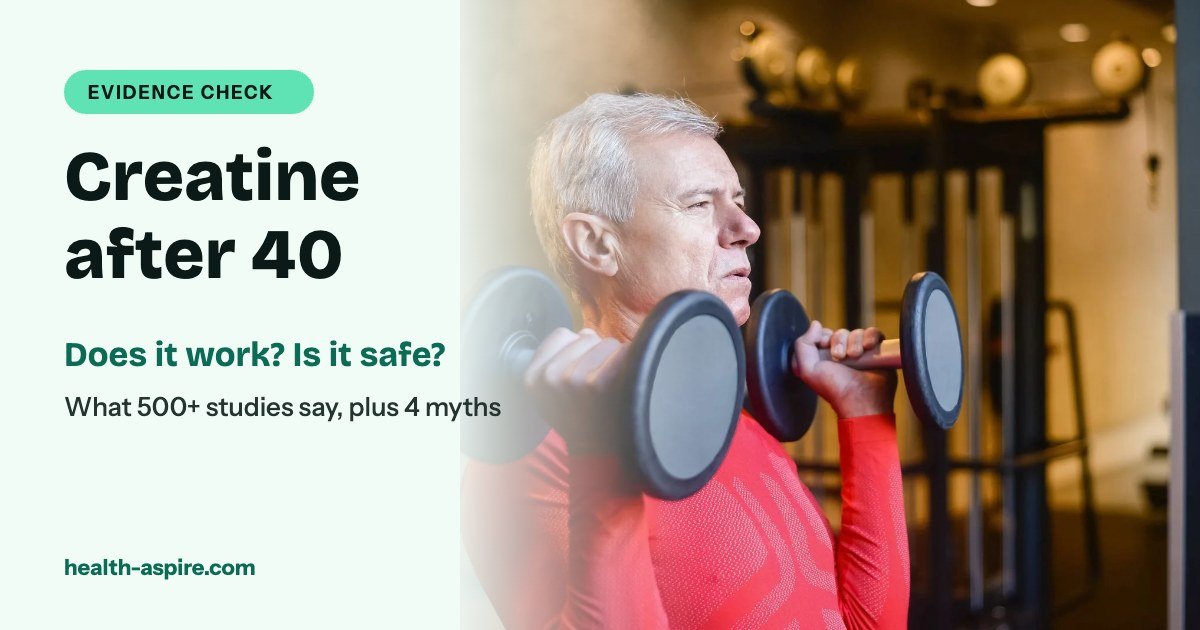
Walk into any gym and you will hear two stories about creatine: it is a miracle for muscle, or it is a bodybuilder powder that wrecks your kidneys and your hairline. Neither is true. Creatine after 40 is one of the most researched supplements in sports science, with more than 500 peer-reviewed studies, and the honest answer is more useful than either story. Here is what it does, what it does not do, the four myths that keep people away, and who should skip it.
What creatine actually does
Your body makes creatine, and you also get some from meat and fish. Most of it is stored in muscle as phosphocreatine, a quick reserve that recharges ATP, the energy your muscles burn during short, hard efforts. In other words, a supplement tops up that reserve. As a result, with a fuller reserve you can often squeeze out an extra rep or two per set. Then, over weeks of training, those extra reps add up to more muscle and strength.
That is the key point most ads skip: creatine works through training. In contrast, on the couch it does very little for muscle.
Does creatine work after 40? What the research shows
Yes, when it is paired with resistance training. In a 2014 meta-analysis of 357 older adults (average age about 64) who lifted for roughly 12 weeks, the creatine groups gained more lean mass, more chest press and leg press strength, and did better on the 30-second chair stand test than the placebo groups (Devries and Phillips, 2014). A newer 2021 meta-analysis reached the same overall conclusion: creatine plus resistance training beats resistance training alone for lean mass and strength in aging adults (Forbes et al., 2021).
Why does this matter so much after 40? Because we lose muscle and strength gradually with age, and strength is closely tied to staying independent. If you want a quick read on where you stand, check your grip strength by age.
Creatine for women over 40
Women have been left out of most creatine research, which is a shame, because they may have the most to gain. Women have roughly 70% to 80% lower natural creatine stores than men, and hormone changes around menopause affect how muscle uses it (Smith-Ryan et al., 2021). For example, studies in post-menopausal women suggest benefits for muscle size and function, and possible benefits for bone when creatine is combined with resistance training. Likewise, early research on mood and brain energy is interesting, but it is still early.
If you are going through menopause, pair this with our guide to strength training after 40 and enough protein: our protein calculator gives you a daily target in seconds.
Creatine myths: what is true and what is not
| Claim | What the evidence says | Verdict |
|---|---|---|
| “Creatine makes you bloated and puffy” | Some people hold a little extra water in muscle in the first days, mostly with high loading doses. It is temporary and is not fat gain. | Partly true, short term |
| “Creatine damages your kidneys” | No good evidence of harm in healthy people at normal doses. The fear traces back to a single 1998 case in a patient with existing kidney disease. | Myth for healthy adults |
| “Creatine makes you go bald” | Based on one 2009 rugby study that saw a rise in DHT. A 2025 randomized trial found no change in DHT, hair density or follicle counts after 12 weeks of 5 g a day. | Not supported |
| “Creatine is a steroid” | Instead, it is a natural compound made from amino acids and found in food. It is not a hormone. | Myth |
| “You need a loading phase” | Loading fills muscles faster, but a steady 3 to 5 g a day gets you to the same place over a few weeks. | Optional |
Who should skip creatine or ask a doctor first
- Anyone with kidney disease or reduced kidney function.
- People taking medicines that affect the kidneys, or with diabetes and kidney problems.
- Pregnant or breastfeeding women, where safety data are limited.
- Before a blood test: creatine can raise your blood creatinine, the marker used to estimate kidney function (eGFR). As a result, your kidneys can look worse on paper than they are. Tell your doctor you take it. This also matters if you enter an eGFR into our heart risk calculator.
How to take creatine after 40
- Choose plain creatine monohydrate. It is the form used in almost all the research. However, fancier and pricier forms have not been shown to work better.
- Take 3 to 5 grams a day, the dose used in most studies. Also, timing matters far less than taking it daily.
- Pair it with resistance training two or three times a week. Otherwise, without training, expect little.
- Look for third-party testing, such as NSF Certified for Sport or Informed Sport, because supplements are not checked like medicines before they are sold.
- Give it 8 to 12 weeks of consistent training before you judge it.
Creatine after 40: FAQ
Is creatine safe after 50?
For healthy adults at normal doses, the research says yes. In fact, creatine is one of the most studied supplements, including in older adults. If you have kidney disease or take medicines that affect the kidneys, talk to your doctor first.
Does creatine cause hair loss?
The best current evidence says no. A 2025 randomized trial found no change in DHT or hair follicles after 12 weeks. Instead, the old claim came from one small 2009 study that has not been repeated.
Should women over 40 take creatine?
Many could benefit, especially if they lift weights. Women start with lower creatine stores, and research after menopause looks promising for muscle and possibly bone. Still, it is not a substitute for training or enough protein.
Will creatine affect my blood test results?
It can raise creatinine, which can make kidney function look lower than it is. Tell your doctor you take creatine before a blood test.
- Strength training after 40
Where to start, safely.
- Protein calculator
Your daily protein target in seconds.
- Grip strength by age
A simple test of how strong you are.
Sources
- Devries M.C., Phillips S.M. Creatine Supplementation during Resistance Training in Older Adults: A Meta-analysis (Medicine and Science in Sports and Exercise, 2014)
- Forbes S.C., et al. Meta-Analysis Examining the Importance of Creatine Ingestion Strategies on Lean Tissue Mass and Strength in Older Adults (Nutrients, 2021)
- Antonio J., et al. Common questions and misconceptions about creatine supplementation (Journal of the International Society of Sports Nutrition, 2021)
- Kreider R.B., et al. ISSN position stand: safety and efficacy of creatine supplementation (Journal of the International Society of Sports Nutrition, 2017)
- Smith-Ryan A.E., et al. Creatine Supplementation in Women’s Health: A Lifespan Perspective (Nutrients, 2021)
- Ashtary-Larky D., et al. Does creatine cause hair loss? A 12-week randomized controlled trial (Journal of the International Society of Sports Nutrition, 2025)
This guide is for education and is not medical advice. Health Aspire does not sell supplements or earn money from any creatine brand. Talk to your doctor before starting a supplement, especially if you have kidney disease or take regular medication. See our medical disclaimer.
Free weekly email
A short, honest health email. Every Thursday.
The week’s most useful research for life after 40, explained in plain English, plus one step picked for what matters to you. No spam, no selling your email, unsubscribe in one click.